On this page
If you are looking for examples of ads that run inside ChatGPT and the specs to build them, this is that page. (If you actually want ad copy written by ChatGPT, that is a different job, see ChatGPT ad copy examples.) Here we cover what a ChatGPT ad looks like, the real creative requirements, who can run them and where, and how to get a compliant square creative ready without a design team.
One honesty note up front: ChatGPT's ad product is new and moving fast. Every figure below is dated and sourced, and you should confirm against OpenAI's own pages before you build or budget. LocalAds is not affiliated with OpenAI and does not place ads; what we do is produce the creative you would upload.
Last verified: 2026-10-13. Availability, pricing, and specs change frequently; our ChatGPT Ads guide keeps the current status and a dated change log. Primary sources: OpenAI Ads Manager, Ads in ChatGPT: The Basics, Create ads for ChatGPT Ads, Testing ads in ChatGPT, New ways to buy ChatGPT ads.
Changelog
- 2026-10-14: Added a gallery of five real ChatGPT ads by vertical (sneakers, kids' nutrition, soda, skincare), each with exact title and copy character counts, plus a table of the title patterns that fit the card. Linked our new guides to South-East Asia, the UAE and Saudi Arabia, ChatGPT ad costs and holiday planning.
- 2026-10-13: Markets updated to 63. The table moved twice more after our last update: the UAE, Saudi Arabia, Israel and Turkey were added mid-September without an announcement, and seven South-East Asia and Taiwan markets opened on 23 September. Shopping unit updated to product feed campaigns, including bulk uploads (reported, 30 September). Noted OpenAI's 5 October announcement of visual ads beside image generation, US only.
- 2026-09-18: Advertiser access jumped from 9 markets to 52 on 2 September, with no announcement. All remaining European markets, India, and 11 Middle East and North Africa markets became available. The Coming Soon tier was removed.
- 2026-08-17: Advertiser access expanded. The UK, Japan, South Korea, and Brazil are now open, joining the US, Canada, Australia, and New Zealand. Mexico announced but reported not yet open. India still closed to advertisers.
- 2026-07-23: First published specs and market list.
Real ChatGPT ad examples by vertical
Every card below is a real ad made in the LocalAds ChatGPT Ads studio from a product URL. The square, the title and the copy line are unedited output. The question and answer above each card are our mockup of where it could sit, not a screenshot of a live placement, and we make no claim that any of these ads ran or how they performed. What they do show is how much a title can carry in 16 to 24 characters and a line in 32 to 48.
Sneakers: comfort angle
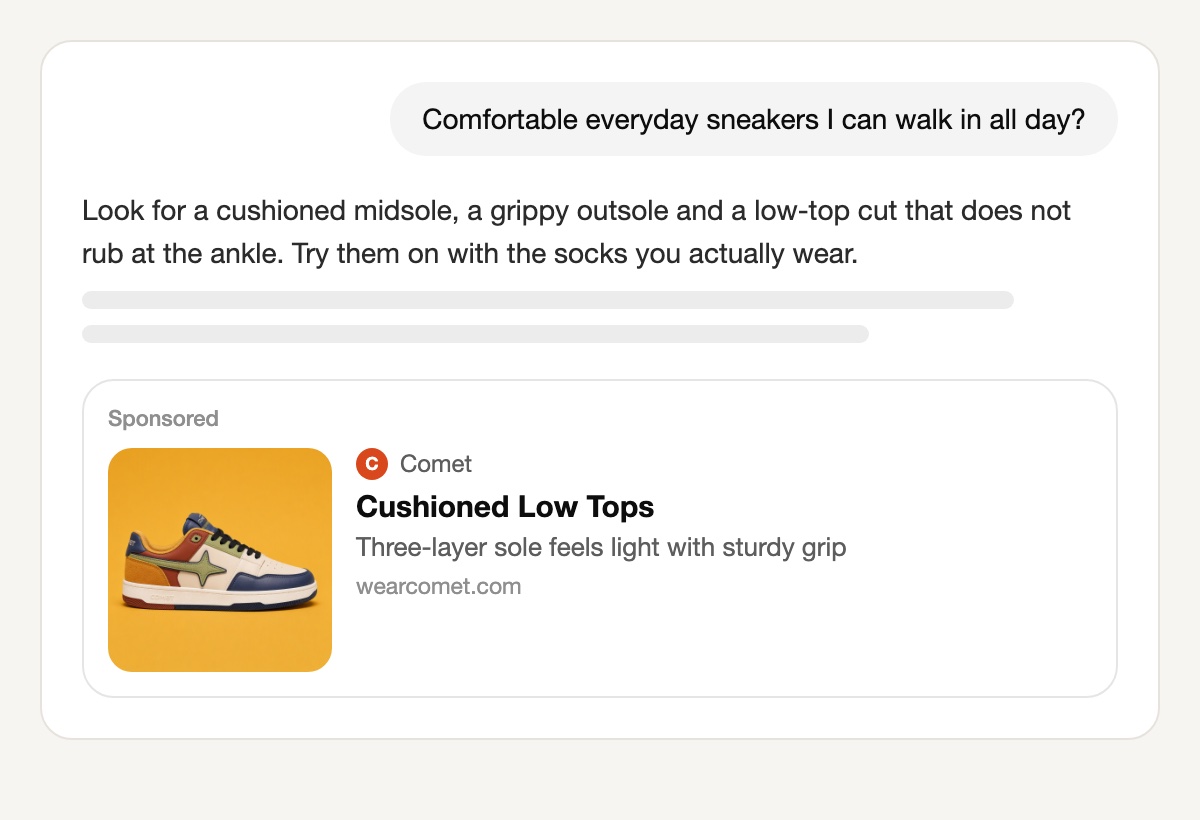
Comet, unedited studio output; the chat is a mockup. "Cushioned Low Tops" (18 characters) answers the comfort question in the title itself, and "Three-layer sole feels light with sturdy grip" (45) backs it with a construction detail rather than an adjective.
Kids' nutrition: audience angle
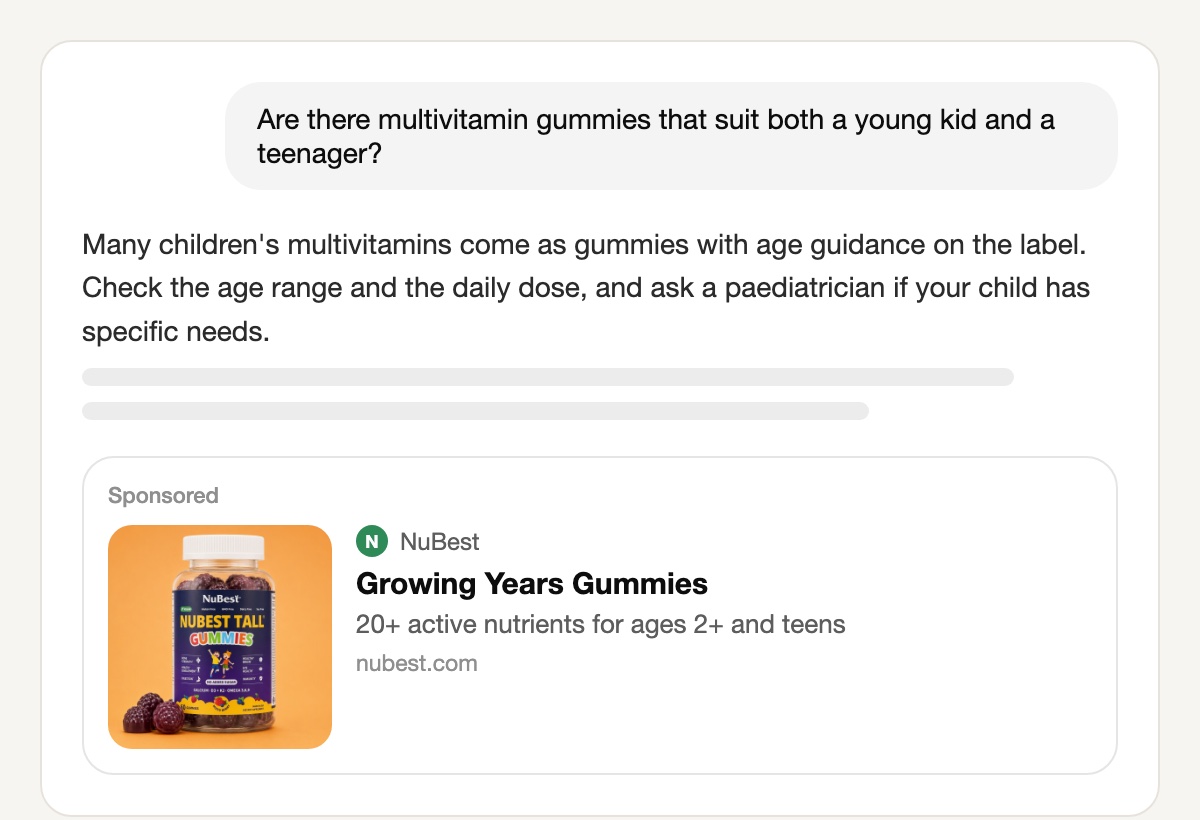
NuBest, generated from the product page and left unedited; the conversation is ours. "Growing Years Gummies" (21) names who it is for, and "20+ active nutrients for ages 2+ and teens" (42) states composition and age range, not a health outcome. That distinction matters: supplements are reported as a US-only, case-by-case category, so anything resembling a medical claim is a rejection risk.
Soda: product-type angle
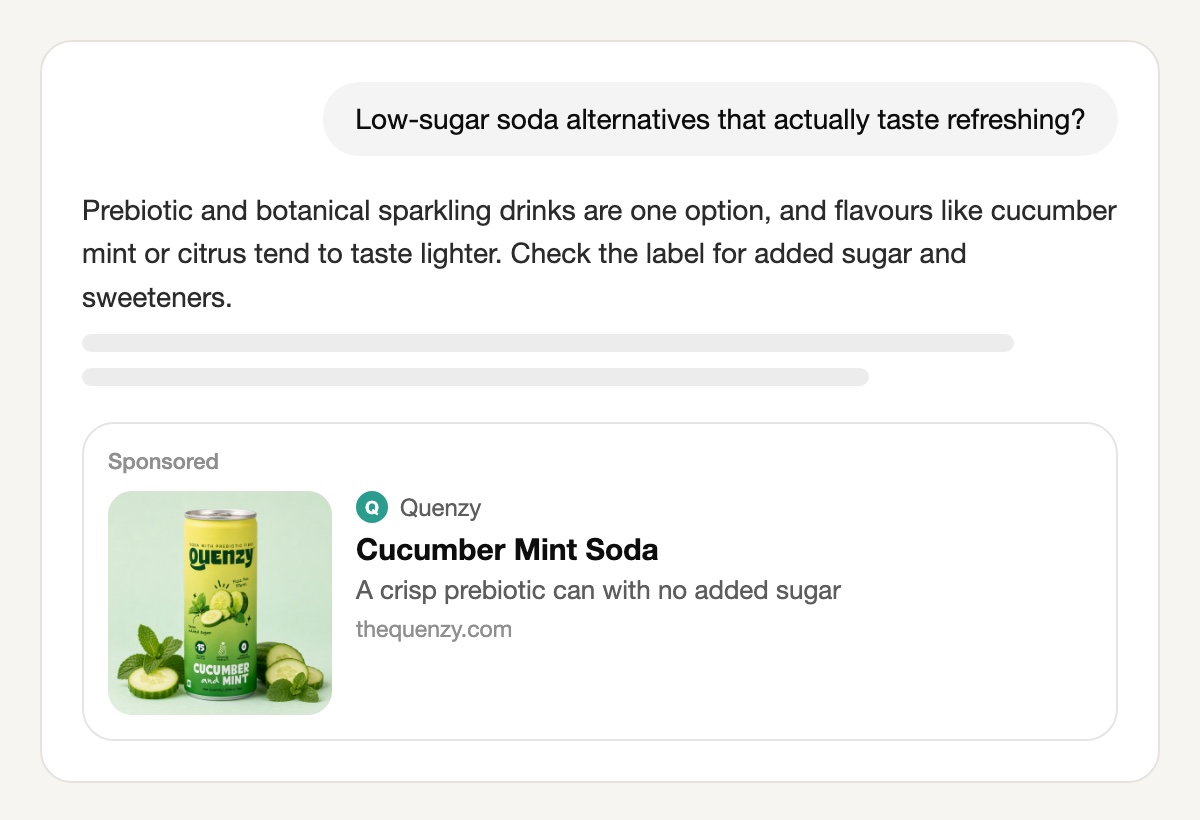
Quenzy, straight from the ChatGPT Ads studio with no edits; mockup chat. "Cucumber Mint Soda" (18) is simply what it is, which is exactly what a shopper asking for a soda wants to see, and "A crisp prebiotic can with no added sugar" (41) carries the two facts that answer "low sugar".
Skincare: spec angle
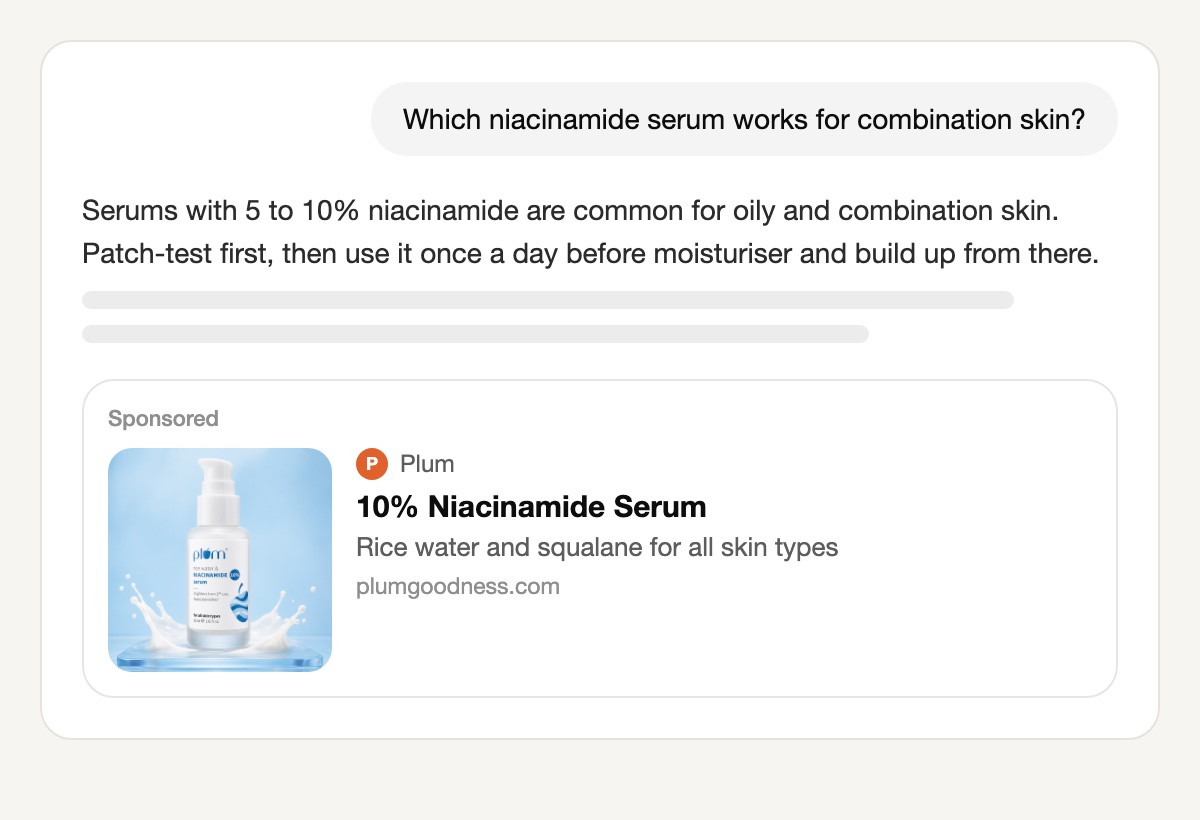
Plum, unedited output from the product page; the question and answer are illustrative. "10% Niacinamide Serum" (21) leads with the strength, the number skincare shoppers compare, and "Rice water and squalane for all skin types" (42) names the supporting ingredients and the fit the user asked about.
Sneakers: utility angle
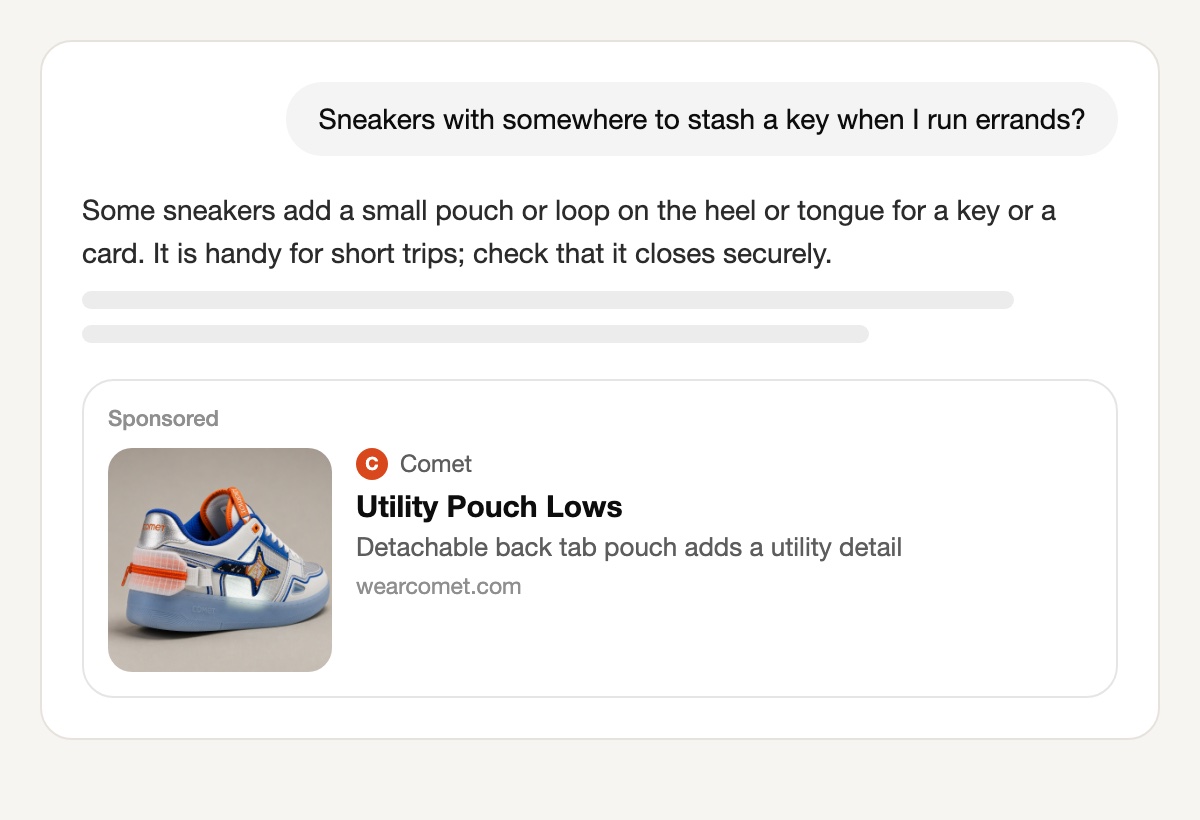
A second Comet ad, also unedited studio output under a mocked-up chat. "Utility Pouch Lows" (18) puts a single distinctive feature in the title, and "Detachable back tab pouch adds a utility detail" (47) explains it in one line, right at the edge of the 48 guidance. Same brand, different angle: that is how one product earns several cards in an ad group.
Title patterns that fit the card
| Pattern | Example title | Why it fits the card |
|---|---|---|
| Name the product type | Cucumber Mint Soda (18) | The card sits under an answer about a category; saying exactly what it is matches the intent instantly |
| Lead with the spec number | 10% Niacinamide Serum (21) | Strength is what shoppers compare, and a number reads at a glance in a small card |
| Benefit as the title | Cushioned Low Tops (18) | Answers the user's actual question (comfort) before they read the copy |
| Name the audience | Growing Years Gummies (21) | Tells a parent who it is for, without a claim that would trip health review |
| One distinctive feature | Utility Pouch Lows (18) | Gives the ad a reason to appear in narrower, feature-led conversations |
Common to all five: no brand name in the title (the card already shows it), no hype adjectives, one claim per line. To check your own pair before upload, paste it into the free ChatGPT ad preview tool. Planning by market rather than by format? See ChatGPT ads in Singapore and South-East Asia and ChatGPT ads in the UAE and Saudi Arabia, which use the same kind of cards for local questions.
What a ChatGPT ad actually looks like
A ChatGPT ad is a single "Sponsored" card that can appear below a relevant answer. It is not a Google-style headline-plus-descriptions block, and it is not a Meta-style carousel of creatives. It is one small unit: a bit of text, a logo, and one image, matched to the intent of the conversation rather than to a keyword. (On 5 October 2026 OpenAI announced a separate visual format beside image-generation results, US only and limited to a test group, with no specs published yet (TechCrunch). Everything on this page is about the Sponsored card.)
That "one image" is the part most brands get wrong, so start there. The image is a 1:1 square, and it needs to read at small sizes with very little text around it. A clean product square like this is exactly the shape and simplicity the format rewards:
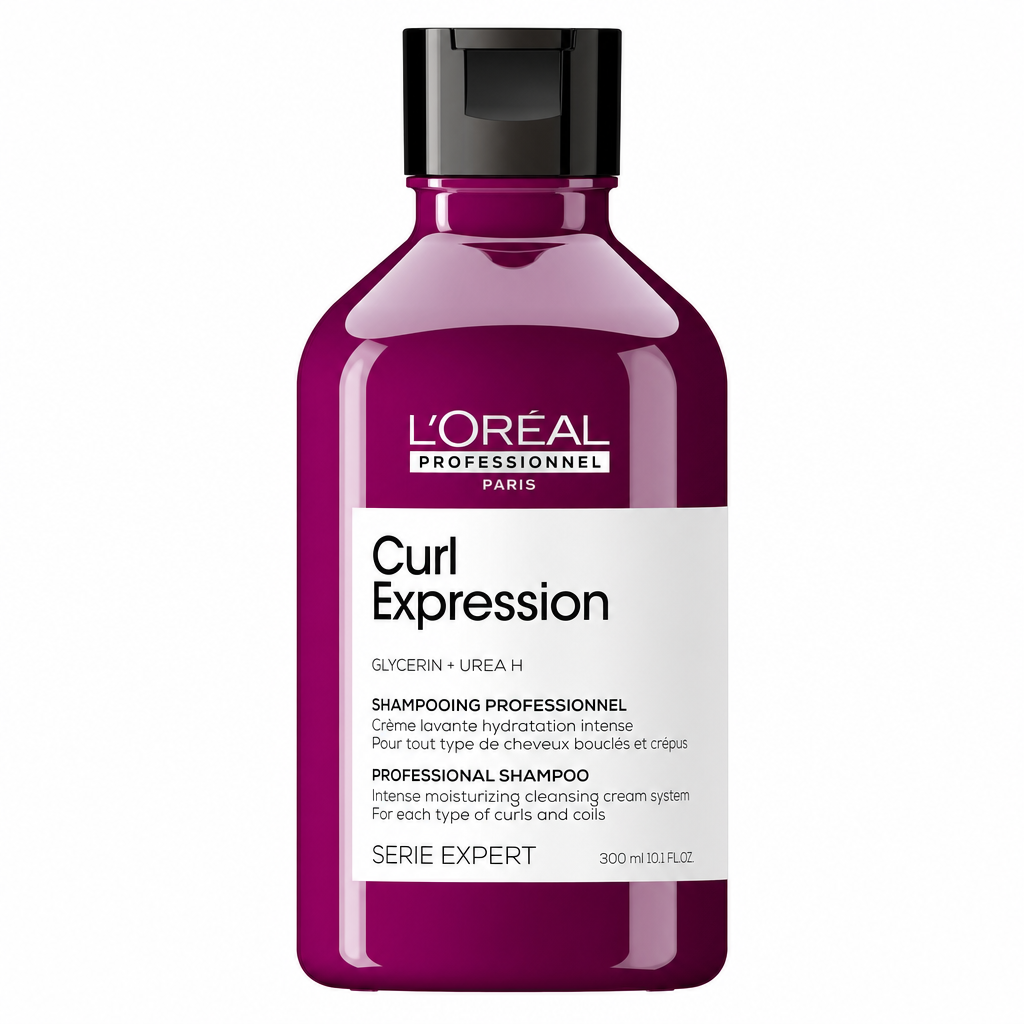
A 1:1 square product image, the literal shape a ChatGPT ad card uses. Because the card carries the words, the image does not need baked-in copy; it needs to be clean, accurate, and legible at 512 pixels. A busy, text-heavy creative that works as a Meta static will not read here.
A lifestyle square works too, as long as it stays simple:
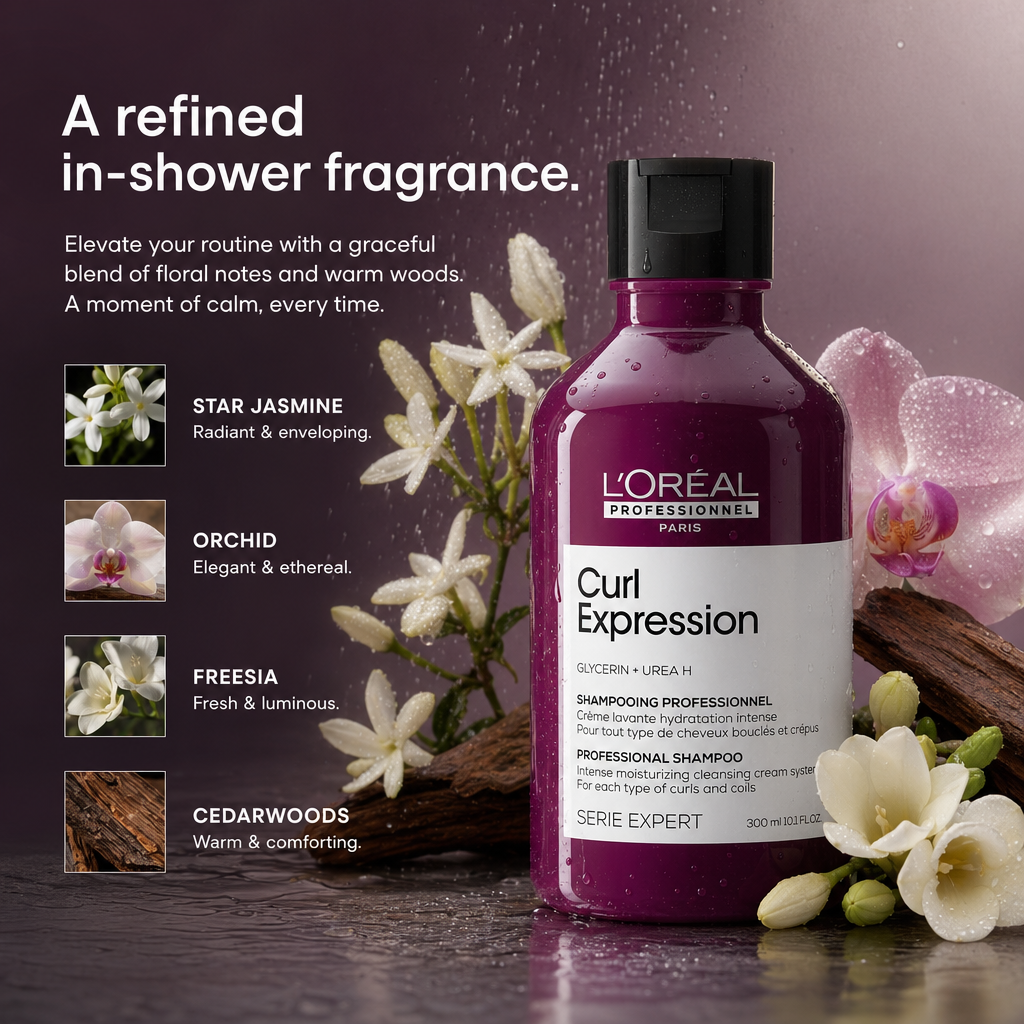
Same 1:1 ratio, a softer context. Either approach fits; what does not fit is a creative that relies on a paragraph of on-image text, because the ChatGPT card gives you separate, tightly limited text fields for that.
The specs, field by field
Based on OpenAI's advertiser documentation and corroborated across industry references (verify current values with OpenAI before building):
| Field | Requirement |
|---|---|
| Advertiser name | Your brand name |
| Favicon | Your small square logo |
| Title | 16 to 24 characters |
| Copy | 32 to 48 characters |
| Image | 1:1 square, minimum 256x256px, optimized around 512x512px, JPG / PNG / WEBP |
| Landing URL | Your product or offer page |
| Placement | One "Sponsored" card below a relevant answer |
| Product-feed ads | Generated from your product catalogue (image, title, price); the ChatGPT Ads app for Shopify is one way to sync it |
The tight character limits are the headline constraint. You are writing a 16-24 character title and a 32-48 character line, not a Meta primary-text block. That rewards a single sharp claim, which is a different copy discipline (and where a copy tool prompted for brevity actually helps, see our ChatGPT ad copy examples).
Other sites publish wider limits, commonly 50 and 100 characters. They are not simply wrong: those figures appear to describe what the upload form accepts rather than what the card displays before truncating. We break the whole disagreement down, source by source, in ChatGPT ads specs 2026.
Who can run them, and where
Advertisers can buy in 63 markets as of 2026-10-13, up from 9 at the start of September, and that list has moved repeatedly this year, so check it before you plan anything.
- Who sees the ads: logged-in adults on the Free and ChatGPT Go tiers. Paid tiers (Plus, Pro, Business, Enterprise, Education) are ad-free, so you are reaching the free-tier audience.
- How to buy: a self-serve Ads Manager (beta) at ads.openai.com, or through approved partners.
- Buying model: CPC and CPM. Reported starting points are around a $25 minimum daily budget and a $3 to $5 recommended maximum CPC (per third-party reporting; confirm in Ads Manager). How those numbers turn into a test budget is in how much ChatGPT ads cost.
- Targeting: context-hint based (topics, needs, situations), not exact-match keywords, with no guarantee of delivery for any particular prompt. OpenAI does not give advertisers users' chats, history, or memories.
- Restricted verticals: health, finance, and legal are restricted. Consumer goods, retail, travel, education, and digital products are the allowed core.
- Markets: the channel started as a US test in February 2026 and expanded in waves. On 2 September 2026 it jumped from 9 self-serve markets to 52 in a single day, then reached 63 by 23 September as the UAE, Saudi Arabia, Israel, Turkey and seven South-East Asia and Taiwan markets were added (market guides: Singapore and South-East Asia, UAE and Saudi Arabia). That covers Europe (32), the Middle East (11), South-East Asia and Taiwan (7), Asia-Pacific including India (5), North Africa (4), North America (3) and Brazil.
- Markets still closed: China, Russia, all of Sub-Saharan Africa, Latin America other than Brazil and Mexico, and Central Asia. There is no Coming Soon tier: a market is on the availability table or it is not. The full country list is in where ChatGPT ads are available.
One distinction that trips people up: being able to buy is not the same as ads being served in your country. Eligibility follows where your business is registered; where ads show is a separate targeting setting, and some new accounts are reported to be limited to targeting their home country at first. Check both sides before you assume a market is reachable.
That split used to be the whole story in India, where users saw Sponsored cards for months while advertisers could not buy. It closed on 2 September 2026, so Indian brands can now open a self-serve account. The constraint there has shifted from access to creative, because most Indian D2C libraries are text-heavy Meta statics that do not survive a 512-pixel card. We cover that in ChatGPT ads in India and the India launch checklist.
What this means for your creative
The format quietly rewards two things: square, low-text images and product accuracy. The card is small, it sits inside a trusted answer, and it carries its own copy, so a drifted or cluttered image stands out for the wrong reasons. This is the opposite of the maximalist static that wins on some social feeds.
Two practical implications:
- You need 1:1 squares, not 9:16 or 4:5 recuts. If your creative library is all vertical video and feed statics, none of it is the right shape.
- For product-feed ads, your feed quality is the ad. Clean titles, accurate real-time price, correct availability, and high-resolution square images are what the ads are generated from. More in ChatGPT shopping ads and your product feed.
Where LocalAds fits
LocalAds turns a product URL into on-brand creatives, and it already outputs 1:1 square images (the exact ratio a ChatGPT ad card uses), generated from your real product page so packaging and claims stay accurate. The two squares in this post are unedited LocalAds outputs. For the shopping unit, the same product-URL grounding is what keeps feed images clean and on-brand.
To be plain about the boundary: LocalAds is not an OpenAI partner, does not place your ads, and cannot guarantee any placement. It produces the square creative and product-accurate imagery you then upload to OpenAI's Ads Manager (or point your product feed at). If your blocker is "I do not have square, on-brand, accurate creative ready for this channel," that is the part we solve, and you can generate ads from your product URL to get a set in the right shape. If you are outside the eligible markets, the same set is what makes you ready for the day the channel opens.
FAQ
What does a ChatGPT ad look like? A single "Sponsored" card below a relevant ChatGPT answer, containing your brand name, a favicon, a short title (16 to 24 characters), a short copy line (32 to 48 characters), one 1:1 square image, and a landing URL. It is matched to the conversation's intent, not to a keyword, and there is no carousel of creatives like a social feed. Separately, product-feed ads generate product listings with image and price from your catalogue.
What are the ChatGPT ad image specs? A square 1:1 image, minimum 256x256 pixels, optimized around 512x512, in JPG, PNG, or WEBP. Because the card carries its own text fields, the image should be clean and legible at small size rather than loaded with baked-in copy. Verify current specs with OpenAI before building.
Can I run ChatGPT ads from India? Yes, since 2 September 2026, when India moved to Available on OpenAI's list alongside 31 European markets and 11 in the Middle East and North Africa. India is one of 63 self-serve markets as of 2026-10-13. Registration is self-serve. The practical blocker for Indian brands is no longer access but creative: most libraries are text-heavy Meta statics whose argument depends on reading small copy, which does not work in a card that renders at around 512 pixels and writes its own headline.
How much do ChatGPT ads cost? Buying is CPC and CPM. Third-party reporting cites roughly a $25 minimum daily budget and a $3 to $5 recommended maximum CPC, but you should confirm current figures inside OpenAI's Ads Manager, as pricing for a new channel changes.
How do I get creative ready for ChatGPT ads? Produce clean 1:1 square product images and short, sharp copy. A product-URL tool like LocalAds generates square, on-brand creatives from your real page, which is the exact ratio the ad card uses, and keeps your product accurate for both the single-image ad and the images your product feed points at. You upload the result to OpenAI's Ads Manager; the tool creates the creative, it does not place the ad.
The takeaway
ChatGPT ads are small, square, and intent-matched, which makes them a creative problem before they are a media-buying problem: one clean 1:1 image and a very short line, accurate to your product, in the markets where the channel is live. Get that creative ready now, ideally before the November peak (our Black Friday and holiday plan has the timeline). If you can run today, run; if your market has not opened, readiness is the whole game. And re-check OpenAI's own pages before you build, because this channel is still changing month to month.
Related reading:
- ChatGPT Ads guide: status, change log and every guide by question
- ChatGPT Ads Specs 2026: Every Character Limit, Reconciled
- How Much Do ChatGPT Ads Cost? CPC, CPM, Minimums
- ChatGPT Ads for Black Friday 2026: Holiday Playbook
- ChatGPT Ads in Singapore and South-East Asia (2026)
- ChatGPT Ads in the UAE and Saudi Arabia: Launch Guide
- How to Create Ads for ChatGPT: A Step-by-Step Guide
- ChatGPT ads creative from your product URL
- 30 ChatGPT Ad Copy Examples That Actually Convert
- Nine Angles From One Product URL: The 9-Shot Set That Sells
- What's the Best AI Ad Platform for Non-Experts?
- Generate Ads From a Product URL, No Prompting