On this page
The fastest way to improve how a product sells online is to stop shipping one image of it and start shipping nine. Not nine near-duplicates from slightly different camera positions, but nine angles that each do a different job: prove what it is, show its scale, sell the texture, place it in a life, answer the buyer's quiet objection. This post covers what those nine angles are, why the number nine keeps showing up across both ad platforms and Amazon, and how to convert one product URL into all nine on-brand shots without booking a photographer.
If you searched for a way to turn a URL into a nine-angle image set, that is exactly the workflow at the end of this post. First, the framework, because the tool only matters if the nine shots are the right nine.
What "nine angles" means, and why nine
"Angle" here is doing double duty, on purpose. It means the literal camera angle (front, top-down, macro) and the marketing angle (the reason to buy that the shot is built around). A good nine-shot set varies both at once. The reason the count lands on nine is not arbitrary:
- Amazon gives you up to nine image slots. Amazon's product image requirements allow a main image plus additional images, and roughly seven show on the detail page before a shopper clicks through. Filling all nine well is a known conversion lever.
- Paid social rewards creative volume. A single hero image gives the delivery algorithm one signal. Nine angles give it nine, and different people click different ones.
- Nine is the point where a gallery becomes a silent sales conversation instead of a repeated product beauty shot.
Here is what a real nine-angle set looks like when it is generated as one consistent system rather than assembled from a shoot. This is a single product, nine shots, one visual language:
The cover image of this post is that set: L'Oreal Curl Expression Shampoo rendered as nine distinct angles (hero, gel-texture macro, water and ingredient, bathroom lifestyle, packaging close-up, cap top-down, botanical ingredient, the range trio, and a splash shot) in one coherent style. That grid is the deliverable. Everything below explains how to make each panel earn its place.
The nine angles, one job per shot
A set converts when every slot answers a different buyer question. This framework holds across most physical-product categories:
| # | Angle | The job it does | Buyer question it answers |
|---|---|---|---|
| 1 | Clean hero | Show exactly what ships, unambiguously | "What is it?" |
| 2 | Scale / in-hand | Establish real size | "How big is it?" |
| 3 | Texture / macro | Sell the sensory detail | "What is it actually like?" |
| 4 | Ingredient / material | Prove what it's made of | "Is it quality?" |
| 5 | Lifestyle / in-context | Place it in the buyer's life | "Is it for me?" |
| 6 | Use-case / how-to | Show the moment of use | "When would I use it?" |
| 7 | Comparison / feature callout | Differentiate from alternatives | "Why this one?" |
| 8 | Social proof / claim | Back it with evidence | "Can I trust it?" |
| 9 | Packaging / detail | Signal care and legitimacy | "Is this a real brand?" |
The mistake is filling nine slots with variations of angle 1. Nine hero shots from nine camera positions is one angle photographed nine times. Nine jobs is a gallery.
Take the clean hero, angle 1. Its only job is unambiguous product truth:
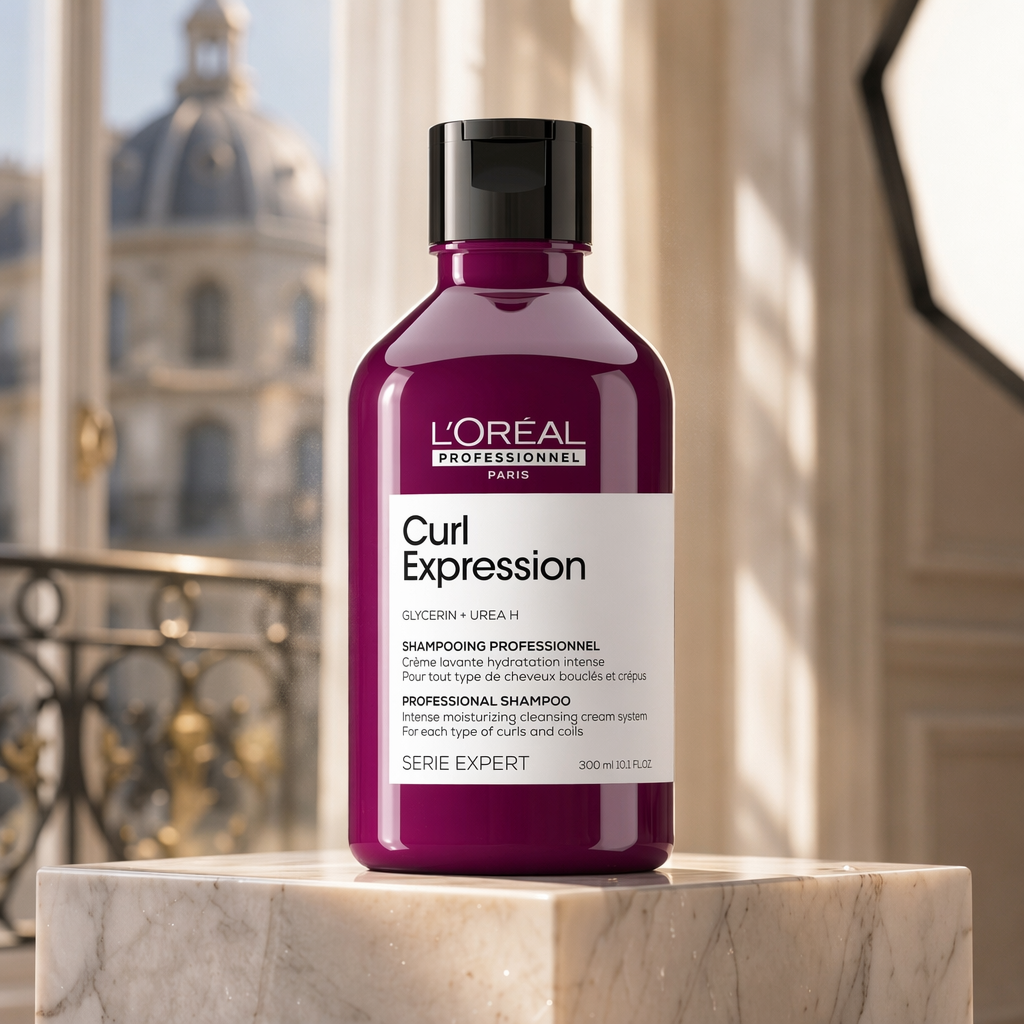
A real generated hero angle. Accurate label, accurate cap, accurate bottle. Nothing clever, and that is correct: angle 1 is not where you get creative, it is where you earn trust before the other eight angles spend it.
Now the texture macro, angle 3, which sells something a hero shot cannot:
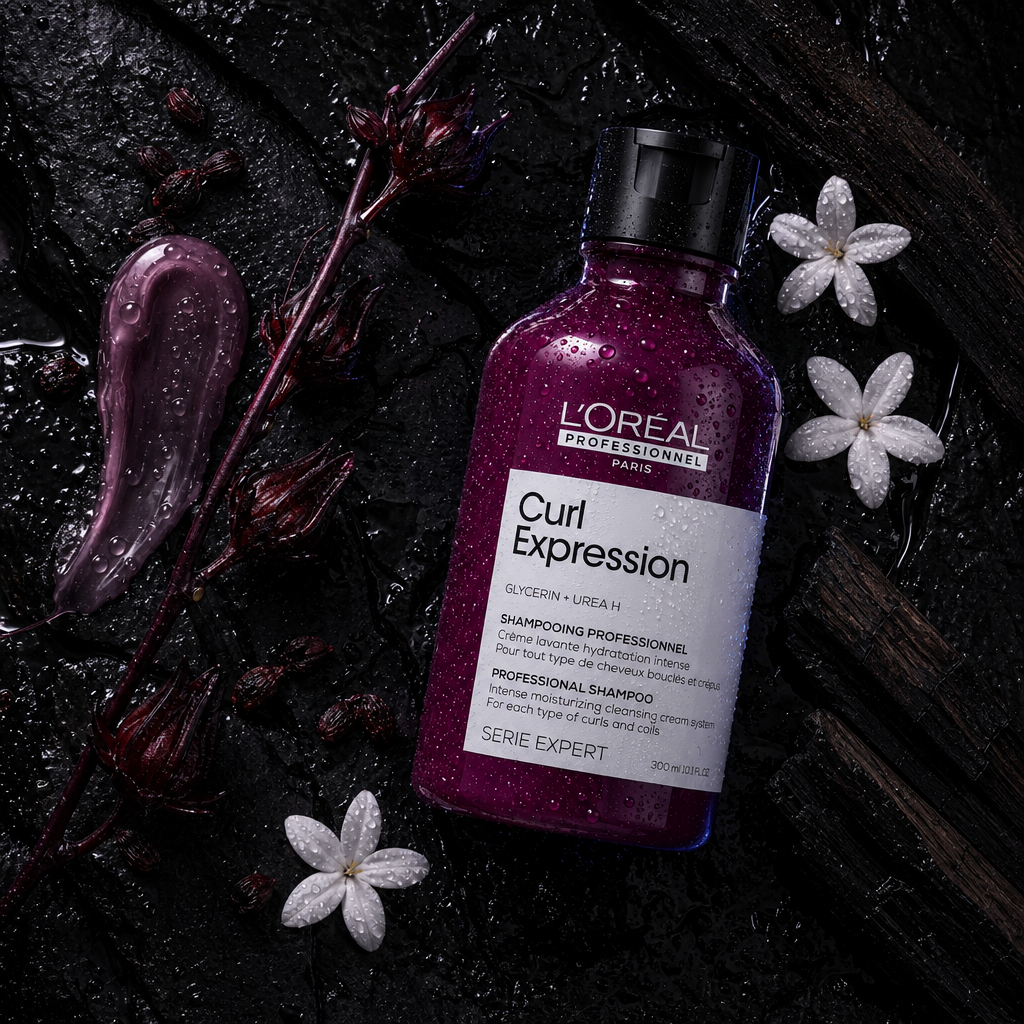
The same product, a completely different job. This shot makes the formula feel real (the smear, the ingredients, the water) in a way the on-plinth hero never could. Angle 3 is where sensory categories, beauty, food, skincare, win or lose.
And an angle that is barely a product shot at all, angle 6, the use-case:
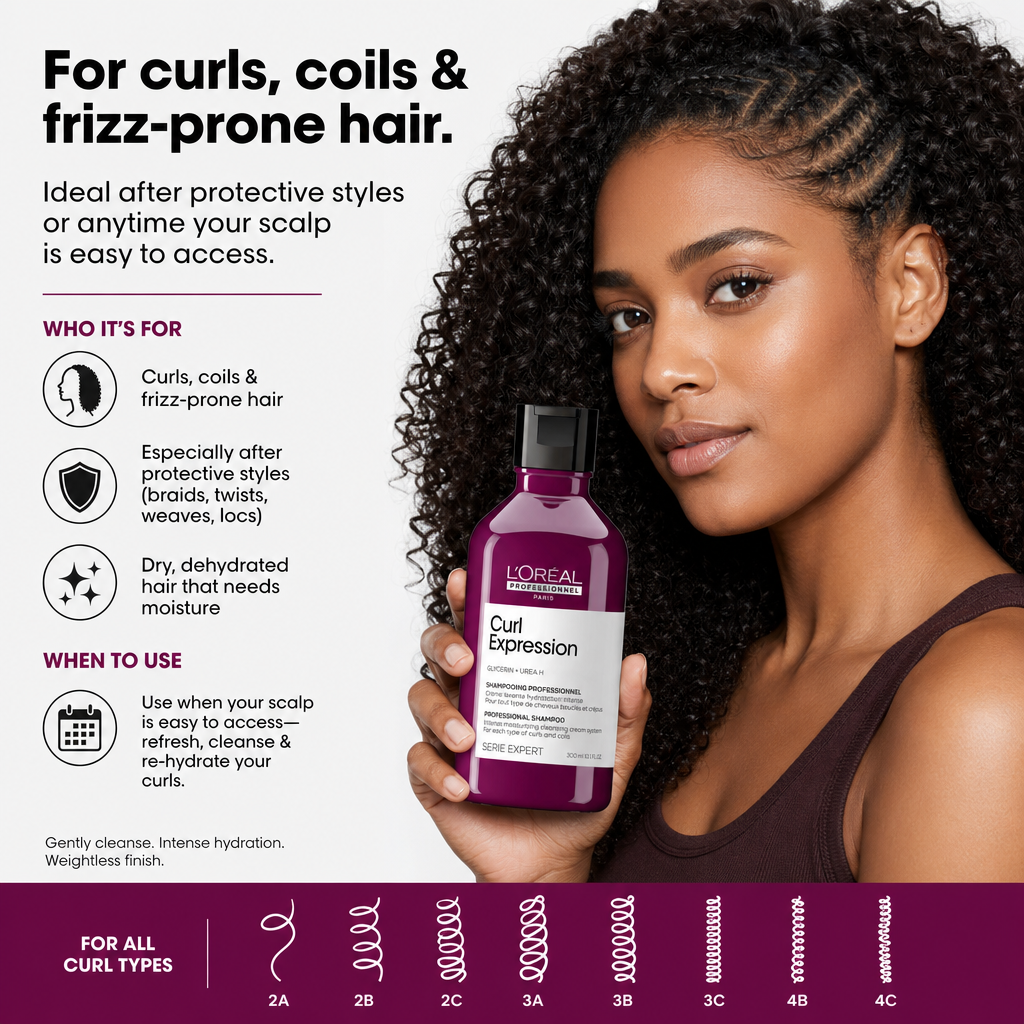
This one answers "is it for me?" with a curl-type chart and a who-it's-for panel. It is doing segmentation work, not beauty work. A nine-angle set that skips shots like this leaves the buyer to guess whether the product fits, and guessing buyers bounce.
Nine for ads is not the same nine for Amazon
The framework is shared, but the emphasis shifts by destination, which is why this is a distinct decision from your listing strategy.
- For a paid social ad set, the nine lean toward angles 3, 5, 6, and 8: texture, lifestyle, use-case, and proof, each paired with a different marketing hook so the platform can test them against audiences. The product is the constant; the angle is the variable you are testing.
- For an Amazon listing, the nine map to the slot gallery in order, front-loading angles 1, 2, and 7 (hero, scale, comparison) because those carry the most weight before the click-through. We cover that slot-by-slot in the dedicated Amazon listing images guide, and the Amazon images product page does it from an ASIN. For hands-on help with marketplace SEO and seller-facing listing content, eseospace offers done-for-you marketplace content services.
Same nine-angle discipline, two different orderings. Decide the destination first, then let it weight the set.
The honest constraint: fidelity across all nine
One warning that scales with the number of shots. Every angle is another chance for a tool to drift your product into something that is not quite what ships. Generic AI image generators are notorious for this: they redraw the label, shift the cap color, invent a variant. Across nine angles, one drift is disqualifying, because the buyer will notice the bottle in shot 4 does not match shot 1.
The fix is anchoring generation to your real product page rather than a text prompt, so packaging and claims stay constant across the set. Platform rules still apply to every shot: Meta's ad image guidance governs ad creatives and Amazon governs listing images, so review the nine before you ship them. A tool removes the shoot, not the review.
How to convert one product URL into nine angles
Here is the workflow the framework is built for. Instead of a shoot, a brief, and a design pass per shot:
- Paste one product URL.
- The tool reads the page (product, claims, brand tone) and generates the nine angles as one consistent set, each mapped to a different job.
- You review for fidelity and claims, reorder for your destination (ad set or listing), and ship.
LocalAds does exactly this: a product URL becomes a set of on-brand creatives sized for Meta, TikTok, Pinterest, and YouTube, plus nine listing images per ASIN for Amazon, with the product held accurate because generation is anchored to your real page. The L'Oreal grid and the three angle shots above are unedited outputs. To see your own nine, generate ads from a product URL and judge the set against the framework in the table.
FAQ
How do I convert a product URL into nine angles or nine images? Use a URL-to-creative tool that reads your product page and generates the set in one pass, rather than a prompt-based generator you have to direct nine times. Paste the URL, the tool produces nine on-brand shots mapped to different jobs (hero, texture, lifestyle, use-case, and so on), and you review them for accuracy before shipping. LocalAds does this for both ad creatives and Amazon's nine listing slots.
Why nine images specifically? Two reasons converge on nine. Amazon allows up to nine listing image slots, and paid social performs best with several distinct creative variations rather than one hero. Nine is the point where a set covers the full range of buyer questions without becoming repetitive.
What are the nine angles a product set should include? Clean hero, scale or in-hand, texture or macro, ingredient or material, lifestyle in-context, use-case or how-to, comparison or feature callout, social proof or claim, and packaging detail. Each answers a different buyer question, which is what separates a nine-angle set from one product shot taken nine times.
Do I need different images for Amazon versus ads? The nine-angle framework is shared, but the ordering differs. Amazon front-loads hero, scale, and comparison for the slot gallery; paid social leans on texture, lifestyle, use-case, and proof paired with different hooks for testing. Decide the destination first, then weight the set.
Will AI keep my product accurate across all nine shots? Only if generation is anchored to your real product page rather than a text prompt. Page-anchored tools hold packaging, label, and claims constant across the set, which matters more the more shots you produce, because a single drifted image undermines the other eight. Always review the full set before publishing.
The takeaway
One hero shot asks the buyer to decide from a single piece of evidence. Nine angles answer nine questions before they have to ask. Build the set by job, not by camera position, weight it toward your destination, keep the product accurate across every frame, and let one product URL produce all nine instead of a shoot.
Related reading: