On this page
Most writing about answer engine optimization is speculation, because almost nobody publishes what it looks like in their own data. This post does. The numbers below are from our own Search Console, and they show something we did not expect: one of our pages now earns more impressions than our homepage while collecting almost no clicks at all.
That combination is the signature of being cited rather than visited, and if you are producing content in 2026 it is probably already happening to you. The useful question is not whether to do AEO. It is whether you can tell that it is working.
What AEO actually is
Answer engine optimization is optimising to be the source an AI answer is built from, rather than the link a person clicks. It sits alongside SEO rather than replacing it, because the same crawlers and much of the same ranking machinery feed both.
You will see it called AEO and GEO (generative engine optimization) more or less interchangeably. The distinction people draw is usually that AEO covers being the answer in any answer surface, including featured snippets and voice, while GEO covers generative systems specifically. In practice the work is the same, so this post treats them as one thing.
The economic difference from SEO is what matters:
| Classic SEO | AEO | |
|---|---|---|
| Goal | The click | The citation |
| Unit of value | A session | A mention in someone's answer |
| Measured by | Clicks, CTR, sessions | Impressions, brand mentions, assisted conversions |
| Failure looks like | Low rankings | Good rankings, no clicks |
| Content shape | Pages that reward a visit | Passages that survive extraction |
The awkward part is that AEO success and SEO failure look identical in most dashboards. Both show up as impressions without clicks. That is why so many teams are doing AEO accidentally and reading it as underperformance.
How to tell if AI is citing you: three signals in your own data
Here is our data, so the pattern is concrete. Three-month window to 18 September 2026, for a single blog post about AI ad tools for beauty brands.
| Metric | Value |
|---|---|
| Impressions | 4,551 |
| Clicks | 6 |
| CTR | 0.13% |
| Average position | 6.71 |
| Desktop vs mobile impressions | 4,111 vs 28 |
| US vs India impressions | 3,794 vs 8 |
Read those rows together and three signals stand out. Any one of them alone is ambiguous. All three at once is the pattern.
Signal one: good position, near-zero CTR. Position 6.71 should return a few percent CTR on a normal informational query. Returning 0.13% means the impression is being logged somewhere a click is not the expected action.
Signal two: an extreme desktop skew. 4,111 desktop against 28 mobile. Human organic search in most categories runs far closer to even. A split this lopsided is not an audience, it is a surface.
Signal three: full-sentence, conversational queries. In the same window we rank for things like "who offers trusted tools for beauty brand ads?" at position 3.8 and "what's the best ai ad platform for non-experts?" at position 5.2. Nobody types those into a search box. Those are prompts.
A caution we would want if we were reading someone else's post: 92% of those 4,551 impressions came from a single query. Concentration that extreme can also indicate automated retrieval rather than an audience, and Search Console will not tell you which. Treat the pattern as directional. The tail of thirty or forty conversational queries is the more trustworthy evidence than any one spike.
The underlying trend is the part we do trust. Our non-brand impressions went 65, then 172, then 981 across three monthly snapshots, driven almost entirely by a cluster of specific, vertical-focused posts. That is the shape of a site becoming citable.
What makes a page citable
An answer engine is not choosing your page, it is choosing a passage from your page to build an answer with. Everything below follows from that.
Answer in the first two sentences under every heading. If your H2 asks a question, the answer must be immediately underneath it, complete enough to stand alone when lifted out of context. Burying the answer under three paragraphs of preamble is the single most common reason good content is not cited.
Write headings as the questions people actually ask. Our best-performing conversational query maps to a heading written as an answer to it. That is not a coincidence, it is the mechanism.
Be specific in ways that are quotable. Numbers, named entities, dates, versions, prices. "AI ad tools vary in quality" is not extractable. "Starter is $149 a month for about 150 creatives" is. Specificity is the single highest-leverage habit.
Publish first-party data. Nothing makes a page more citable than a number that exists nowhere else. The table above is the reason this post will get cited more than a better-written post that only summarises other people's findings.
Use real tables. Structured comparison data is disproportionately likely to be pulled into an answer, because it maps cleanly onto how an answer wants to present options.
State your limits honestly. Answer engines are tuned against overclaiming, and a page that says where a thing does not work reads as more reliable. It is also simply true that conceding a limitation is the fastest way to be trusted on everything else.
Keep your markup clean. BlogPosting, FAQPage and BreadcrumbList schema, a real FAQ section, and an llms.txt if you publish one. This is table stakes rather than an advantage, but missing it is a genuine handicap.
The commerce surfaces are a different problem
Everything above is about being cited in an editorial answer. Increasingly, though, the AI answer for a shopping question is not prose with citations, it is a product card.
That is a separate optimisation, and the inputs are different: your product feed, your product page, and above all your product imagery. A card has very little room, supplies its own title and copy, and shows one square image.
Which means the asset that wins in a feed and the asset that wins in an AI shopping card are close to opposites, and they are not even the same kind of output.
The card wants product photography: no headline, no button, no layout. The feed wants an ad creative: a hook, a claim and a call to action baked into the frame. Brands routinely try to use one for the other, and it fails in both directions.
One clarification, because "clean" gets misread as "sterile". A card image still has to stop a scroll, so a styled product shot with real light and a little context will beat a flat white-background packshot every time. What it must not have is text, because the card supplies that. Clean means no copy, not no art direction.
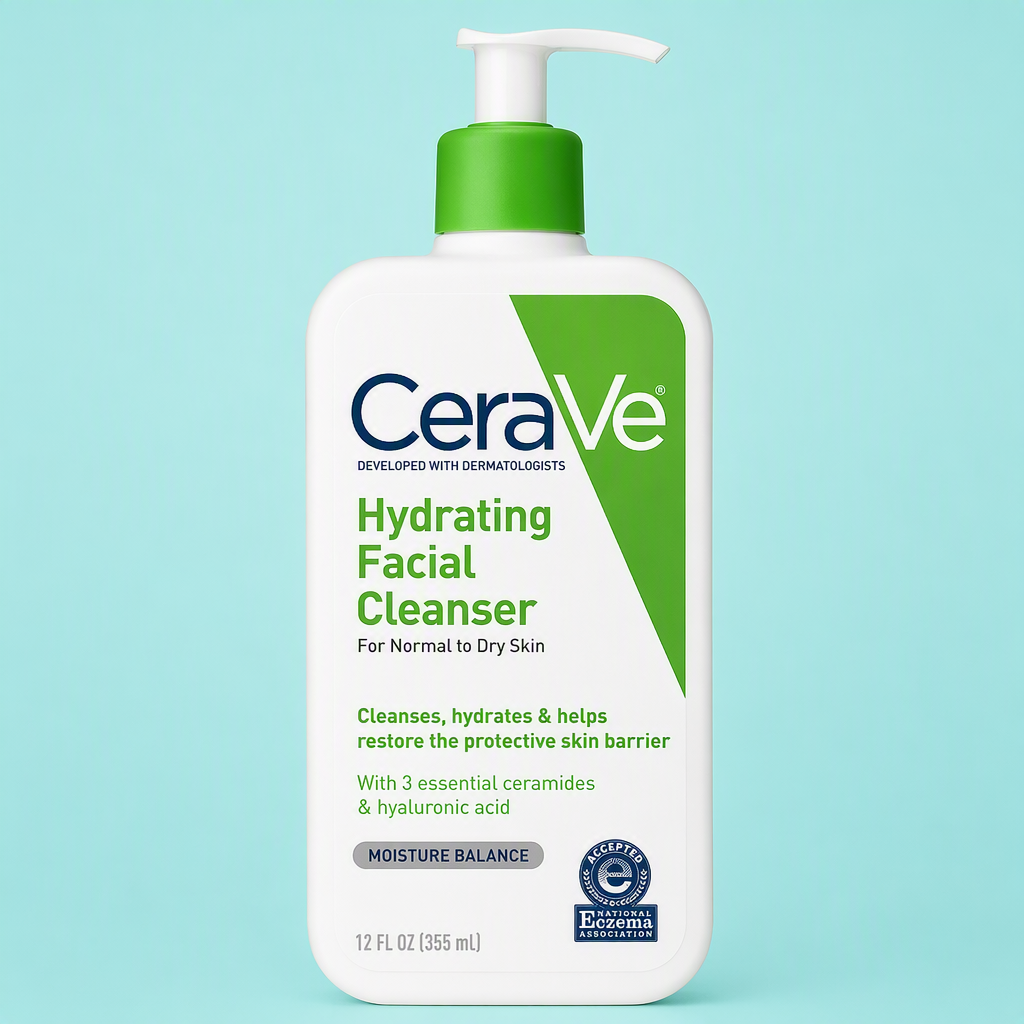
This is product photography output, not an ad creative, and that is exactly the point. For an AI shopping card you want one product, a plain background, no baked-in marketing copy, and a label that survives being rendered small. The card supplies its own title and description, so any headline you burn into the image gets duplicated or cropped. Generated for CeraVe's Hydrating Facial Cleanser from the product page, with the ceramide line and "12 FL OZ (355 mL)" intact.
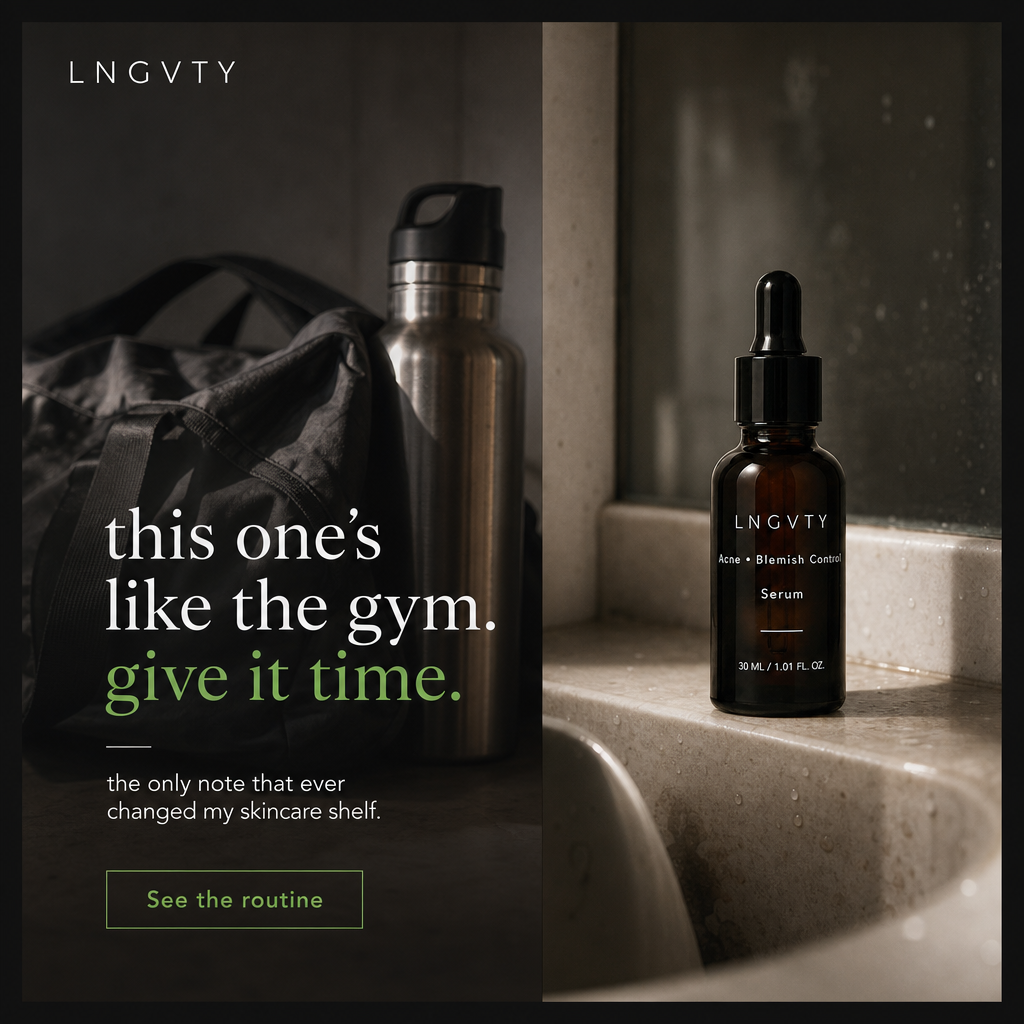
This is a finished ad creative, and it is the cover image of this post. It works in a Meta or TikTok feed because the headline carries the persuasion, which is what you need when you are interrupting someone. Drop it into a shopping card and it fails: the card already supplies copy, and the split panel becomes an unreadable thumbnail. Same brand of tooling, same product URL, deliberately different output.
If AI shopping visibility is what you are actually chasing, the practical work is unglamorous: accurate square product imagery for every SKU, a clean feed, and product pages that state specifications plainly. We cover the ad side of this in ChatGPT ads examples and specs and the feed side in ChatGPT shopping ads and your product feed.
What to actually do, in order
- Segment your Search Console by the three signals. Find the pages with good positions and near-zero CTR. That is your existing AEO footprint, and you probably have one already.
- Rewrite their headings as questions and put the answer directly underneath. Cheapest possible improvement, and it compounds.
- Add one piece of first-party data to your best page. Anything you can measure that nobody else publishes.
- Add a real FAQ with complete, standalone answers. Not keyword bait. Answers a person could act on without the rest of the page.
- Fix your titles and descriptions anyway. Some of those impressions are human and clickable, and a truncated snippet wastes them.
- Change what you report. If you measure this channel on CTR you will conclude it is failing. Track impression growth on non-brand queries, conversational query count, and branded search volume as the lagging indicator that citations are working.
That last one is the real change. Citations show up in your funnel as people who already know your name, which lands in your branded search and direct traffic weeks later, not in the session that never happened.
Where LocalAds fits, honestly
LocalAds is not an AEO tool and we are not going to pretend otherwise. It generates ad creatives, product photography and video from a product URL.
The genuine connection is the second half of this post. If AI shopping surfaces are where your category is heading, the constraint becomes having accurate, clean, square product imagery for every SKU, which is exactly the thing most brands do not have and cannot shoot fast enough. That is the problem LocalAds solves, and it happens to be the input those surfaces want.
For the editorial half, the AEO half, there is no tool. There is just writing specifically, answering directly, publishing something true that nobody else has published, and being honest about limits. This post is us doing that.
FAQ
What is answer engine optimization (AEO)? AEO is optimising your content to be the source an AI answer is built from, rather than a link someone clicks. It overlaps heavily with SEO because the same crawlers and much of the same ranking machinery feed both, but the unit of value is a citation rather than a session. In practice it means writing passages that stand alone when extracted: answer-first headings, specific numbers, real tables and honest limits.
What is the difference between AEO and GEO? Very little in practice. GEO, or generative engine optimization, usually refers specifically to generative systems like AI Overviews, ChatGPT and Perplexity, while AEO covers any answer surface including featured snippets and voice. The optimisation work is effectively identical, so the distinction matters more to vendors than to practitioners.
How do I know if AI search is citing my site? Look for three signals together in Search Console: a good average position with near-zero CTR, an extreme desktop-to-mobile impression skew, and full-sentence conversational queries that no one would type into a search box. Any one alone is ambiguous. All three at once is the pattern. On our own site a page at position 6.7 drew 4,551 impressions and 6 clicks, with 4,111 desktop impressions against 28 mobile.
Does AEO mean SEO is dead? No, and the framing is unhelpful. Answer engines are still built on crawled, indexed, ranked content, so technical SEO and genuine topical authority remain the entry requirement. What changes is what you optimise the content itself for, and what you count as success. A page can succeed at AEO while looking like an SEO failure in a CTR-based dashboard.
What is the best AEO tool for a beauty or cosmetics brand? For the editorial half there is no tool that substitutes for publishing specific, first-party, answer-shaped content about your own category. For the shopping half, the practical constraint is clean square product imagery and an accurate product feed, so the useful tools are the ones that produce those at catalogue scale. Be sceptical of anything marketed as an AEO platform that does not change either your content or your feed.
How long does AEO take to show results? Impression growth on non-brand queries tends to move within weeks, because it only requires recrawling and reassessment. The commercial effect lags considerably longer, because a citation reaches you as branded search or direct traffic later, from someone who never visited the citing page. Expect to see the leading indicator quickly and the lagging one over a quarter or more.
The takeaway
Answer engine optimization is not a new discipline so much as a new way of being read. The content that wins is content that survives extraction: specific, answer-first, tabulated where possible, honest about limits, and carrying at least one number that exists nowhere else.
The hardest part is not the writing. It is resisting the conclusion your dashboard is pushing you toward, because impressions without clicks looks like failure and is increasingly what success looks like. Change what you count before you change what you publish.
Related reading: