On this page
Every category has a thing that makes its ad creative hard. In fashion it is fabric. In beverage it is the pack. In supplements it is that the ad itself is a regulated document, and a generative model has no idea.
This is the category where an AI tool can hand you something beautiful that is also, strictly, a drug claim. Not because the model is careless, but because the internet is full of supplement marketing that overpromises, and a model trained on it will reproduce the register. Ask for a confident ad about a magnesium supplement and you will get sentences that read exactly like the ones that trigger warning letters.
This post covers what actually breaks, the one rule most AI supplement creative gets wrong, and the angles that convert without putting you in front of a regulator. Real generated ads throughout, from Goli, David, HK Vitals and The Whole Truth.
Why supplements are harder than skincare
Skincare has a claims problem. Supplements have a claims problem plus a classification problem.
A skincare ad that overclaims gets rejected by Meta and you rewrite it. A supplement ad that crosses one specific line does something different: under US law it can reclassify your product. If the labeling bears a disease claim, 21 CFR 101.93 is explicit that the product becomes subject to regulation as a drug unless the claim is an authorised health claim it qualifies for.
The gap between a legal claim and an illegal one is often a single word:
| Structure/function claim (permitted) | Disease claim (not permitted) |
|---|---|
| Supports a healthy immune system | Prevents colds |
| Helps maintain healthy joints | Relieves arthritis |
| Supports restful sleep | Treats insomnia |
| Helps maintain healthy cholesterol levels already in the normal range | Lowers cholesterol |
| Supports digestive comfort | Cures IBS |
Read the right column again and notice that every one of those is a better ad. That is exactly why this is hard. The persuasive version and the illegal version are the same sentence with one verb changed, and a model optimising for persuasion will reach for the wrong verb every time.
The disclaimer rule most AI creative gets wrong
Here is the specific mechanic that AI-generated supplement creative almost always misses.
If you make a structure/function claim, 21 CFR 101.93 requires a disclaimer: "This statement has not been evaluated by the Food and Drug Administration. This product is not intended to diagnose, treat, cure, or prevent any disease." And the rule is more specific than most marketers realise:
- It must be placed adjacent to the statement with no intervening material, or linked to it with a symbol such as an asterisk that appears next to both.
- It must be in boldface type.
- It must be no smaller than one-sixteenth of an inch.
A generative model will happily produce a beautiful supplement ad carrying three structure/function claims and no disclaimer anywhere, because it has learned what supplement ads look like rather than what they must contain. That is not a defect you can prompt your way out of. It is a review step you have to own.
The habit worth building: every claim in the creative needs either a qualifier attached to it or a disclaimer linked to it. Good supplement brands already do this, and you can see it in the work.
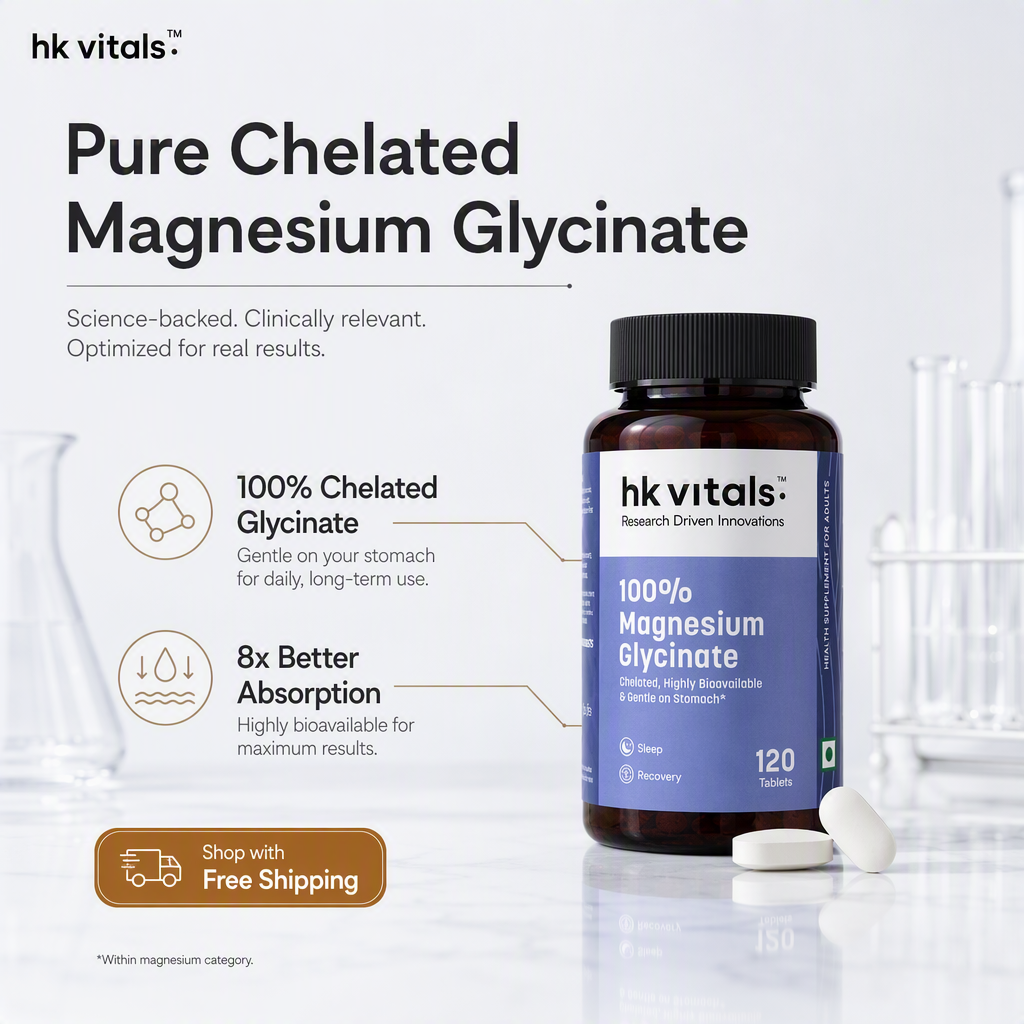
Generated for HK Vitals' Magnesium Glycinate. Look at the bottom-left corner: "\Within magnesium category". That tiny line is what makes the "8x Better Absorption" claim above it defensible, because it says what the comparison is against. A comparative claim without its qualifier is the single most common way a supplement creative becomes a problem, and it is trivially easy to generate one that has lost the asterisk. This brand is Indian and so sits outside FDA jurisdiction, but the discipline is universal.*
What accurate supplement creative looks like
The baseline is that the pack survives. Supplement labels carry a mandated statement of identity, a claim set and certification marks, and all of it has to render correctly.
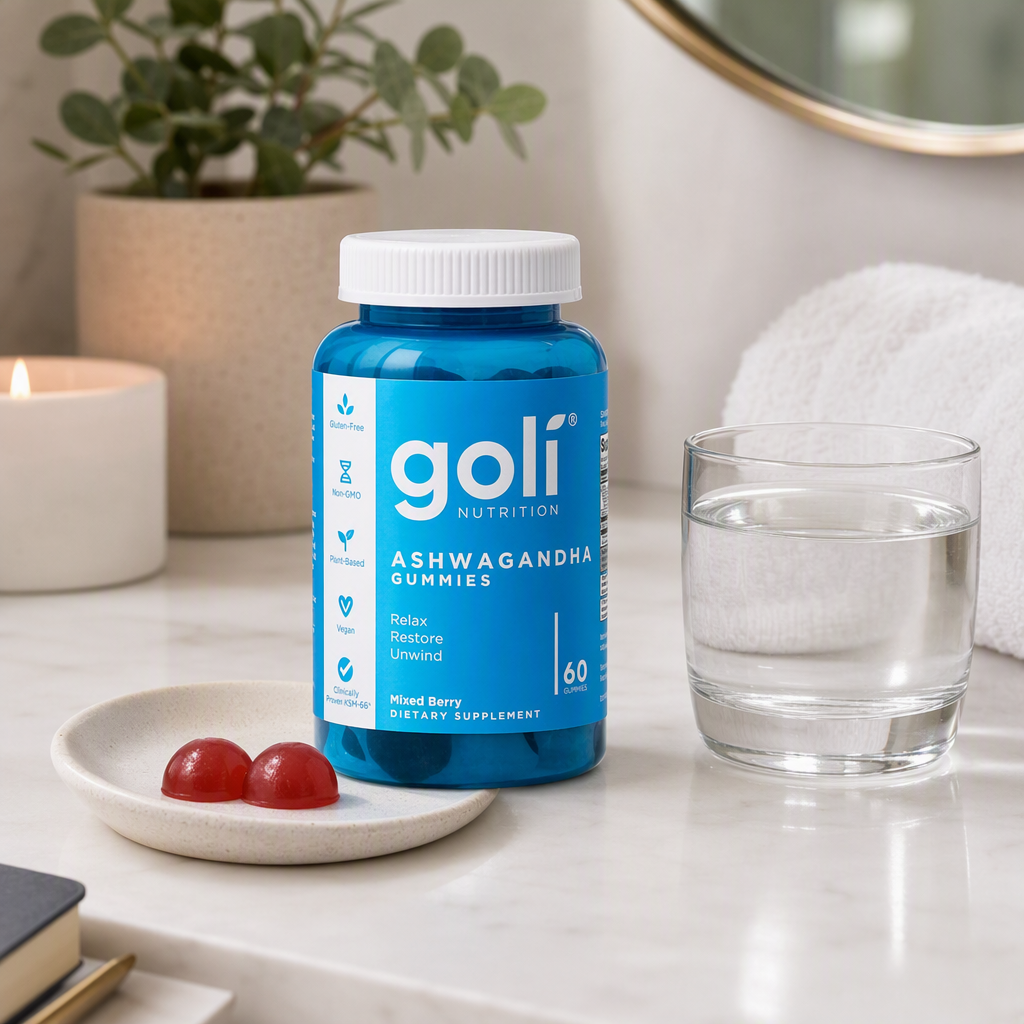
Generated for Goli's Ashwagandha Gummies from the product page. Read the bottle rather than the scene: "DIETARY SUPPLEMENT" is present, which is a required part of the statement of identity, along with "60 GUMMIES", "Mixed Berry", and the icon strip down the left for Gluten-Free, Non-GMO, Plant-Based, Vegan and Clinically Proven KSM-66. The headline claim, "Relax Restore Unwind", is a clean structure/function trio that stays well clear of the disease line.
The second thing that works in this category is education. Supplement and functional-food buyers are unusually willing to read, because they are trying to decide whether a product is real.
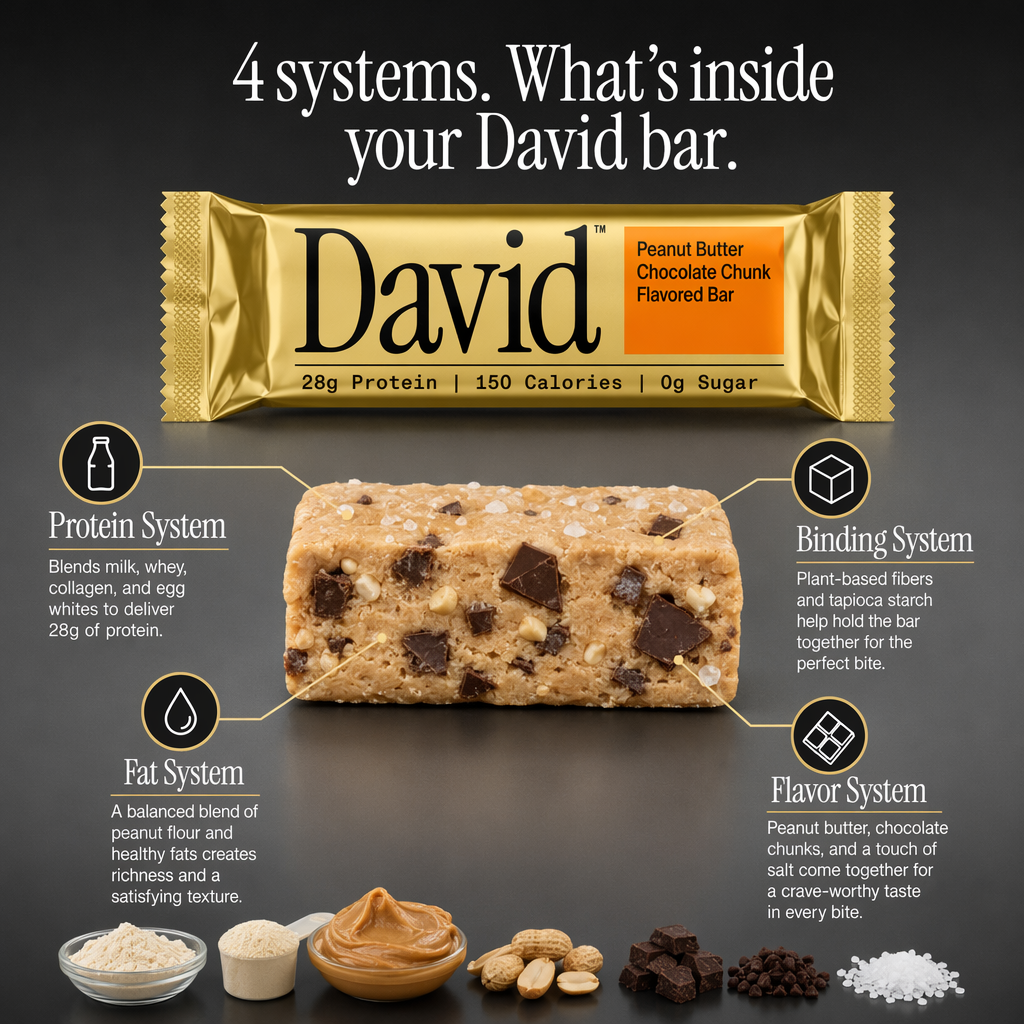
Generated for David's Peanut Butter Chocolate Chunk bar. This is the highest-performing shape in functional food: it explains the mechanism rather than promising an outcome. Note the wrapper says "Flavored Bar", which is the correct statement of identity, and the three nutrient content claims (28g Protein, 150 Calories, 0g Sugar) are rendered exactly as they appear on the real pack. Those numbers are the ones to check on every single generation.
And sometimes the strongest creative in this category is just the ingredient list, shot close enough to read.
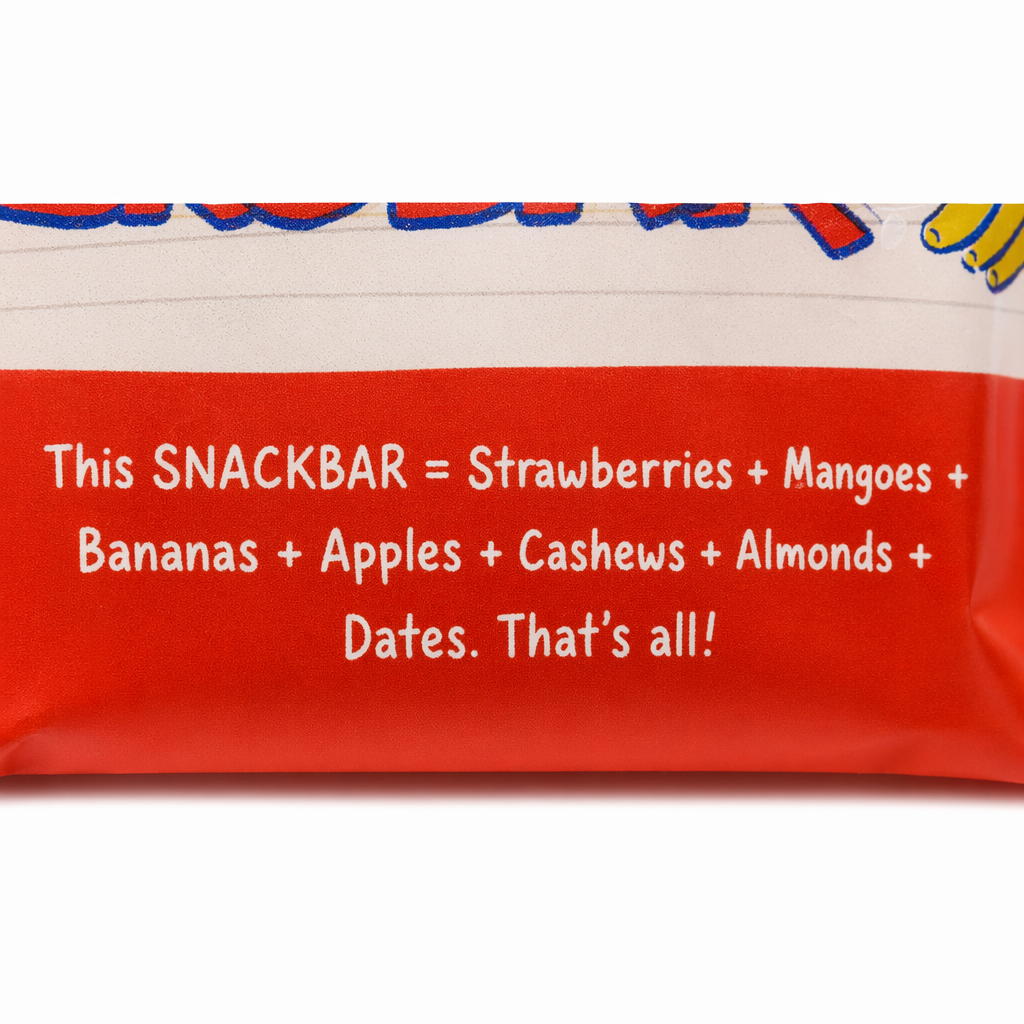
Generated for The Whole Truth's Mixed Fruit Snackbar. The entire creative is a crop of the ingredient statement, which is both the brand's whole position and the safest possible claim, because it is not a claim at all. It is a fact printed on the pack. Cropping this tight also sidesteps the usual failure mode: there is no fine print left to garble.
The angles that convert in supplements and functional food
| Angle | What it does | Claim risk |
|---|---|---|
| Ingredient transparency | Shows what is in it, nothing promised | Lowest, it is a fact |
| Mechanism education | Explains how it works | Low, if it stops at mechanism |
| Form and format | Gummy, tablet, powder, bar, taste | Low |
| Routine and occasion | When it fits in a day | Low |
| Comparative | Better absorption, more protein, less sugar | Medium, needs a qualifier |
| Outcome or benefit | What it does for you | Highest, needs a disclaimer |
The pattern across a testing set should be weighted toward the top of that table, not the bottom. Brands instinctively reach for outcome claims because they feel like the strongest pitch, but in this category ingredient transparency routinely outperforms them, because the buyer's real question is "is this legitimate" rather than "what will it do".
Functional food is the same problem, lower stakes
Protein bars, fortified snacks, high-fibre drinks and the rest sit in a gentler regime: they are food, not supplements, so the drug-reclassification risk does not apply and the FDA disclaimer is not required. What does apply is nutrient content claim regulation, which governs phrases like "high protein", "low sugar", "good source of fibre" and "light". Each of those is a defined term with a threshold, not a marketing adjective.
So the David bar above can say 28g Protein because that is what is in it. The moment a creative upgrades that to "high protein" or "the highest protein bar", it has entered regulated territory with specific tests to meet.
Practically: treat any adjective attached to a nutrient as a claim, and any number as something that must match the pack exactly.
A workflow that keeps this safe
- Generate from the product page. The page carries the approved claim language, the real numbers and the statement of identity. A prompt makes the model invent all three, and invention is where disease claims come from.
- Read every word of copy as a regulator would, not as a marketer. Specifically: is any verb doing disease work? Treats, prevents, cures, relieves, reverses.
- Check every number against the pack. Protein, calories, sugar, count, serving size, mg.
- For each claim, find its qualifier or disclaimer. If a comparative claim has lost its asterisk, the creative is not ready.
- Keep a substantiation file per claim. The question is never what you meant, it is what you can evidence.
- Weight the test set toward ingredient and mechanism angles. Lower risk and, in this category, usually higher converting.
Where LocalAds fits
LocalAds reads your product page and builds the strategy before the image, so the claim language, the nutrient numbers and the statement of identity come off your real page rather than from the model's idea of how supplement ads sound. That removes the largest single source of invented claims, which is the model filling a gap you left.
What it does not do, and cannot: decide whether your claim is substantiated, or whether a phrase crosses from structure/function into disease. No generation tool can, and any tool that implies otherwise is selling you a liability. The review step above is yours.
Every image in this post is real output, generated from product URLs for Goli, David, HK Vitals and The Whole Truth. The same engine animates any static into video and generates 30-second creator-led UGC ads, which in this category means the script needs the same claim review the static got, and arguably more, because spoken claims feel more like promises.
FAQ
Can AI generate ad creatives for supplement brands safely? Yes for the imagery, with a mandatory human review of the claims. The risk in this category is not an inaccurate picture, it is generated copy that crosses from a permitted structure/function claim into a disease claim, which under 21 CFR 101.93 can subject the product to regulation as a drug. Generate from your real product page so the claim language starts from what you already approved, then read every verb before anything runs.
What is the difference between a structure/function claim and a disease claim? A structure/function claim describes how a nutrient affects the normal structure or function of the body, such as "supports a healthy immune system". A disease claim says the product diagnoses, treats, cures, prevents or mitigates a disease, such as "prevents colds". The two are often one verb apart, which is why generated supplement copy needs reviewing word by word rather than skimming.
Do supplement ads need the FDA disclaimer? If the labeling carries a structure/function claim, yes. The required text is "This statement has not been evaluated by the Food and Drug Administration. This product is not intended to diagnose, treat, cure, or prevent any disease." It must sit adjacent to the claim or be linked to it by a symbol such as an asterisk, appear in boldface, and be no smaller than one-sixteenth of an inch. AI-generated creative routinely omits it entirely, so treat its presence as a checklist item rather than something the tool handles.
What ad creative works best for supplement brands? Ingredient transparency and mechanism education tend to outperform outcome promises, because the buyer's real question is whether the product is legitimate rather than what it will do. They also carry the lowest claim risk, which makes them the rare case where the safer creative is also the better one.
Does this apply to protein bars and functional foods too? Partly. Functional foods are regulated as food rather than supplements, so the drug-reclassification risk and the FDA disclaimer do not apply. Nutrient content claims still do, so terms like "high protein", "low sugar" and "good source of fibre" are defined thresholds rather than free adjectives. Numbers must match the pack exactly either way.
The takeaway
Supplements punish careless AI creative harder than any other category, because the failure is not an ugly ad, it is a regulatory one. The model is not going to learn the difference between "supports restful sleep" and "treats insomnia", because both are everywhere in its training data and only one of them is legal.
So put the discipline where it belongs: generate from your pack, weight your testing toward ingredient and mechanism angles, check every number, and make sure every claim still holds its qualifier. Done that way, this becomes one of the best categories for AI creative, because the education-led angles that keep you safe are the ones that were converting best anyway.
Related reading: