On this page
Every review of every AI ad tool is written in English, about English creative, for English-speaking markets. Which leaves a question nobody answers: does any of this actually work in German?
It is not an academic question. If you run paid social for a DACH brand, you already know that a creative which is 95% right in German reads as instantly foreign. Germans notice a missing umlaut the way an English reader notices a missing apostrophe. They notice €17.00 where it should be 17,00 €. They notice when a streetwear brand addresses them as Sie, and they draw a conclusion about the brand from it.
This post is written in English because the people making the tooling decision usually work in English. The creatives in it are real German output, generated from German product pages, and they are here so you can check the details yourself rather than take a vendor's word for it.
The four things that break in German ad creative
Umlauts and ß. The basic failure. Image models render text as pixels, not as characters, so ö becomes o, ü becomes u, and ß becomes B or ss at random. This is worst in brand names and logos, which is precisely where it is least forgivable.
Compound nouns. German builds words by fusing them. Versandkostenfrei, Kaffeerösterei, Kompressionszonen, Genussmomente. A headline that fits comfortably in English routinely overflows in German, and the break has to land on a morpheme boundary rather than wherever the line runs out. Most template tools just shrink the type until it fits, which looks cheap.
Register: du or Sie. German forces a choice English does not. Du is informal and is now standard for most D2C and lifestyle brands. Sie is formal and still correct for finance, B2B, medical and premium-traditional positioning. Get it wrong and the ad is not merely awkward, it signals that you do not know the market. Worse, a model that mixes both inside one creative looks machine-made, because only a machine would.
Number and currency formatting. This is the tell that separates real German creative from translated English creative. Under DIN 5008, the German standard for business writing, the currency unit follows the number and is separated by a space, and there is a space between a number and the percent sign. So it is 17,00 € and 100 %, with a comma as the decimal separator. An ad that says €17.00 was written in English and find-and-replaced.
What correct German creative actually looks like
The cover image on this post is the clearest example, so it is worth reading closely.
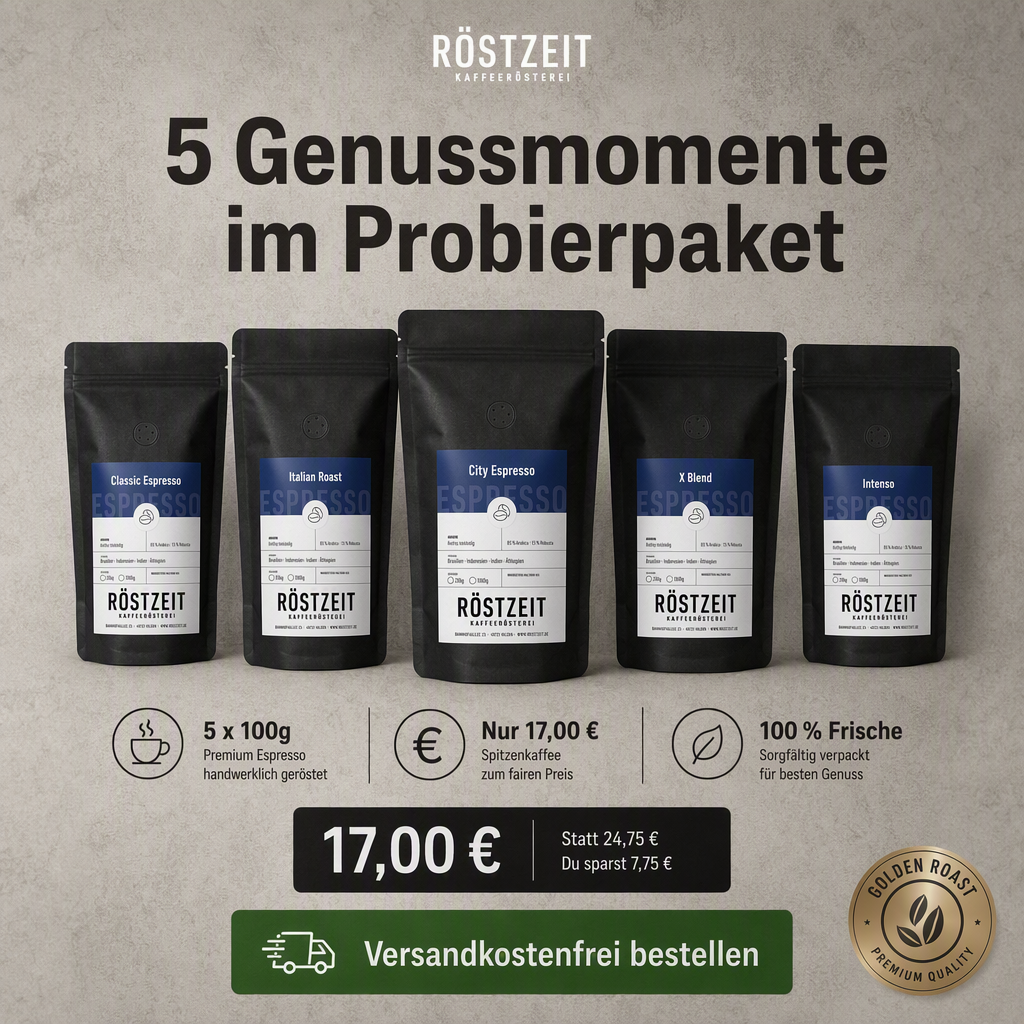
Generated for Röstzeit's Probierpaket from the German product page. Four things to check: the umlauts hold in RÖSTZEIT and KAFFEERÖSTEREI including at small sizes on the labels; "Genussmomente" and "Versandkostenfrei" are rendered as single compound words rather than split; the pricing follows DIN 5008 as 17,00 € and 100 %, not €17.00 and 100%; and the register is consistently informal, with "Du sparst 7,75 €" rather than "Sie sparen".
The same discipline shows up in a simpler layout, where the constraint is a long compound noun in a large headline.
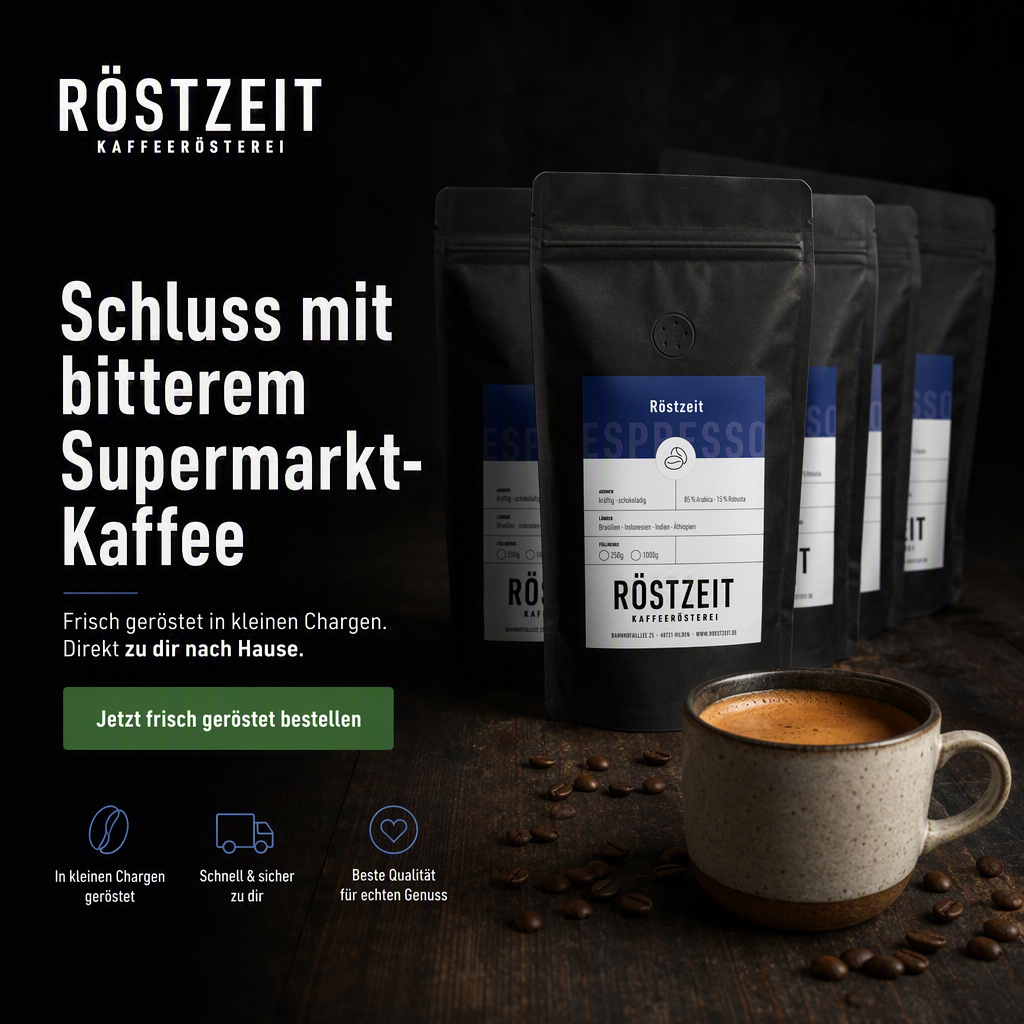
"Schluss mit bitterem Supermarkt-Kaffee" is a real German hook rather than a translated one. Note the hyphenated compound breaking cleanly across lines at the morpheme boundary, the correct adjective ending on "bitterem", and the informal "zu dir nach Hause". The label text on the pouch keeps its umlauts down to a few pixels, including "Äthiopien" and "FÜLLMENGE".
German buyers also skew toward specification over persuasion, which changes what a good creative looks like structurally. Feature-annotation layouts work considerably harder in DACH than they do in the US.
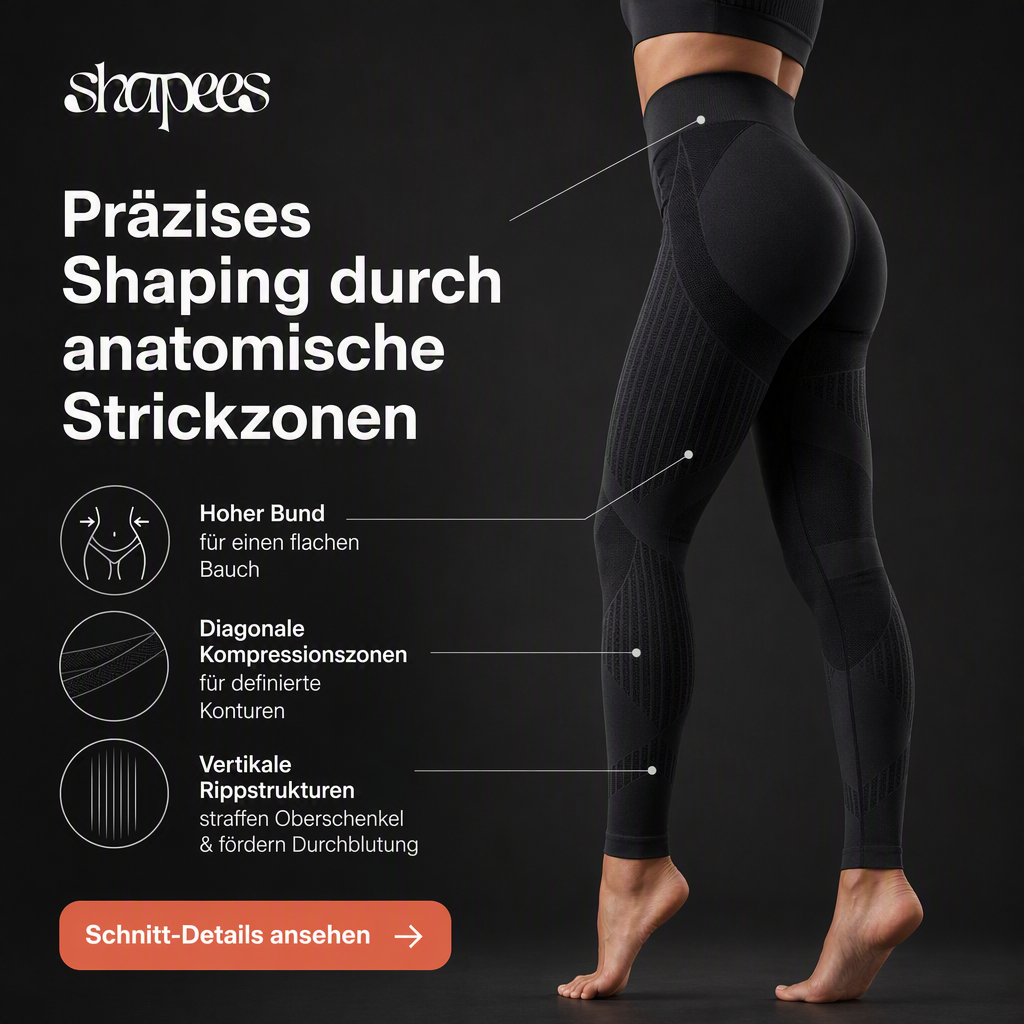
Generated for Shapees' CHLOE leggings. The interesting choice is what it sells: knit construction and cut, annotated to the garment, rather than a body transformation promise. "Präzises Shaping durch anatomische Strickzonen" is a mechanism claim, which is both a more German way to sell and a safer one. One caveat worth naming honestly: "fördern Durchblutung" is a physiological claim, and claims like that need substantiation you can produce on request.
And when there is no copy at all, the fidelity question becomes purely about the product.
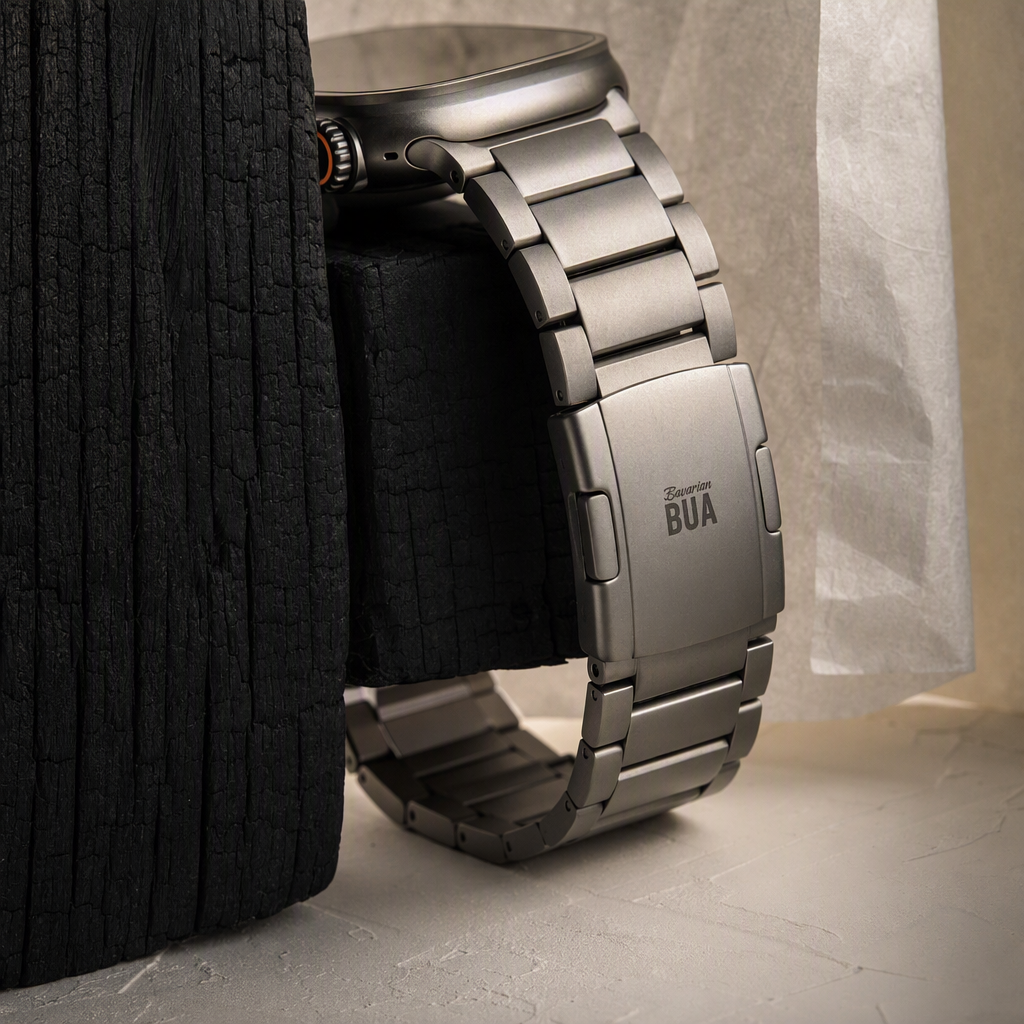
Generated for Bavarian BUA's titanium Apple Watch Ultra bracelet. The engraved brand mark on the clasp stays legible and correctly shaped, the link articulation is consistent, and the brushed titanium reads as titanium rather than as generic chrome. Premium hardware is unforgiving in exactly this way.
Where German advertising law raises the bar
DACH is not just a language difference, it is a stricter regulatory environment, and it is enforced differently. Under the Act against Unfair Competition (UWG), misleading commercial practices are prohibited, and Germany's distinctive mechanism is the Abmahnung: competitors and qualified associations can issue formal warning letters directly, which means enforcement does not wait for a regulator to notice you.
Practically, for ad creative:
| Claim type | Lower risk | Higher risk |
|---|---|---|
| Product benefit | Mechanism and construction ("anatomische Strickzonen") | Outcome promises about the body |
| Pricing | Strikethrough against a genuine former price | "Statt" prices with no substantiated reference |
| Health adjacent | Ingredient or material facts | Physiological effects without substantiation |
| Superlatives | Specific, measurable and provable | "Bester", "Nr. 1" without a citable basis |
None of this means DACH creative has to be timid. It means the persuasion has to come from specificity rather than from promises, which happens to be what German buyers respond to anyway.
Should you run English or German creative in DACH?
Run German. This comes up because English creative performs acceptably in the Netherlands and Scandinavia, and teams generalise from that to Germany. It does not transfer. In our experience German-language creative outperforms English creative with German audiences in D2C categories, and the gap is widest on cold traffic where you have no brand equity to lean on. Treat that as a strong prior to test against, not a law.
The practical caveat is the one this whole post is about: badly localised German is worse than English, because English reads as international while broken German reads as a scam. If you cannot produce correct German creative, English is the safer fallback. The point is to be able to produce correct German creative.
A workflow for DACH creative
- Generate from the German product page, not the English one. The German page holds the real register, the real compound vocabulary and the correct pricing format. Translating output after the fact reintroduces every problem above.
- Fix the register once, at the top. Decide du or Sie for the brand and hold it across every creative. Inconsistency is the most visible machine tell.
- Proof the four details before anything else. Umlauts and ß intact, compounds unbroken or broken on a morpheme,
17,00 €not€17.00,100 %not100%. - Prefer mechanism claims to outcome claims. Better for UWG exposure and better for conversion in this market.
- Have a native speaker review the hooks, not the whole batch. Hooks carry the register and the idiom. Body copy generated from a German product page is usually fine.
- Keep a substantiation file. If an Abmahnung arrives, the question is what you can evidence, not what you intended.
Where LocalAds fits
LocalAds reads the product page you point it at, so if you point it at a German page it works from German source material: the real product vocabulary, the real claims, the real pricing conventions. The creatives in this post were generated that way for Röstzeit, Shapees and Bavarian BUA, and the German-language details held up well enough to publish without correction.
That is the honest version of the claim. It is not that AI has solved German localisation. It is that generating from a German page produces materially better German than generating in English and translating, and the four checks above will tell you in about ten seconds which one you are looking at.
The same engine also produces animate-to-video versions of any static and 30-second creator-led UGC video ads. Video raises the localisation bar again, because voiceover adds pronunciation to the list of things that can be wrong, so review German video output more carefully than German statics.
FAQ
Can AI generate ad creatives in German? Yes, and the quality depends almost entirely on the source. Generating from a German product page produces materially better German than generating in English and translating, because the register, compound vocabulary and pricing conventions come from real German source text rather than from a translation layer. Check umlauts, compound word breaks, du versus Sie consistency, and DIN 5008 number formatting before you run anything.
What is the best AI ad tool for German and DACH brands? The one that generates from your German product page rather than from an English prompt, and that renders umlauts and ß reliably at small sizes. Most tools are built and tested on English, so test German specifically before committing: generate one creative with a long compound noun and a price in it, and inspect both.
Should I run German or English ad creative in Germany? German, in almost every D2C case, especially on cold traffic. English creative underperforms with German audiences even though it performs acceptably in the Netherlands and Scandinavia. The exception is that poorly localised German is worse than English, so if you cannot produce correct German, use English until you can.
Do German umlauts break in AI-generated ad images? Often, yes. Image models render text as pixels rather than characters, so ö, ü, ä and ß can drop or distort, most visibly in logos and at small label sizes. It is the first thing to check on any German output, and it is why generating from a German source page matters more than the prompt wording.
What advertising claims are restricted in Germany? Misleading commercial practices are prohibited under the UWG, and Germany's Abmahnung system lets competitors and qualified associations enforce directly rather than waiting for a regulator. In practice this means unsubstantiated superlatives, unsupported strikethrough reference prices, and physiological effect claims you cannot evidence carry real risk. Mechanism and construction claims are both safer and more persuasive in this market.
The takeaway
The DACH question is not whether AI ad tools work, it is whether they work in German, and almost nobody tests for it. The four checks in this post take ten seconds each and will tell you more than any vendor comparison table: umlauts intact, compounds unbroken, register consistent, and 17,00 € rather than €17.00.
Generate from the German page. Fix the register once. Sell the mechanism rather than the outcome. Do that and the German market stops being the one you postpone because the creative is too much work.
Related reading: