On this page
Short answer: one square per buying conversation, not one per product. For most D2C catalogues that lands somewhere between fifteen and forty creatives to start, which is more than people expect and for a different reason than they expect.
Last verified: 2026-08-17. LocalAds makes ad creative and does not place ads.
Why the usual volume logic does not apply
On Meta you produce volume to fight fatigue. Frequency climbs, the same static stops working on the same people, and you refresh. Volume is a function of time.
ChatGPT ads are not primarily a fatigue problem, at least not yet, because the inventory is new and the audience per topic is thinner. The volume driver is different: targeting is contextual.
You do not bid on keywords. You supply context hints, topics, needs, and situations, and your card can surface beside a conversation that matches. There is no guarantee of delivery against any specific prompt. Which means a single creative has to be equally apt across every conversation your hints cover, and it will not be.
So volume here is a function of breadth, not time. You are covering conversational surface area.
Working out your number
Three steps, and the arithmetic is not complicated once you stop counting products.
1. List the conversations, not the SKUs
For each product, write out what someone might actually be asking ChatGPT before they buy. Not search queries. Questions.
An evening clutch might sit beside:
- "what bag goes with a midi dress for a wedding"
- "is real leather worth it for an occasional bag"
- "small bag that still fits a phone and keys"
- "gift ideas for someone who has everything"
Four genuinely different conversations. The gift one is a different buyer with a different motivation from the "does it fit my phone" one. A single image and a single 24-character title cannot serve both.
2. Group by what the answer needs to show
Some conversations collapse. "Small bag that fits a phone" and "is this big enough for essentials" want the same image: the interior, with things in it. Merge those.
Others do not collapse. The wedding-outfit conversation wants the bag styled on a person. The gift conversation wants it looking giftable. Same product, incompatible images.
Realistically you end up with three to five distinct conversation groups per product, not the ten you started with.
3. Multiply, then start smaller
Five priority SKUs times three to four groups is fifteen to twenty creatives as a first build. A full catalogue rollout is larger, but do not start there.
| Catalogue stage | SKUs | Groups each | Creatives |
|---|---|---|---|
| First test | 3 | 3 | 9 |
| Sensible start | 5 | 3 to 4 | 15 to 20 |
| Full rollout | 20 | 3 | 60 |
Nine creatives is enough to learn whether the channel works for you. Sixty is what covering a catalogue looks like, and there is no reason to commit to it before the first nine tell you something.
What that actually looks like for one product
This is one clutch, shot nine ways:
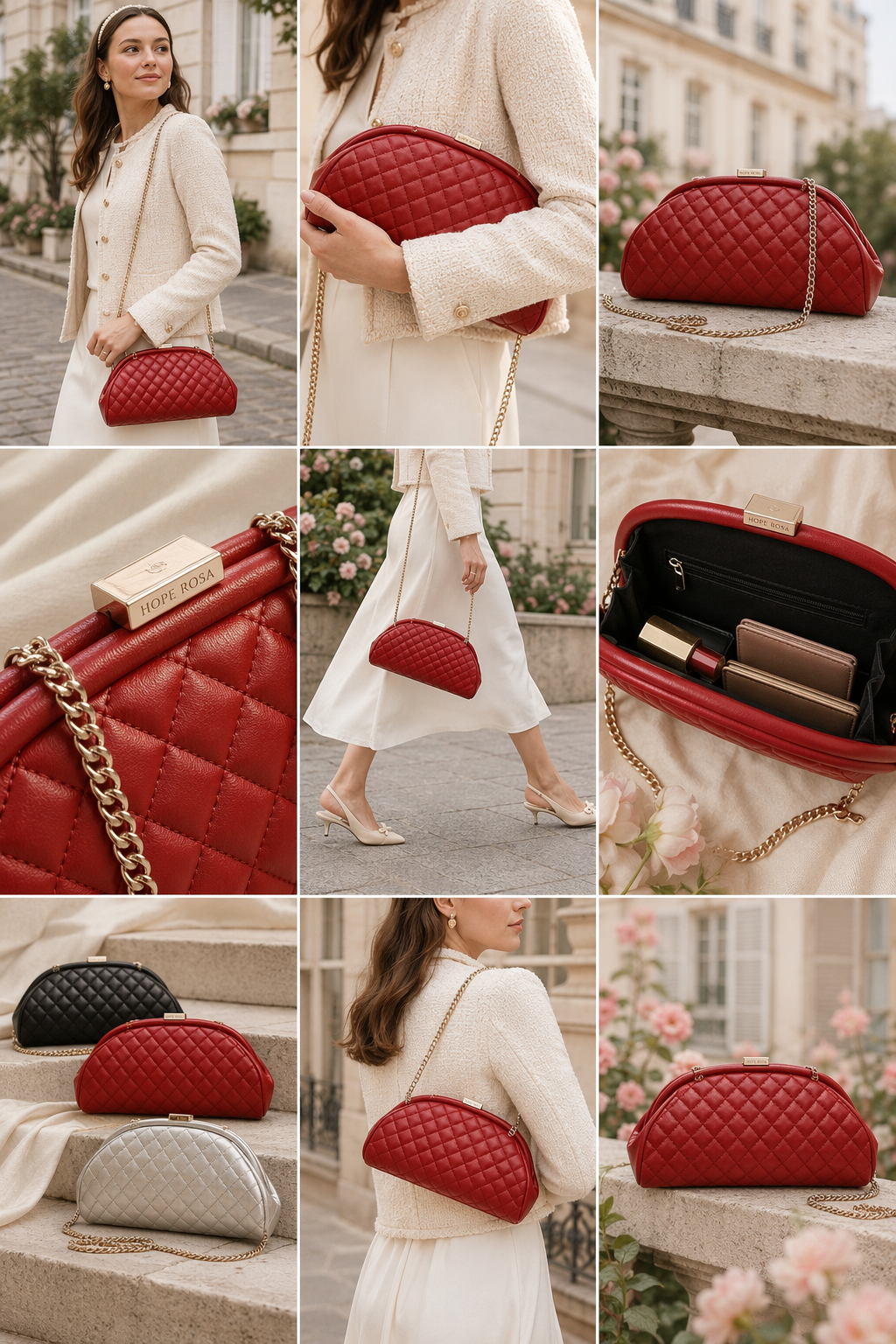
Street style, detail on the hardware, the open interior, the colourway lineup, worn crossbody, product alone. Each frame answers a different question. The interior frame belongs beside "will my phone fit". The colourway lineup belongs beside "which colour should I get". The street style frame belongs beside "what goes with a midi dress".
That is the mental model: a shot list built from questions, not a set of variations for their own sake.
And one of those frames, on its own, at full size:
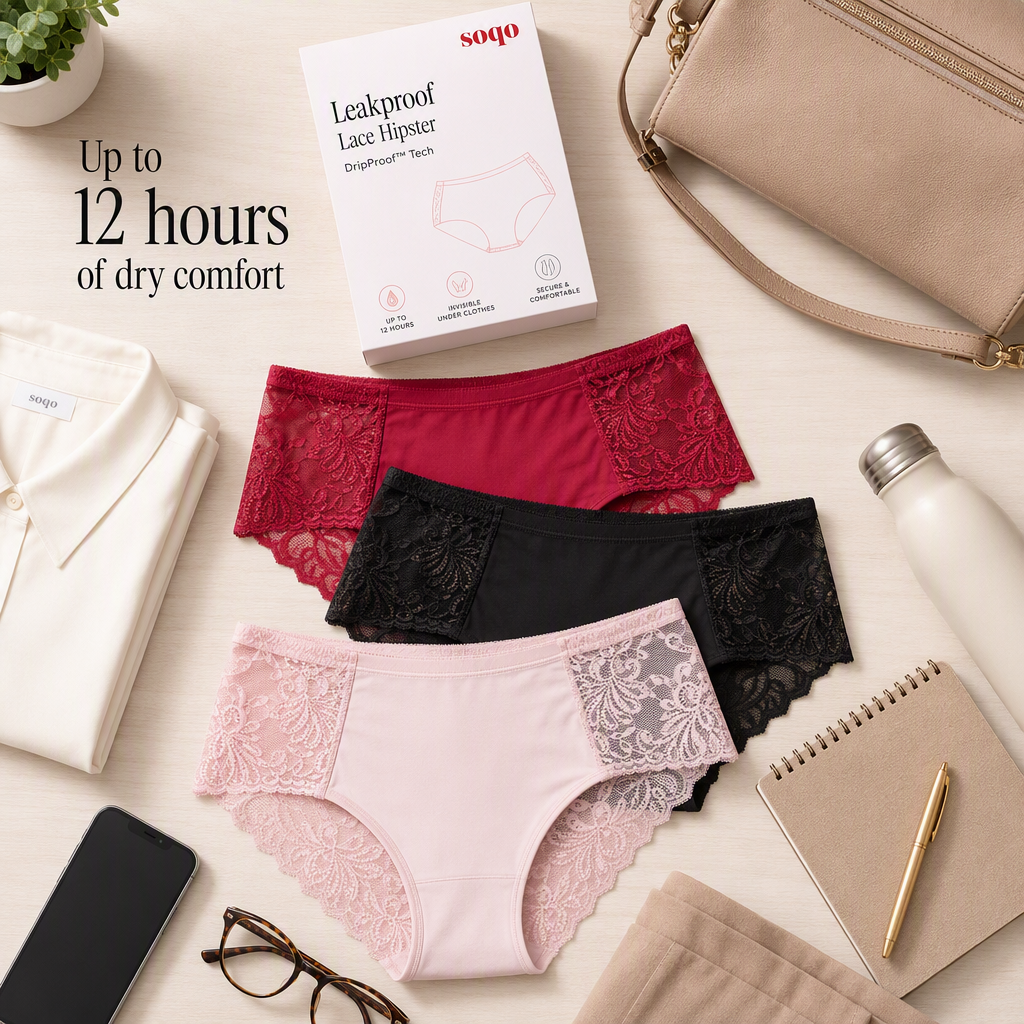
A different product, showing the same principle. This frame answers "what do I actually get" and "does it look like normal underwear". It would be the wrong frame for a conversation about overnight protection, which wants a different image entirely.
Volume without a proportional cost
The obvious objection: fifteen to sixty creatives is a lot of photography.
It would be, if each one were a shoot. Three things make the number tractable.
The card supplies the words. You are not designing fifteen layouts with fifteen headlines. You are producing fifteen images plus thirty short text lines. No layout work at all, which is where most creative production time actually goes.
No text means no localisation. A clean square works in every market you are eligible in. A creative with a burnt-in English headline does not.
Generation from a product URL removes the shoot. This is what LocalAds does: one product page in, on-brand squares out, grounded in your real product so packaging and colours stay accurate across every variation. Both images above are unedited output. We produce the creative; you upload and run it.
How to test with this many
Do not launch twenty creatives and stare at a dashboard.
Test the image before the copy. In a placement this small, the square carries most of the variance. Hold the title and copy steady within a conversation group and vary the image first.
Judge by group, not in aggregate. One group can carry a whole account average and hide three groups that never worked. Aggregate CTR across contextually different conversations is close to meaningless.
Give it enough impressions. With reported CPMs between roughly $18 and $65 and a $25 minimum daily budget, a twenty-creative launch splits budget so thin that nothing reaches significance. Better to run nine properly than twenty badly.
Expect the fatigue question to change. Everything above assumes fatigue is not yet the main driver. As inventory and competition grow, refresh cadence will start to matter the way it does on Meta. We will update this page when that shifts.
FAQ
How many creatives do I need for ChatGPT ads? One square per buying conversation rather than one per product, which usually means three to five per SKU after grouping. A sensible first build is five priority SKUs times three to four conversation groups, so fifteen to twenty creatives. A first test can be as small as nine.
Why do ChatGPT ads need more creatives than I expect? Because targeting is contextual rather than keyword-based. Your card can surface beside any conversation matching your context hints, and a single image plus a 24-character title cannot be equally relevant to genuinely different conversations. You are covering conversational surface area, not fighting audience fatigue.
Do ChatGPT ads suffer from creative fatigue like Meta ads? Less so today, because the inventory is new and per-topic audiences are thinner, so the dominant problem is coverage rather than repetition. That is likely to change as the channel grows and more advertisers compete for the same conversations.
Should I test images or copy first? Images. In a card this small the square carries most of the performance variance, and the copy fields are so short that the range of possible variation is narrow. Hold copy steady inside a conversation group and vary the image.
How do I produce that many square creatives affordably? The volume is manageable because there is no layout or localisation work: the card supplies the text, so you are producing images plus short lines rather than designed compositions. Generating from a product URL removes the photography step while keeping the product accurate.
Can I use one creative for all my ChatGPT ads? You can, and it is a reasonable way to run a first cheap test. It will underperform once your context hints cover more than one kind of conversation, because relevance to the surrounding answer is what makes this placement work.
The takeaway
Count conversations, not products. Group them by what the image has to show, expect three to five per SKU, and start with nine rather than sixty. The reason the number is higher than on other channels is not fatigue, it is that contextual targeting puts you beside questions you did not write, and only a relevant image earns the click.
Related reading: