On this page
Beauty brands worry about claims. Fashion brands worry about returns, and that turns out to be a harder creative problem.
When a skincare ad overpromises, Meta rejects it and you rewrite the headline. When a fashion ad misrepresents a fabric, nothing gets rejected at all. The ad runs, it converts, the parcel arrives, and the customer opens a bag containing something that drapes differently, reads a half-shade off, or has a neckline that sits nowhere near where the creative implied. Then it comes back. The ad worked and still lost you money.
That is why generic AI ad tools tend to disappoint apparel brands specifically. They are optimised to make an attractive image. Fashion needs an accurate one, because the creative is effectively a product specification that the customer will check against the real garment within a week. This post shows what that looks like when it is done properly, using real generated ads for apparel and fashion brands, and breaks down the angles that actually convert in the category.
The three things fashion creative has to get right
Almost every failure in AI-generated apparel creative traces back to one of three things.
Fabric behaviour. A cotton jersey, a silk satin, a waffle knit and a sheer georgette all catch light differently and all hang differently. Most image models default to a generic smooth drape, which is why AI apparel shots so often look like a render of a garment rather than a photograph of one. Sheer fabric is the hardest case, because the model has to hold transparency and print at the same time.
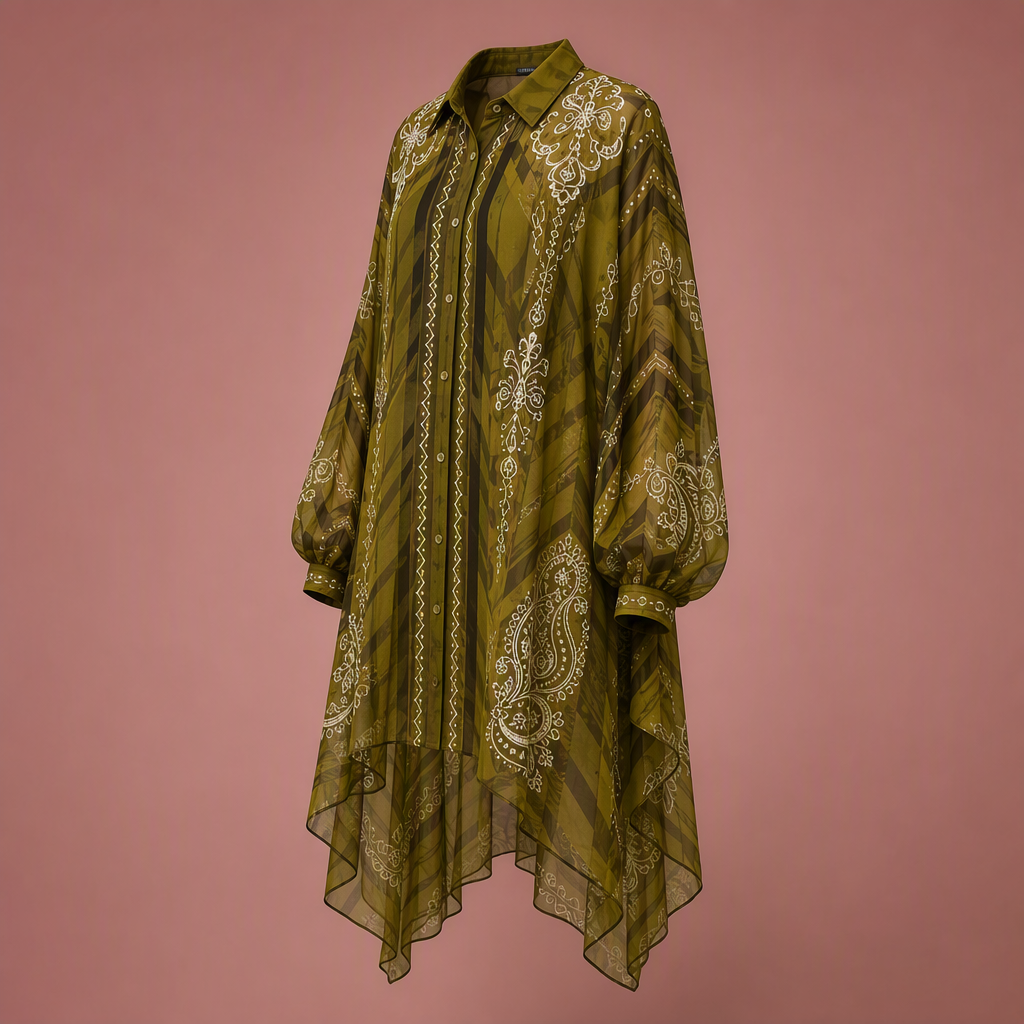
Generated for Kritika Murarka's Olive Paisley Sheer Longline Overlay from the product page. The thing to check here is the hem: the fabric stays genuinely sheer where it layers over itself, the handkerchief points keep their weight, and the white embroidery follows the drape instead of sitting flat on top of it like a decal. That is the test most AI apparel shots fail.
Colourway. Size and fit get blamed for most apparel returns, but colour mismatch is the quiet second. A garment photographed half a shade warm is a return waiting to happen, and it is the single easiest thing for a generative model to get wrong, because it has no reason to prefer your exact dye lot over a more pleasing one.
Construction. Seams, topstitching, hardware, ribbing, raw hems, patch edges. These are what a considered buyer zooms in on, and they are precisely the details a model will smooth away unless the generation is anchored to real product imagery.
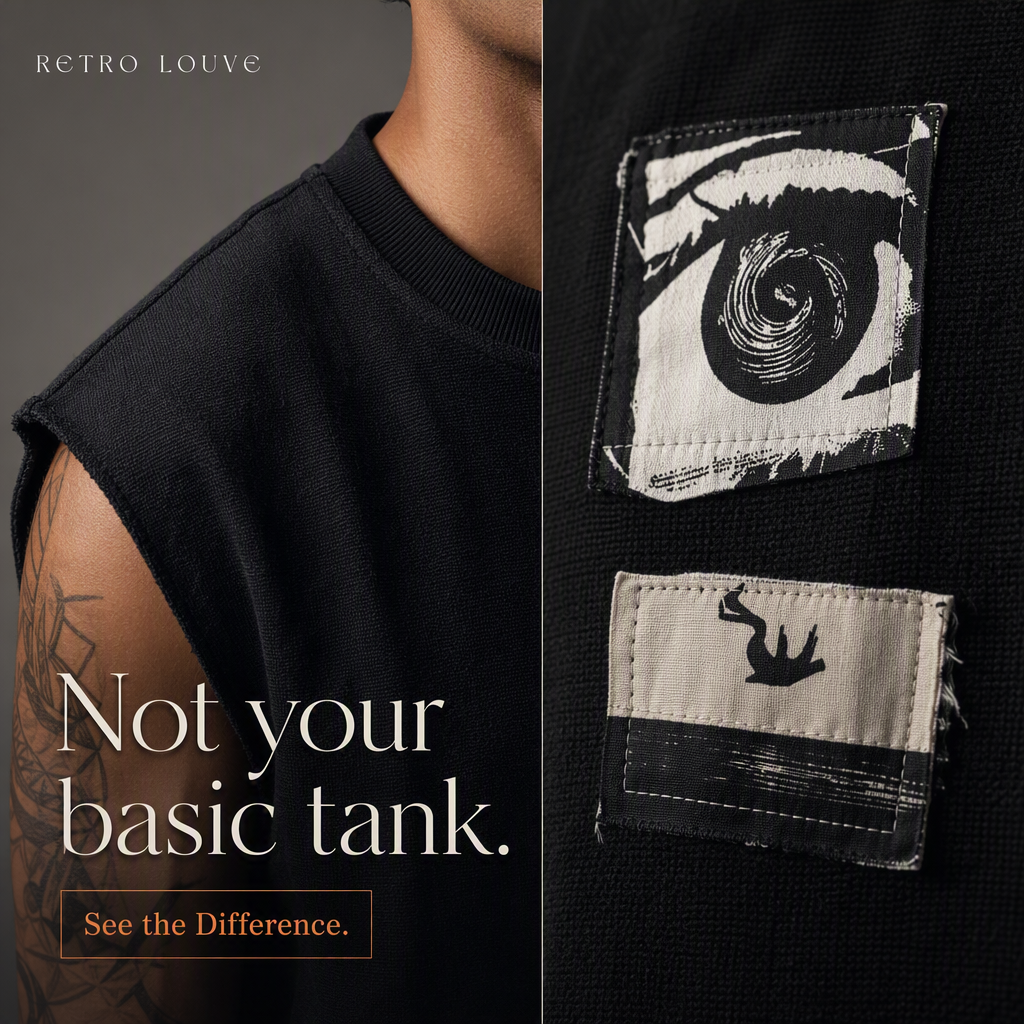
Generated for Retro Louve's After Hours Tank. This is the construction case done right: you can read the waffle texture, the raw-cut armhole, the ribbed neckline, and the frayed edges and visible topstitching on the applied patches. A buyer deciding whether this is a fifteen-dollar tank or a premium one is deciding on exactly these pixels.
Why an inaccurate fashion ad costs more than a rejected one
This is the part most AI-ad content skips, and it is the reason fashion deserves its own playbook rather than the generic D2C one.
According to the NRF and Happy Returns 2025 Retail Returns Landscape, an estimated 19.3% of online sales were returned in 2025, with total retail returns reaching $849.9 billion. Apparel sits well above that average, and category benchmarks generally put online fashion returns in the mid-twenties to low-thirties by percentage. Fit is the most cited driver, with appearance and colour mismatch close behind.
Run the arithmetic on your own account and the creative question changes shape. If a campaign returns a 3x ROAS on paid-social reporting but a quarter of the units come back, the real number is not 3x. Your ad platform will never tell you this, because the return happens weeks later in a different system. So a fashion creative has two jobs that pull against each other: make the garment desirable, and make it unambiguous. Most AI tools only optimise the first.
The practical consequence: for apparel, generation quality should be judged on fidelity first and beauty second. A slightly less glamorous shot that shows the true colour and the true drape is worth more than a gorgeous one that buys you a return.
The angles that convert in fashion
Fashion is unusual in that the same garment genuinely needs several different creative treatments, because buyers are answering different questions at different moments. Four angles do most of the work.
The finished statement ad. Brand-led, headline-forward, built for cold traffic that has never heard of you. This is the one that has to carry a point of view rather than a product spec.
The cover image on this post is that angle: Retro Louve's "Wear your poetry" execution, where the garment is clear but the brand posture is doing the selling.
The editorial or lifestyle angle. Places the garment in a world, which is how considered-purchase fashion actually sells. The risk is that the styling swallows the product.
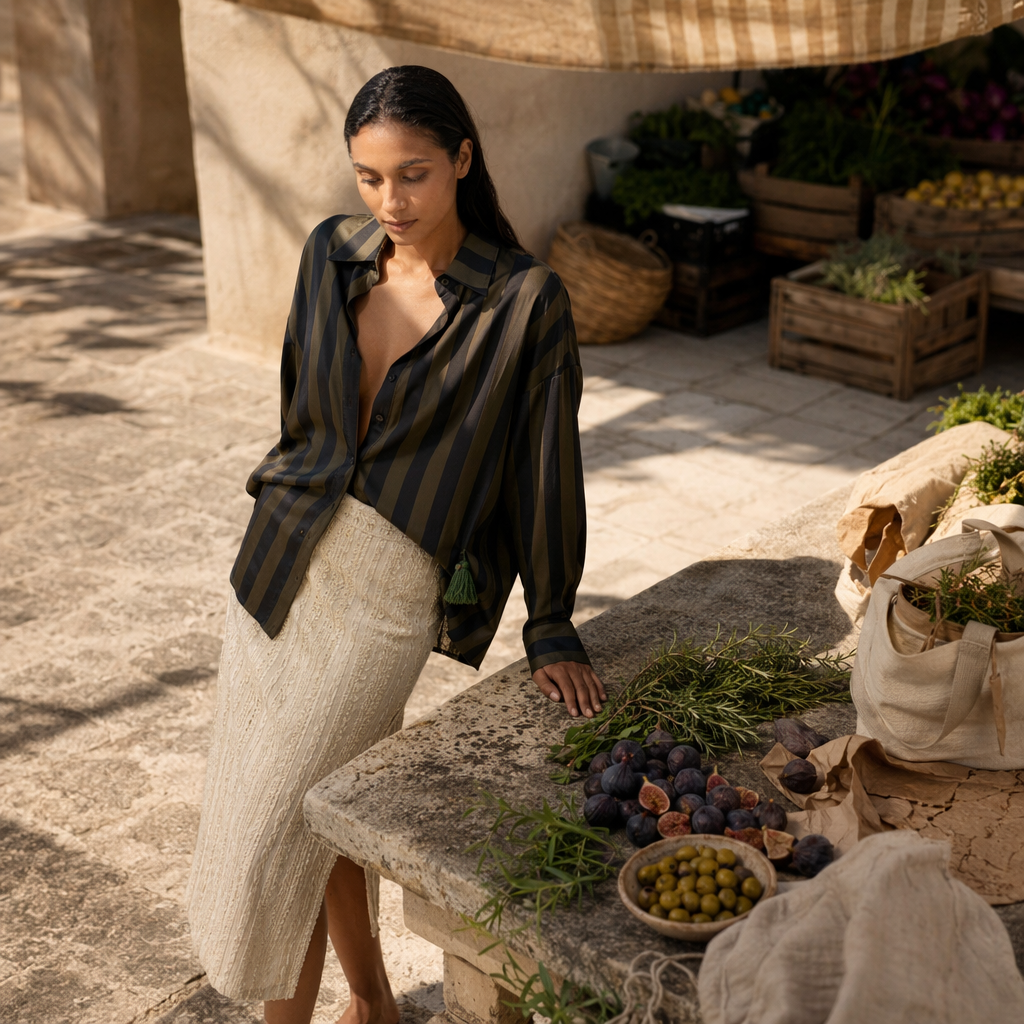
Generated for Kritika Murarka's striped shirt and skirt pair. The scene is doing real work, but note that the stripe direction, the satin sheen and the texture of the cream skirt all stay readable. A lifestyle shot that you cannot buy from is just a mood board.
The place and story angle. A variant of editorial that leans further into narrative, often shot from behind or at distance. Useful for brands whose customer buys an identity, and a good way to show the back of a garment without it feeling like a catalogue plate.

Generated for 5feet11's Baharon Phool Barsao shirt. Shot from behind, which most brands never test, and which answers a question customers genuinely have about a printed shirt: what does the back look like. The print placement and the embroidery texture survive at distance.
The coverage set. Not one ad but a full angle grid: on-model, flat lay, macro texture, hanger, folded. This is what actually reduces returns, because it pre-answers the questions that drive them.
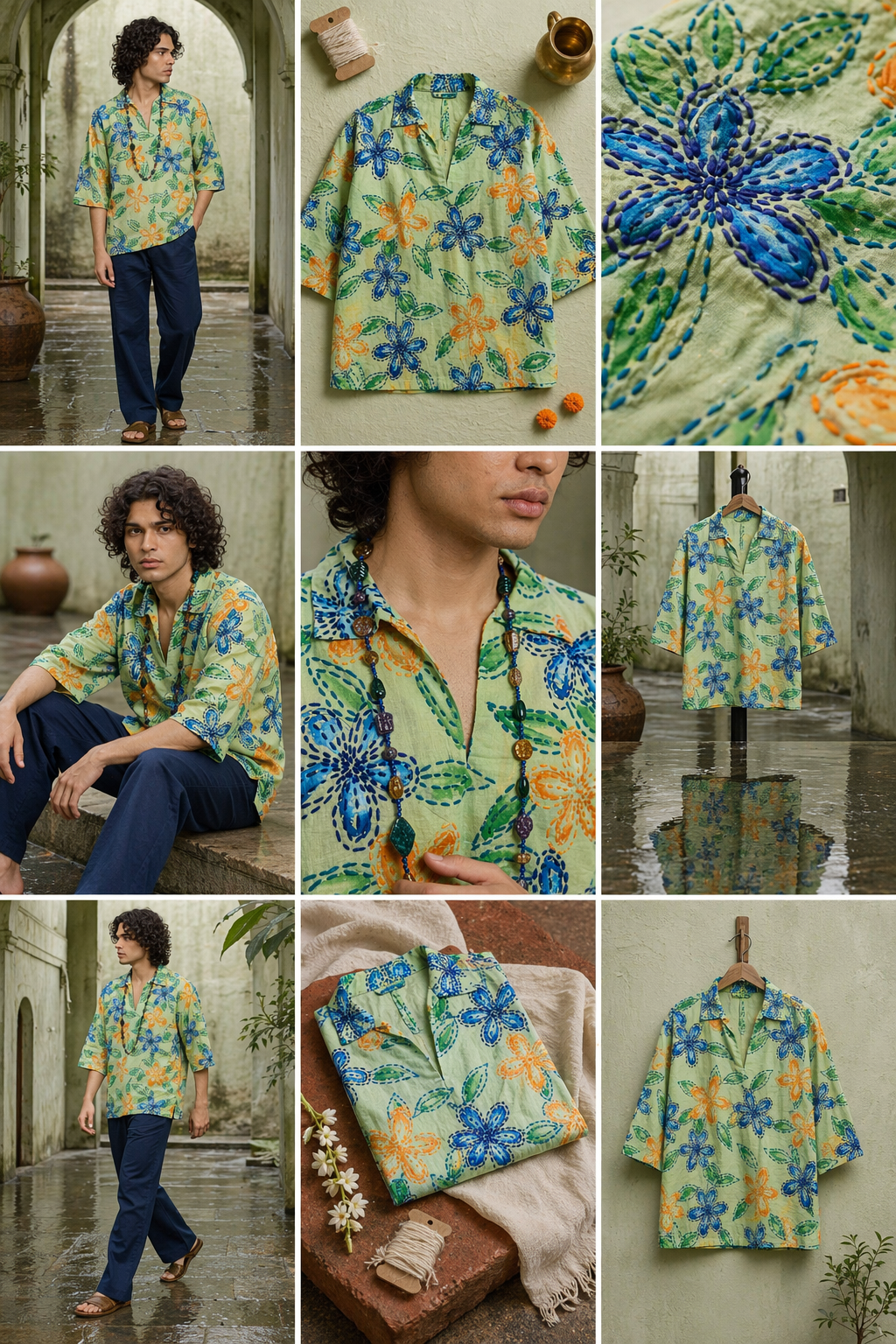
Nine angles of one shirt, generated from a single product page. The macro panel is the one that matters commercially: it shows the raised hand-stitch embroidery clearly enough that a buyer understands what they are paying for, which is the difference between a considered purchase and a speculative one they will send back.
What "creative automation" actually means for a fashion D2C brand
Fashion brands ask for creative automation more than any other category, for an obvious structural reason: the catalogue turns over constantly. A skincare brand might launch four SKUs a year. A fashion brand drops a collection, and every style needs its own creative in multiple angles, sizes and placements, then gets replaced next season.
The term covers three quite different products, though, and buying the wrong one is the usual disappointment.
| What it is | What it actually does | Fits a fashion brand when |
|---|---|---|
| Template automation | Applies your layouts and overlays across a product feed at scale (price badges, sale flags, new-in tags) | You already have good photography for every SKU and need it merchandised fast |
| Feed-driven dynamic ads | Assembles ads from your catalogue feed automatically at serve time | Your catalogue is large and your bottleneck is coverage, not quality |
| URL-to-creative generation | Reads the product page and generates the imagery and the ads themselves | You do not have photography for every SKU, or shoots are the bottleneck |
Most fashion brands asking for "creative automation software" discover the constraint is upstream of automation entirely. Templates cannot save you if you have no photograph of the new colourway. Feed ads cannot save you if the feed points at one flat product shot. The bottleneck is usually production, not assembly.
A practical workflow for an apparel brand
- Start from the product page, not a prompt. Your page already contains the true colourway, the fabric composition, the construction notes and the styling intent. A prompt makes a model guess at all four.
- Generate the coverage set before the hero. Get the angle grid first. It is what protects your return rate, and the hero often emerges from it.
- Check fidelity before you check beauty. Colour against your dye reference, texture against a real macro, construction details against the sample. Reject on fidelity even when the image is lovely.
- Then split by angle, not by aesthetic. One statement ad, one editorial, one detail or construction ad, one social-proof or fit-focused ad. Four genuinely different arguments beat four recolours of the same one.
- Animate the winners. Motion belongs on creatives that have already proven they convert, not on everything.
- Read returns as a creative metric. If a style returns above your baseline, look at its ad before you look at its pattern.
Where LocalAds fits
LocalAds reads your product page and builds the strategy first: audiences, angles, offer frames and hooks, then renders each branch as a finished creative. For fashion that ordering matters, because the fabric, colourway and construction details come off your real page rather than from a prompt, and because a losing ad tells you which argument failed rather than just which image lost.
All the images in this post are real output, generated from product URLs for Retro Louve, Kritika Murarka and 5feet11. The same engine produces the nine-angle coverage set, product photography, animate-to-video versions of any static, and 30-second creator-led UGC video ads, so a garment looks like the same garment across every format instead of drifting between three different tools.
Where it is not the right fit: if you want to cast a specific recurring presenter from a roster of named stock avatars, an avatar-first tool like Creatify is built for that and this is not.
FAQ
What are the best AI ad creatives for fashion brands? The ones that stay faithful to fabric, colourway and construction, because in apparel an inaccurate ad converts and then comes back as a return. Judge AI fashion creative on fidelity first: sheer fabric that reads sheer, colour that matches your dye reference, and visible seams and stitching. Beauty is the second test, not the first.
Can AI generate ad creatives for clothing accurately? Yes, if the generation is anchored to your real product page and imagery rather than to a text prompt. Prompt-only tools guess at drape, sheen and colour, which is where apparel output usually falls apart. Tools that read the product URL keep the true colourway and construction because they are working from your actual assets.
What is the best creative automation software for fashion D2C brands? It depends which bottleneck you have. If you already hold good photography for every SKU, template automation or feed-driven dynamic ads will merchandise it fastest. If your constraint is that new styles have no photography yet, template tools cannot help you and you want URL-to-creative generation, which produces the imagery as well as the ads.
How many creatives does a fashion brand need per style? Plan for a coverage set rather than a single hero: on-model, flat lay, macro texture, hanger and folded, plus at least four distinct angle-led ads for testing. The coverage set is what reduces returns, and the angle set is what tells you which argument sells the style.
Does AI ad creative help reduce apparel returns? It can, but only if you use it for coverage. Returns fall when buyers can see fit, true colour and fabric texture before ordering, so generating a full angle set per style helps. Generating one flattering hero shot that overstates the garment does the opposite.
The takeaway
Fashion is the category where creative accuracy has a direct line to margin. The ad does not just win the click, it sets an expectation that a parcel has to meet a few days later. Generic AI ad tools optimise for the click and leave the parcel to you.
Judge apparel creative on fabric, colour and construction first. Generate the coverage set before the hero. Split your tests by argument rather than by aesthetic. Do that, and AI stops being a way to make more images and starts being a way to sell more garments that stay sold.
Related reading: