On this page
In most categories the packaging is a container. In beverage, the packaging is the entire brand asset. Nobody has ever bought a soda because of the liquid inside; they bought the can.
That makes beverage the hardest category for AI ad creative, and for a reason that has nothing to do with aesthetics. A can is not a texture to be approximated. It is a dense piece of typographic design that also happens to be a regulated document, carrying net contents, a statement of identity, and nutrient content claims that are governed by law. When a generative model renders your can, it is re-typesetting all of that from memory.
Get it slightly wrong on a leather bag and you have an inaccurate product shot. Get it slightly wrong on a can and you may have published a nutrition claim your product does not support.
This post shows what good looks like with real generated ads for OLIPOP and Liquid Death, and is specific about where this category still breaks.
The label is a legal document, not a decoration
Under 21 CFR 101.13, nutrient content claims on a food or beverage label are tightly constrained. Some of the rules are exactly the kind a generative model has no concept of. One example: a nutrient content claim must be in type no larger than twice the size of the statement of identity, and must not be unduly prominent in type style beside it. A model rendering a "9g FIBER" flash bigger and bolder than the product name has not made a design choice, it has made a compliance problem.
The failure modes that actually matter, in order of how much trouble they cause:
- Invented claims. The model adds "Boosts Metabolism" or "Supports Immunity" because cans like yours often say things like that. This is the serious one.
- Altered numbers.
5g of sugar per canbecomes0g.12 fl ozbecomes16 fl oz. Small pixel changes, large consequences. - Dropped mandatory text. Net contents or the statement of identity quietly disappears in a tighter crop.
- Garbled fine print. The ingredient strip turns into convincing-looking nonsense.
Only the fourth is merely embarrassing. The first three are the reason beverage creative needs a different review process than apparel or homeware.
What accurate beverage creative looks like
The cover image on this post is the baseline case: a clean product hero where every piece of label text survives.
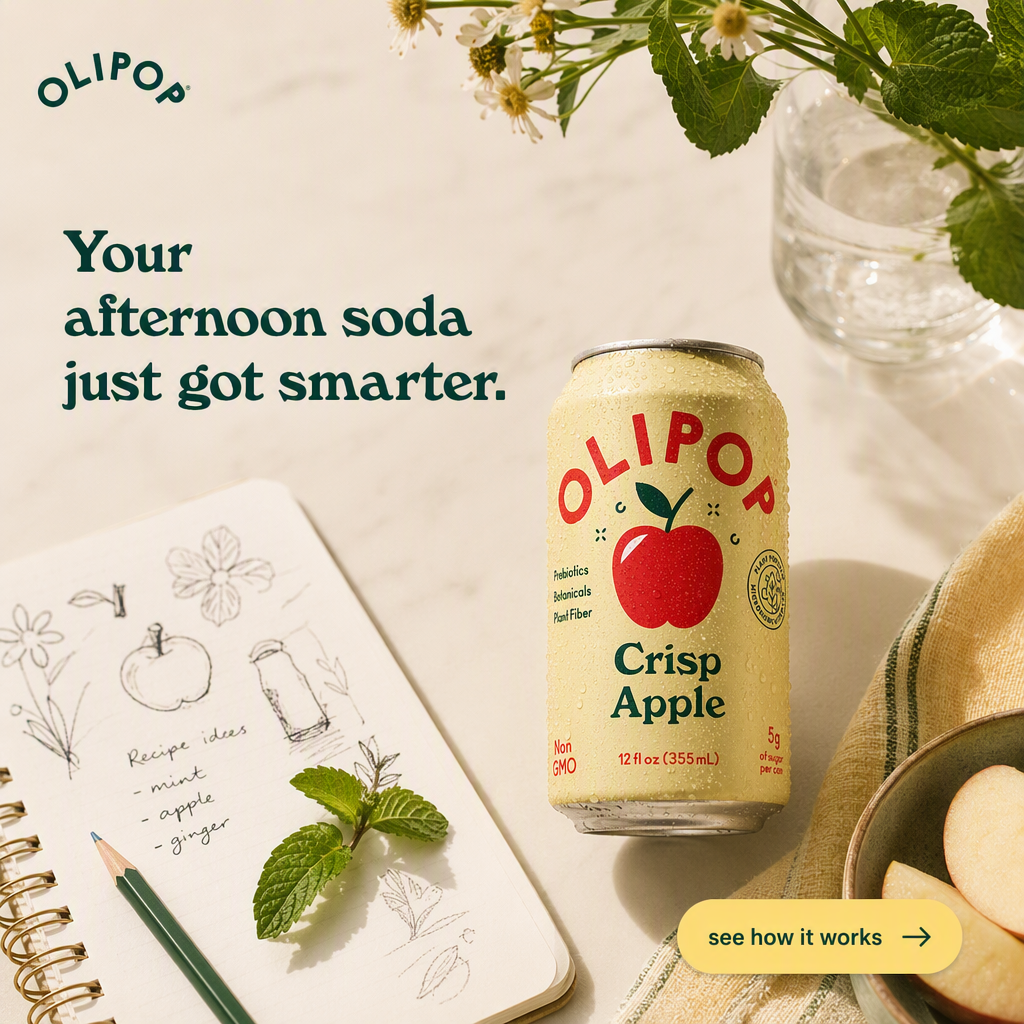
Generated for OLIPOP's Crisp Apple from the product page. Read the can rather than the scene: "Prebiotics / Botanicals / Plant Fiber" down the left, "Non GMO", "12 fl oz (355 mL)" and "5g of sugar per can" all present and correct, at the relative type sizes they hold on the real can. That last number is the one to check every single time, because it is both the product's main selling point and a regulated claim.
Beverage also supports a creative format that most categories do not: the arithmetic ad. Functional drinks are bought on a comparison, so showing the comparison directly tends to outperform showing the lifestyle.
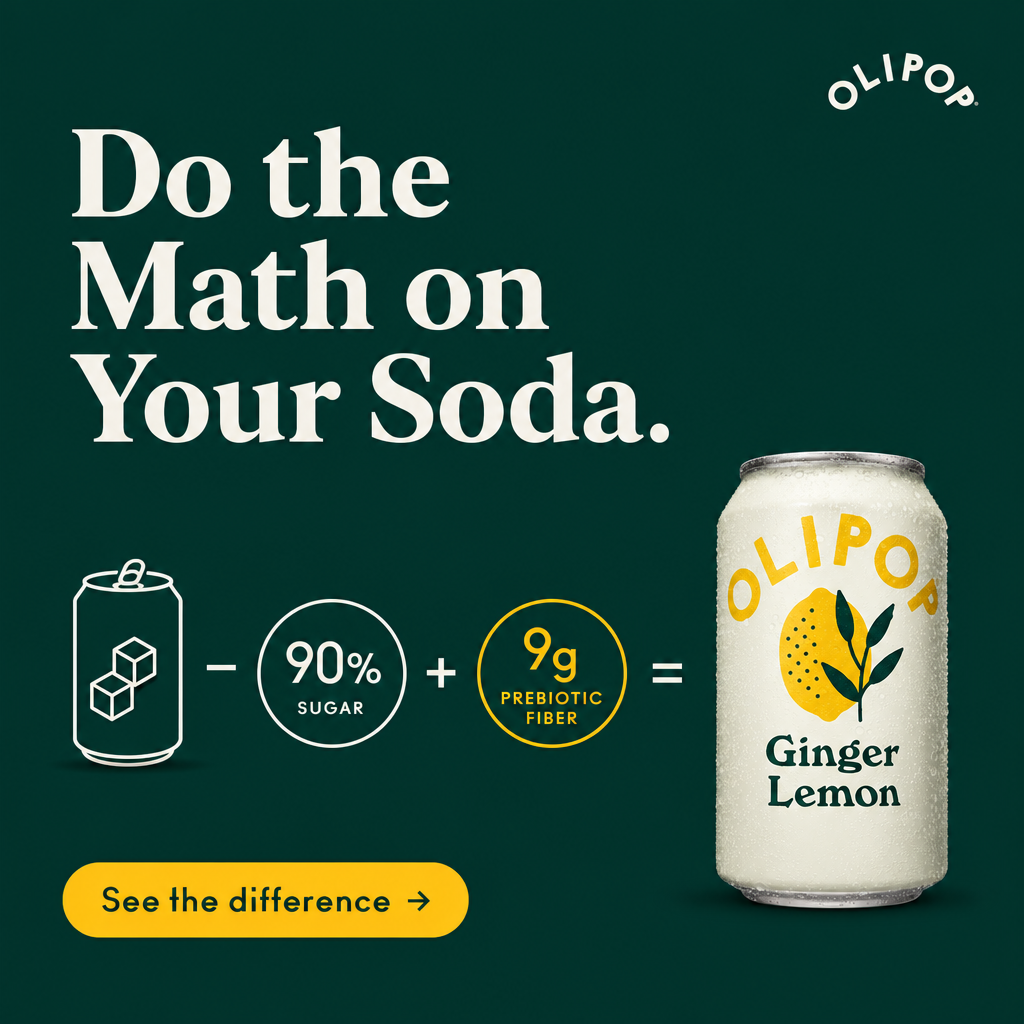
Generated for OLIPOP Ginger Lemon. This is the highest-converting shape in functional beverage and also the highest-risk, because it puts two numbers in large type. Before this runs, someone has to confirm that both the 90% and the 9g are claims the brand can substantiate against the specific comparison implied. The creative tool produces the layout. It cannot produce the evidence.
And where the brand voice is the product, the creative has to carry tone rather than information.
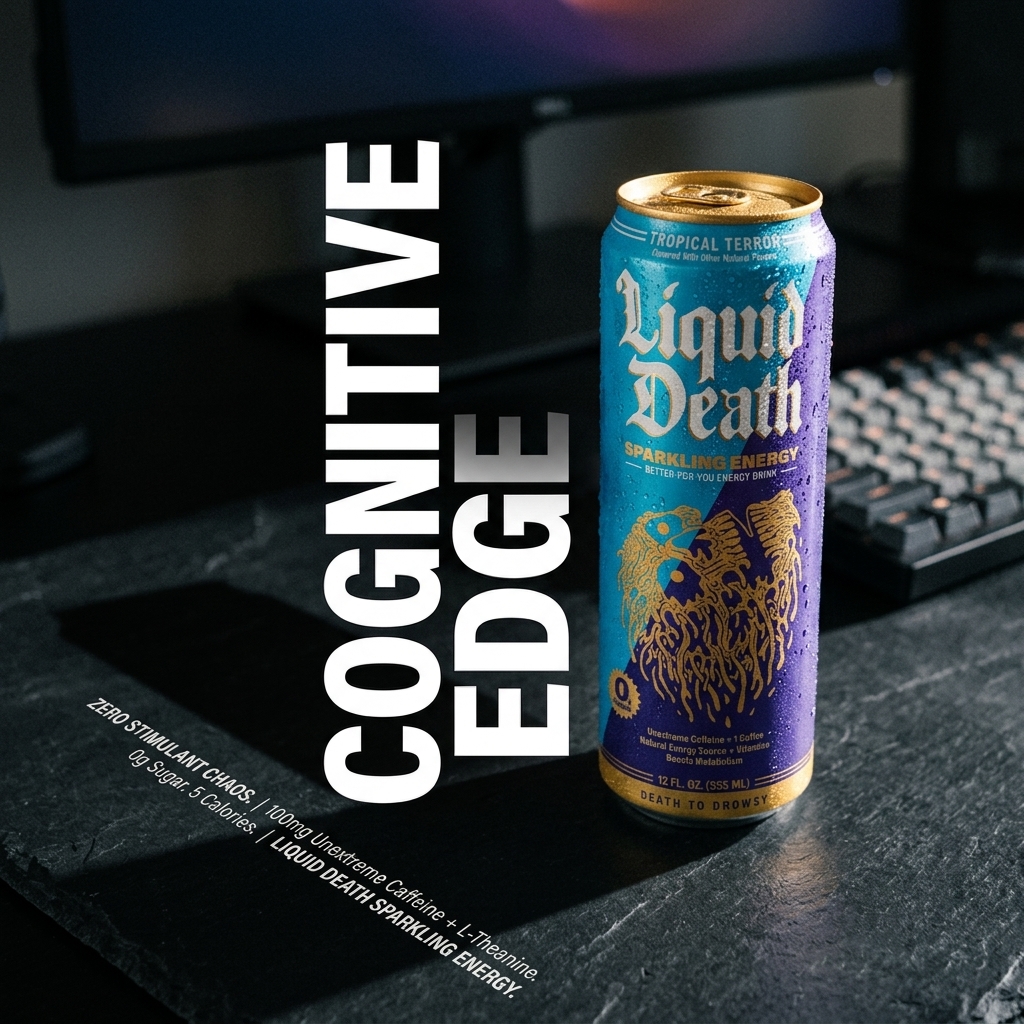
Generated for Liquid Death's Tropical Terror Sparkling Energy. The blackletter wordmark, the gold foil eagle artwork and the "12 FL. OZ. (355 ML)" line all hold, and the desk setting matches the energy-drink occasion. Now the honest part: zoom into the small print band on the can and it softens into approximations. That is the normal failure boundary in this category, and it is why the review rule below is worth following literally.
The review rule for beverage creative
Zoom to 100% and read every word on the pack. Not scan, read.
If a word on the can did not come off the real product page, it does not run. That single rule catches all four failure modes above, takes under a minute per creative, and is the difference between a category where AI creative is a liability and one where it is a large advantage.
A practical corollary: crop tighter rather than accept soft fine print. A hero crop that shows the wordmark, flavour and one clean claim at full legibility beats a full-can shot with a mushy ingredient strip. The mushy strip is what a careful buyer zooms into.
The cooler test
Beverage has a purchase moment almost no other D2C category has: a person standing at a cooler door with roughly two seconds to find you among forty competitors. Creative that ignores this is leaving the category's best angle on the table.
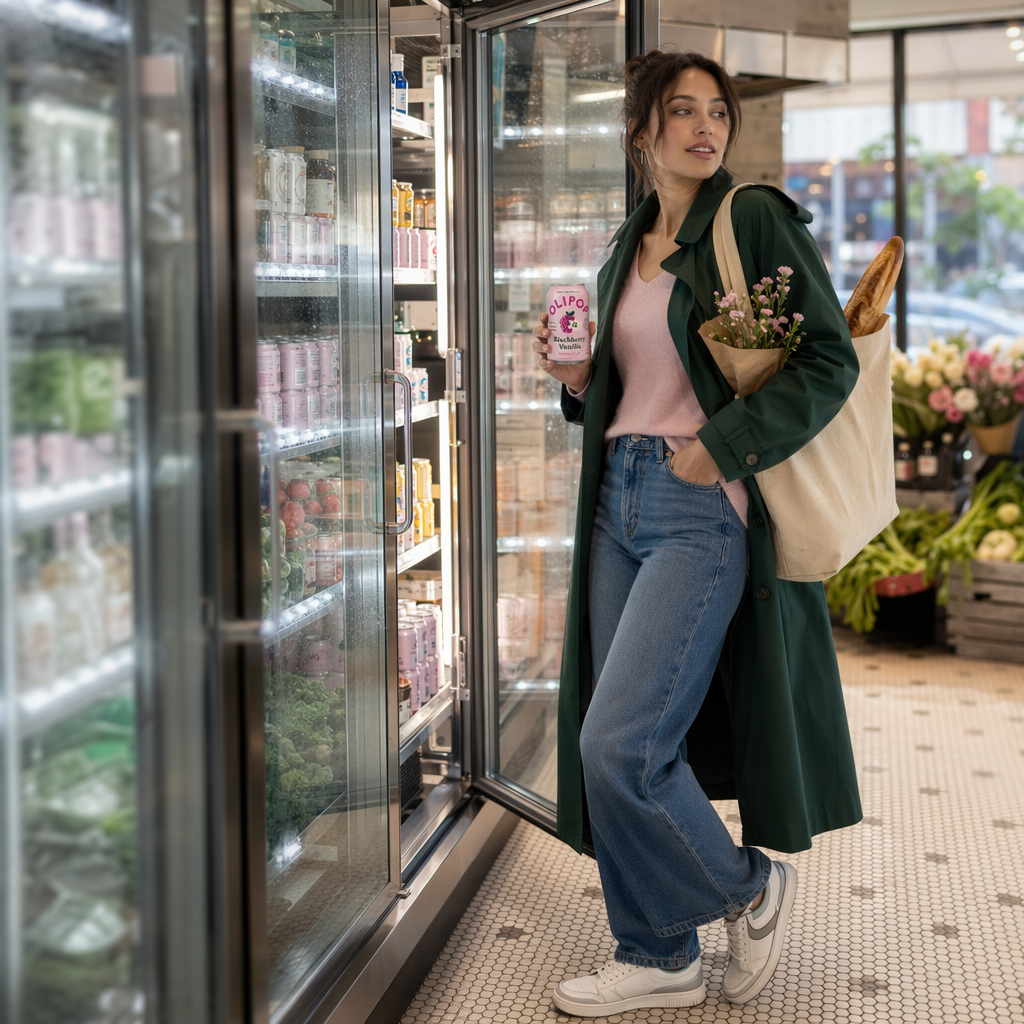
Generated for OLIPOP Blackberry Vanilla. The scene does a specific job: it shows the can where the decision actually happens, in the cooler, in the hand, against the competition. Note the trade-off it makes, though. At this distance the label goes soft, so this is a brand and occasion ad rather than a claims ad. Run it as the top of the set and let the hero crops carry the specifics.
Build the set around the moment rather than around the SKU:
| Angle | What it does | Where it runs |
|---|---|---|
| Product hero | Establishes the can, carries one clean claim | Prospecting, always-on |
| The arithmetic ad | Wins the comparison against legacy soda | Cold traffic, conversion |
| Occasion or cooler | Places the drink in a real moment | Top of funnel, brand |
| Multipack or value | Shifts from trial to stock-up | Retargeting, subscription |
| Flavour range | Solves "which one do I start with" | Retargeting |
Running the same can in another language
One quiet advantage in beverage: the can is the constant. The typography, colour and artwork carry the brand, so a creative can move markets by changing only the headline layer.
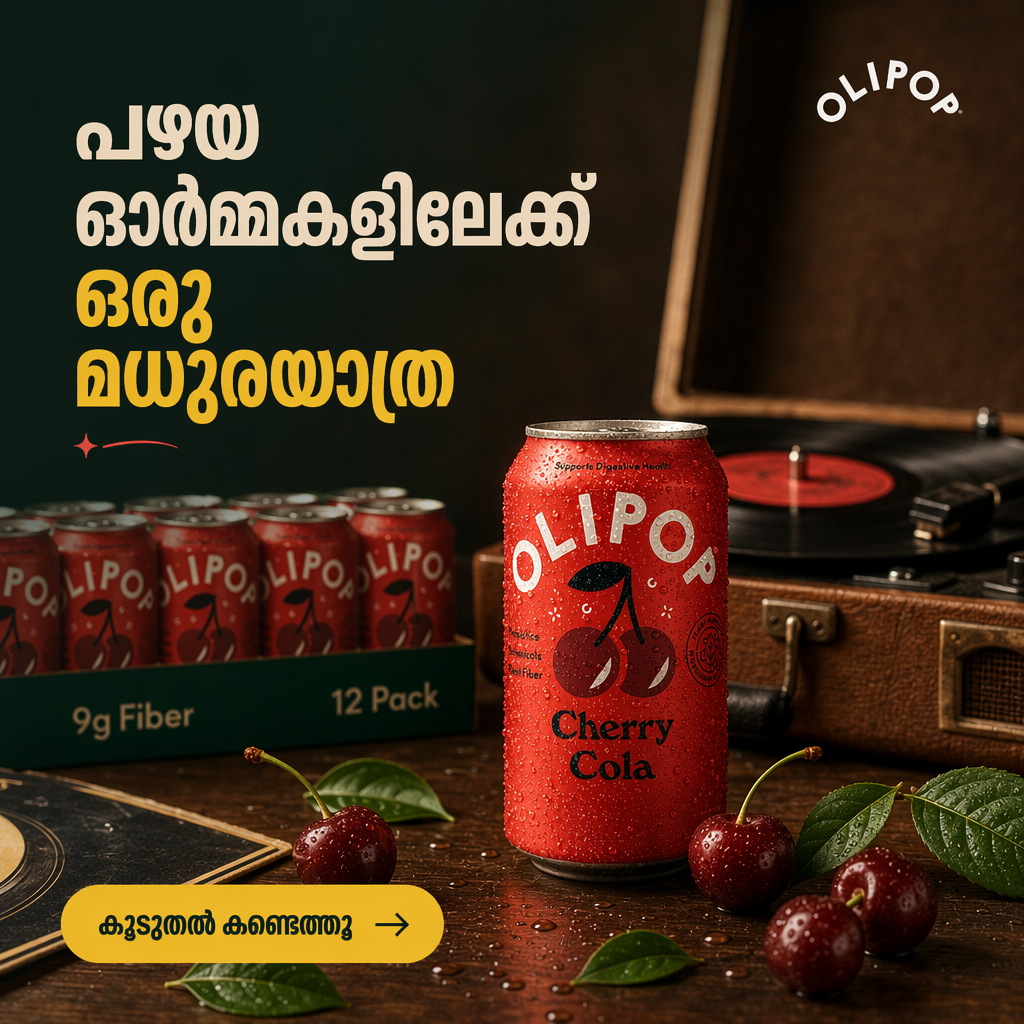
Generated for OLIPOP Cherry Cola with Malayalam headline and CTA copy. The English regulated text stays on the can where it belongs, including "Supports Digestive Health" on the rim and "9g Fiber" on the case, while the persuasion layer is fully localised. That split, localised headline over an unchanged pack, is the right pattern for any market. We go deeper on localisation pitfalls in AI ad creatives for German and DACH brands.
A workflow for a beverage brand
- Generate from the product page. The page holds the real flavour name, net contents, sugar figure and claim set. A prompt makes the model guess at all of them, which is where invented claims come from.
- Lead with hero crops. Get two or three tight, fully legible product heroes before any lifestyle work. They are the ones that have to be exactly right.
- Read every word at 100%. The one-minute rule above. Reject on a single wrong character.
- Route numeric claims through whoever owns substantiation. If a creative puts a number in large type, it needs the same sign-off the pack got.
- Then go wide on occasion. Cooler, desk, picnic, post-gym. Soft labels are acceptable here because the claims live in the hero set.
- Animate the winners. Condensation, carbonation and light on aluminium are among the best things image-to-video does, and beverage benefits from motion more than most categories.
Where LocalAds fits
LocalAds reads your product page and builds the strategy before the image: audiences, angles and hooks, then renders each one. For beverage the useful part is that the flavour name, net contents, sugar figure and claim language come off your real page rather than from a prompt, which removes the most common source of invented label text.
Every image in this post is real output generated from product URLs for OLIPOP and Liquid Death, including the Liquid Death example where the fine print softens, because showing only the wins would make this post useless as a buying guide.
The same engine animates any static into video and generates 30-second creator-led UGC video ads from the same page, which matters in a category where condensation and pour shots carry so much of the appetite appeal.
FAQ
Can AI generate accurate ad creatives for beverage cans and bottles? Yes, with one discipline: generate from the real product page and then read every word on the pack at full zoom before running it. Beverage packaging is dense regulated typography, so the risk is not an ugly image, it is an invented claim or an altered number. Tools that work from your product URL drift far less than prompt-only tools, because the claim language comes from your page rather than from the model's idea of what cans say.
What usually goes wrong with AI-generated beverage ads? Four things, in descending order of seriousness: invented claims the product does not support, altered numbers like sugar content or net contents, dropped mandatory label text, and garbled fine print. Only the last is merely cosmetic. This is why beverage needs a stricter creative review than most D2C categories.
What ad creative works best for functional beverage brands? The comparison, or "do the math", format tends to outperform lifestyle for cold traffic, because functional drinks are bought as a substitution for something else. Pair it with tight product heroes that carry one clean claim each, and use cooler and occasion scenes for top of funnel where label legibility matters less.
How many creatives does a beverage brand need per SKU? Plan for a small hero set per flavour, two or three tight crops that are fully legible, plus occasion and multipack angles shared across the range. Flavour ranges multiply fast, so the practical constraint is usually review capacity rather than generation capacity.
Is AI ad creative safe for regulated food and drink claims? The imagery is safe; the claims are your responsibility, exactly as they are on the pack itself. Nutrient content claims are governed by FDA regulation and marketing claims by the FTC, and no generation tool can substantiate a number for you. Treat any creative that puts a figure in large type as needing the same sign-off the label got.
The takeaway
Beverage rewards AI creative more than almost any category, because the catalogue is flavour-wide, the refresh cadence is fast, and the product photographs beautifully. It also punishes carelessness harder, because the pack is a regulated document and the model is re-typesetting it every time.
Generate from the page. Lead with legible hero crops. Read every word at 100%. Send numbers to whoever owns the evidence. Do that and the category's difficulty becomes your advantage, because most of your competitors will not.
Related reading: