On this page
Last checked: 29 October 2026. ChatGPT Ads go into 2027 as a real channel rather than a test: 89 countries, more than 100,000 advertisers, three ways to bid, product feed campaigns and a Shopify app. OpenAI has told investors to expect about $11 billion in ad revenue in 2027, more than four times its 2026 projection, and its latest announcement promises "additional formats, objectives, buying options, and measurement capabilities" without dates. For brands, that means more competition in the auction, more ad surfaces than the single Sponsored card, and a creative format that is still small, square and easy to get wrong.
LocalAds is not an OpenAI partner and does not place ads. We make the creative brands upload, so this is written from the creative side. Our running log of every change is the ChatGPT Ads guide.
Where ChatGPT Ads stand going into 2027
The channel went from a closed US test to 89 countries in eight months.
| Date (2026) | Change |
|---|---|
| 9 February | US test starts for Free and Go users, sold on CPM to a small group of advertisers |
| 5 May | Self-serve Ads Manager in the US, with cost-per-click bidding |
| 5 June | Conversion-optimised (cost-per-acquisition) bidding, as reported by trackers |
| 11 June | Product feed ads enter the Ads Manager beta |
| August | UK, Japan, South Korea, Brazil and Mexico |
| 31 August | OpenAI reports a $1 billion annualised run rate in under 200 days |
| 2 September | Europe, India and the Middle East and North Africa open to self-serve |
| 16 September | Shopify app for US merchants, and a Sponsored Agents test |
| 23 September | South-East Asia and Taiwan |
| 5 October | Image ads shown next to ChatGPT image generation, US test |
| 21 October | 26 more countries, 89 in total; 100,000+ advertisers since launch |
Sources: PPC Land on the 21 October expansion, Digital Applied's dated market ledger and the TechCrunch report on visual ads. Of the 26 countries added on 21 October, OpenAI named only 11: Argentina, Chile, Colombia, Peru, Nigeria, South Africa, Serbia, Ukraine, Cambodia, Bangladesh and Pakistan.
India deserves its own line, because that is where many of our customers sell. Ads went live in India on 27 August with around 50 launch brands, and self-serve followed in early September with a minimum daily budget of ₹725 (Quartz via Yahoo Finance, 28 August 2026). Our ChatGPT Ads India guide covers setup.
What OpenAI has said about 2027
Very little that is dated. Three signals are worth reading:
- The revenue target. OpenAI told investors to expect $2.5 billion in ad revenue in 2026, $11 billion in 2027 and $100 billion by 2030 (Reuters via Yahoo Finance, 9 April 2026). Analysts are sceptical of the long-range number, but the near-term direction is clear: far more ads in 2027 than in 2026.
- The roadmap sentence. The 21 October post says the next phase "will include the development of additional formats, objectives, buying options, and measurement capabilities." No timeline.
- The tests already running. Image ads during image generation and Sponsored Agents are both live tests in the US. Tests in 2026 have tended to become products within a few months.
Seven changes to plan for
These are our expectations for 2027, each tied to something that has already happened. Treat them as planning assumptions, not announcements.
1. A busier, pricier auction
Four times the revenue target means far more advertisers bidding for the same conversations. Prices are already high for some: in October, the measurement firm Measured told Modern Retail that ChatGPT's cost per click was running at about six times Google's, with results it called "pretty bad" for a new platform (Modern Retail, 9 October 2026). Expect relevance, which in a Sponsored card mostly means the square image and the 48-character line, to decide who pays less.
2. More visual surfaces than the Sponsored card
The 5 October test puts ads beside images people ask ChatGPT to generate. That is the first ChatGPT placement where the creative is the main event rather than a thumbnail under an answer. Specs were not published at launch, so keep high-resolution, text-free product squares on hand.
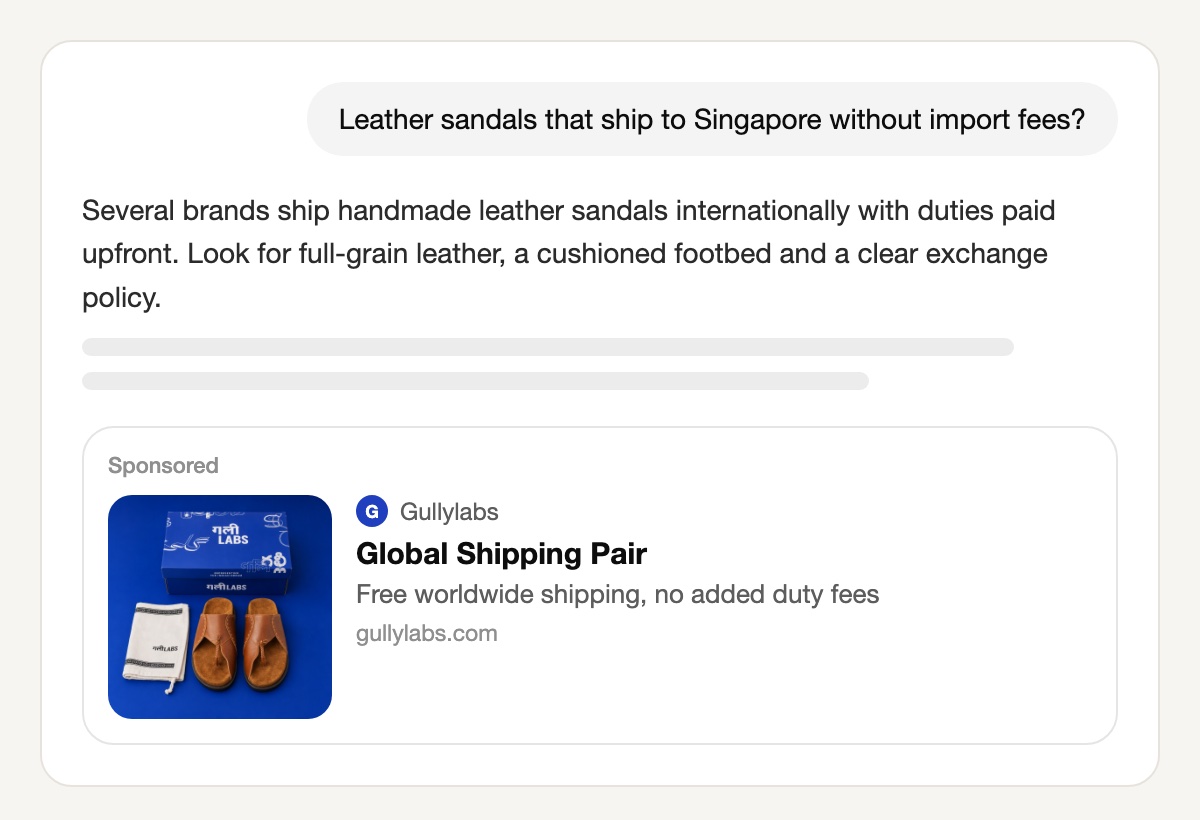
The conversation is a mockup; the square, title and copy are unedited LocalAds output for Gullylabs.
3. Agents that talk for your brand
In the Sponsored Agents test, a user who clicks an ad can open a separate, labelled conversation with the advertiser's own AI agent. If that ships widely, the ad becomes the start of a sales conversation. The brands ready for it will have clean product facts, sizing, shipping and returns written somewhere an agent can read.
4. Shopping gets deeper
Product feed campaigns, the Shopify app, bulk campaign creation from a feed sheet and a virtual try-on button for clothing all arrived in the second half of 2026. In feed-driven ads your product photos are the creative, so a catalogue of plain packshots will compete against brands with clean lifestyle squares. See ChatGPT shopping ads and product feeds.
5. Measurement grows up
Conversion bidding, a pixel, and brand-suitability pilots with DoubleVerify and IAS announced in October mean ChatGPT Ads can be judged on the same terms as Meta and Google in 2027. That also removes the excuse for running it without a clear test plan.
6. Ads inside AI answers become a category
ChatGPT is no longer alone. Google expanded ads in AI Mode to India, Australia, Canada, Singapore and six other markets on 28 October 2026, and launched ads in follow-up questions in the US (Google). Google says AI Mode queries are about three times longer than classic searches. Creative that answers a specific question will travel across both.
7. More markets, unevenly
The 89-country list still leaves out large parts of Latin America, Africa and Central Asia, and new accounts in some markets could only target their home country at first. Check the countries list before you plan a cross-border launch.
What does not change: the creative
Whatever new formats arrive, the core Sponsored card in 2026 is a 1:1 square image, a title of 16 to 24 characters, a copy line of 32 to 48 characters, your brand name, a favicon and a landing URL. The rules that worked this year will still work:
- No text on the image. The card already shows your title and copy; repeating them in the square makes it unreadable at thumbnail size.
- One product, one clear subject. The square is small. A single product on a strong colour beats a busy lifestyle scene.
- One ad group per conversation. Gifting questions, comparison questions and problem questions need different squares and different lines.
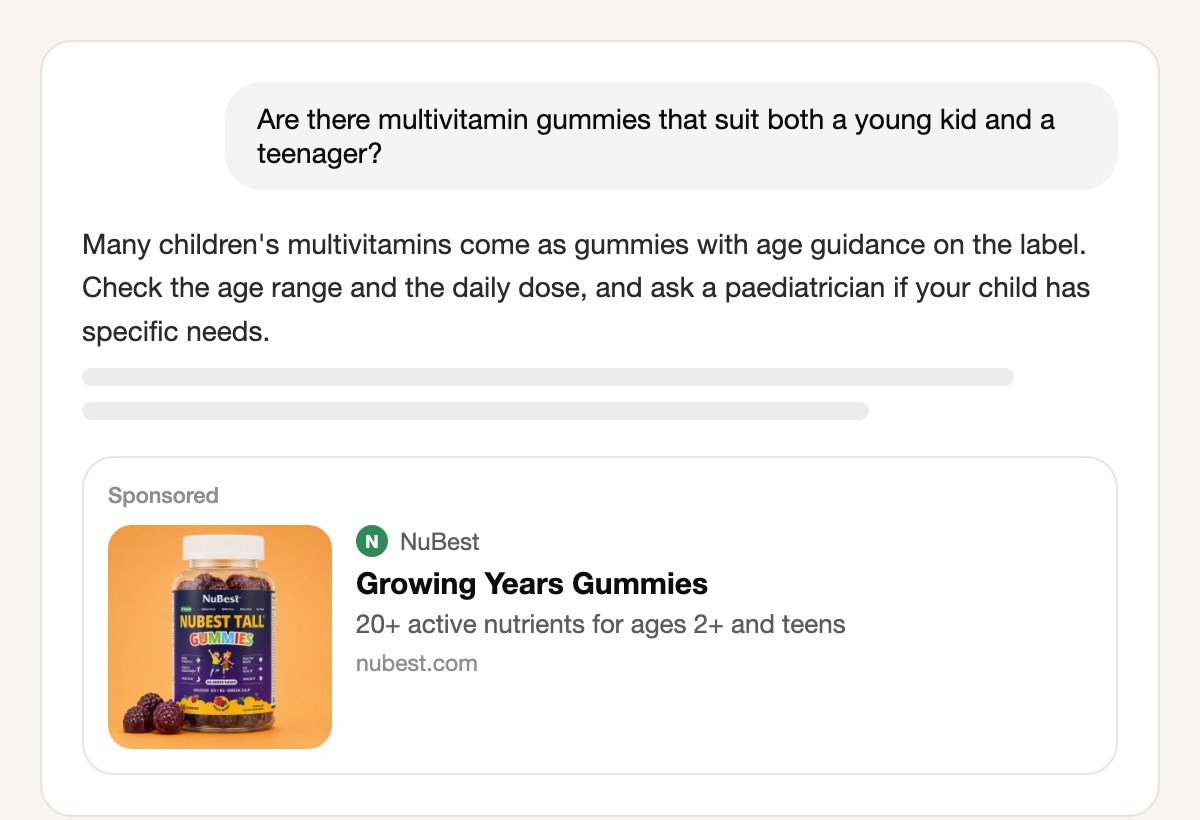
Mockup conversation, real LocalAds creative. The line answers the exact question (a young child and a teenager) instead of repeating the brand slogan.
Full specs and examples: ChatGPT ad specs.
A Q1 2027 checklist
| Do this | Why |
|---|---|
| Write down what you learned from Q4 2026, even if you did not run ChatGPT Ads | Your Meta and Google search terms show which questions people ask before buying |
| Build three ad groups around real questions: gifting, comparison, problem | Each needs its own square and copy line |
| Make a library of clean, text-free 1:1 squares for every hero product | Feed ads, image-generation ads and Sponsored cards all reuse them |
| Install the pixel or the Shopify app before you spend | Conversion bidding needs data to learn from |
| Set a fixed test budget and a success metric in advance | CPCs are high; decide what "worked" means before you look |
| Write product facts an agent can use: sizes, shipping, returns, ingredients | Ready for Sponsored Agents if they roll out |
| Plan your 2027 moments | See our 2027 ecommerce marketing calendar |
FAQ
Will ChatGPT have more ads in 2027? Almost certainly. OpenAI told investors it expects about $11 billion of ad revenue in 2027, up from $2.5 billion projected for 2026, and it has said new formats, objectives and buying options are coming.
How many countries have ChatGPT Ads? 89, after OpenAI added 26 countries on 21 October 2026. It named 11 of the new markets; the full list is in OpenAI's Ads Manager availability page.
Will ChatGPT have video ads in 2027? Nothing has been announced. The newest format, tested in the US from October 2026, is image ads shown next to ChatGPT's image generation. Video is a reasonable guess for later, but plan around squares for now.
What are Sponsored Agents in ChatGPT? A US test from September 2026 in which a user who clicks an ad can open a separate, labelled conversation with the advertiser's own AI agent, rather than going straight to a website.
Are ChatGPT Ads worth it in 2027? For brands whose customers research before buying, they are worth a capped test with a pixel installed and a success metric set in advance. Early reports put cost per click well above Google's, so do not move core budget until your own results justify it.
How do I prepare creative for ChatGPT Ads? Make clean 1:1 product squares without text, write titles of 16 to 24 characters and copy lines of 32 to 48 characters, and build a separate ad group for each type of question your buyers ask.