On this page
Last checked: 6 November 2026. On 28 October 2026 Meta published the next generation of Andromeda, the system that decides which ads are even considered for each person on Facebook and Instagram. The industry is calling it Andromeda 2.0. In plain terms: the old version searched a sorted index and skipped whole groups of ads, while the new one scores every eligible ad for every person, reads each person through a panel of specialist models, and pays attention to the order in which people engaged with ads. There is no new setting to turn on. What changes is what your creative has to do.
This guide is written for marketers, not engineers. Every technical idea comes with a picture, and every number is labelled with who said it.
Andromeda 2.0 in 60 seconds
- What it is: the first gate in Meta's ad delivery. It builds a shortlist of ads for each person before the ranking models and the auction pick a winner.
- What changed: it now scores every eligible ad instead of skipping branches of an index, it uses several "expert" models of each person instead of one, and it reads the sequence of ads a person engaged with.
- What Meta claims: over one billion ads scored per second on a single GPU server, 100x the throughput of the 2024 system, roughly 300x less compute per prediction, and a 2.4% lift in Facebook conversions credited to Andromeda since 2025.
- What it is not: an Ads Manager feature, a confirmation of "Entity IDs", or the end of targeting.
- What to do: count ideas instead of ads, run a few genuinely different angles per ad set, plan creative as a sequence, and keep your conversion signal clean.
First: what Andromeda actually does
Every time someone opens Facebook or Instagram, Meta has to pick one ad for each ad slot out of an enormous pool. It does that in stages, because no single model could score hundreds of millions of ads in the few milliseconds a feed has to load.
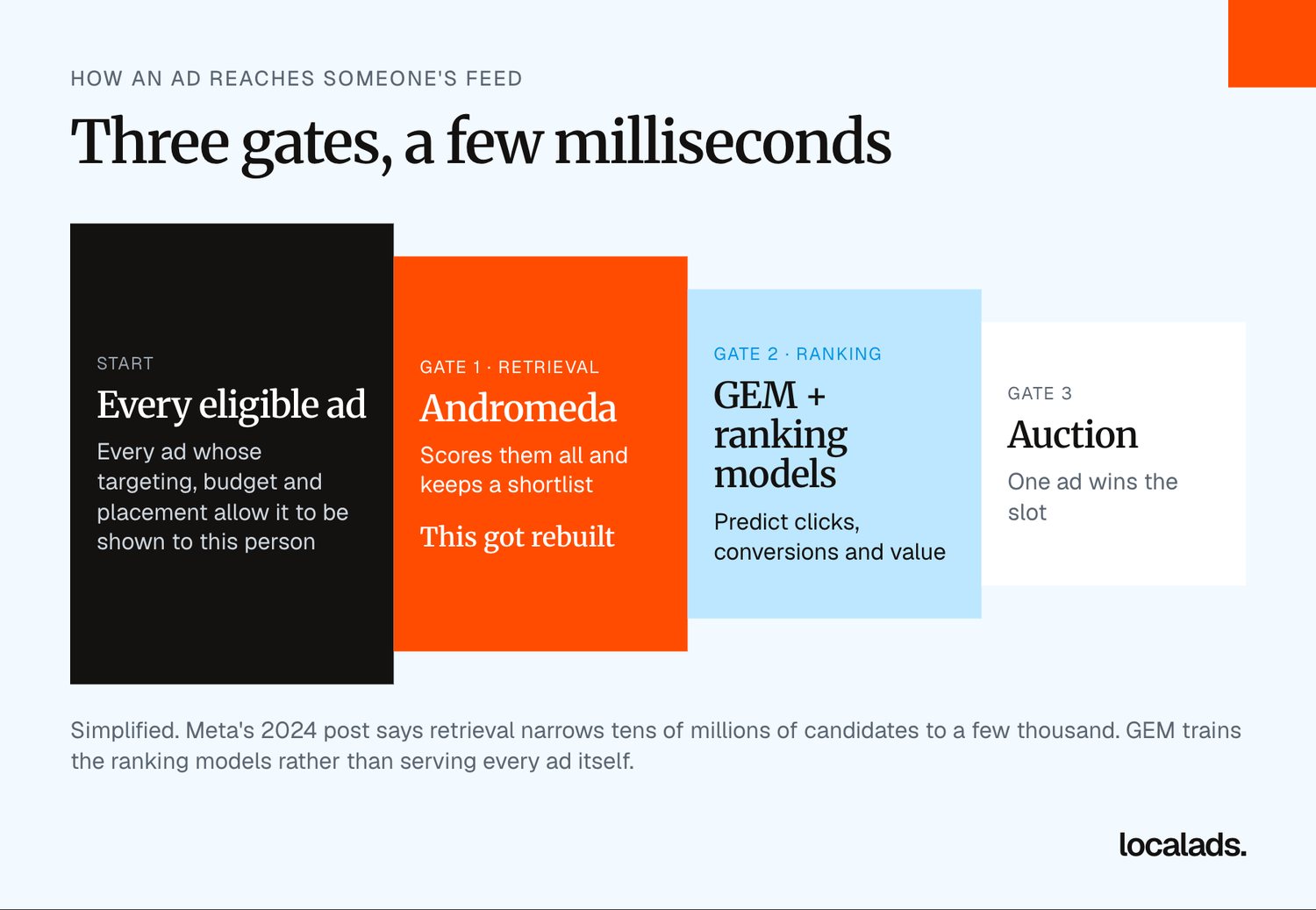
- Retrieval (Andromeda). From every ad that is eligible to reach this person, build a shortlist. Meta's original 2024 post describes this as narrowing tens of millions of candidates to a few thousand.
- Ranking (GEM and the ranking models). Score the shortlist on how likely this person is to click, convert, or create value for the advertiser.
- Auction. Combine those predictions with bids and quality to pick the ad that actually shows.
The practical point is simple: if Andromeda does not shortlist your ad, nothing downstream gets a vote. A brilliant ad that never makes the shortlist for the right people never gets the chance to win. That is why a change to retrieval matters even though you will never see it in Ads Manager.
A quick note on names. "Andromeda 2.0" is the industry's label. Meta's engineering post calls it the next generation of Meta Andromeda. We use "2.0" here because that is what marketers are searching for.
How we got here
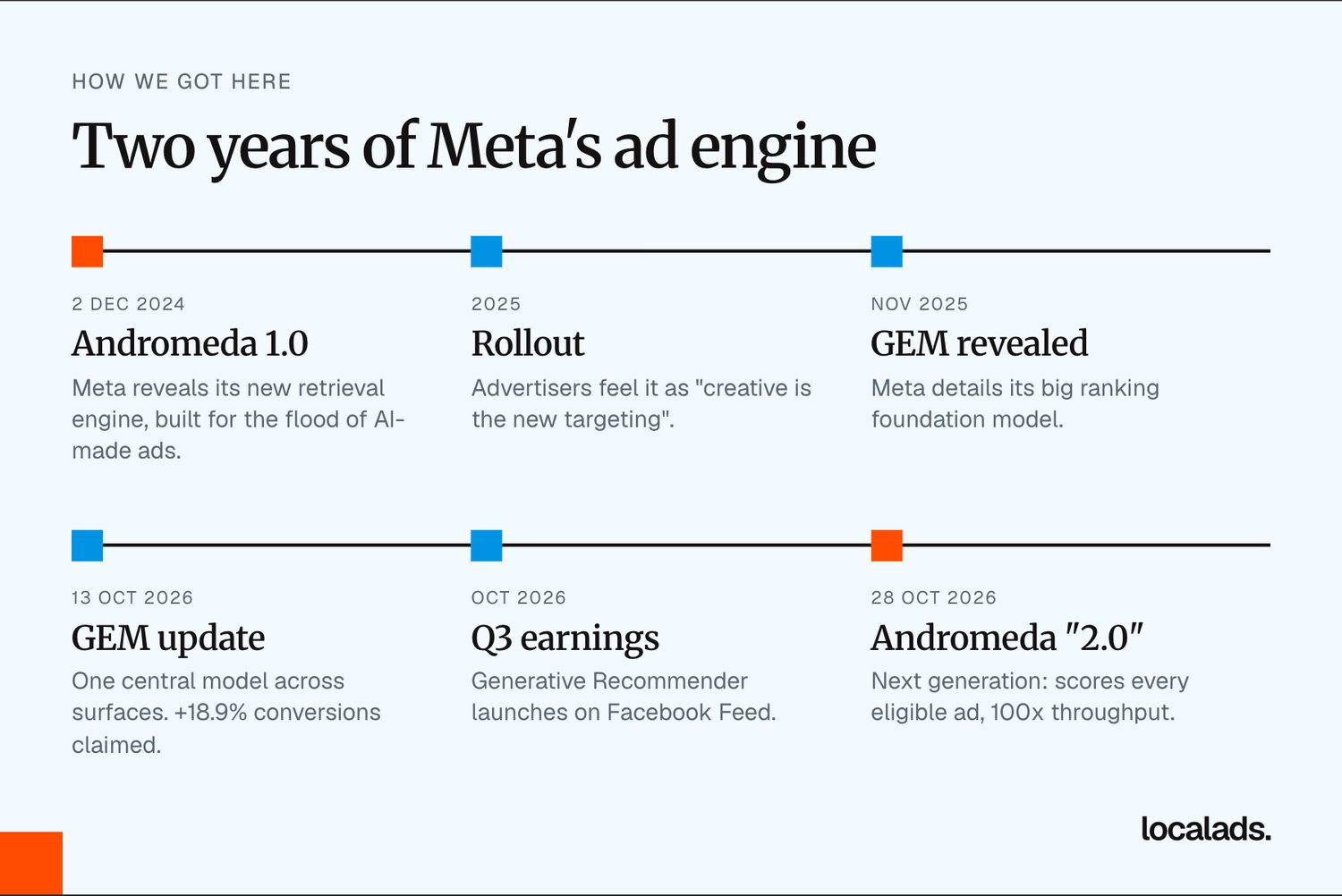
The first Andromeda arrived in December 2024 with a specific job: cope with the flood of ads that generative AI tools and Advantage+ were creating. Meta's 2024 post said it raised model capacity 10,000x and improved retrieval recall by 6%. Through 2025 advertisers felt it as the shift we covered in creative is the targeting: broad audiences, with the creative telling the system who the ad is for.
In October 2026 Meta updated both halves of the engine within a fortnight. On 13 October it published a GEM update for the ranking side. On 28 October it published the new Andromeda for the retrieval side. The 2026 post says the reason is the same as in 2024, only bigger: generative AI creative tools have helped advertisers create "hundreds of millions of new ads", and retrieval had to keep up.
Andromeda 1.0 vs 2.0: what changed
| Andromeda 1.0 (Dec 2024) | Andromeda 2.0 (Oct 2026) | |
|---|---|---|
| How it searches | Walks a hierarchical index of grouped ads and only opens the most promising branches | Scores every eligible ad in the candidate pool |
| How it reads a person | One "user tower" (a single model of the person) | An ensemble of specialist user towers, with a router picking the relevant ones per ad |
| Notable inputs | People and ad data (Meta gave few specifics) | Adds the sequence of ad engagement events, cohort signals, AI-read meaning of content, and cross-app behavior |
| Speed | Tens of millions of ads per second per GPU | Over one billion ads per second per GPU server |
| Compute per prediction | Baseline | About 300x fewer operations |
| Hardware | NVIDIA Grace Hopper and Meta's MTIA chips | NVIDIA GH200, with matching, scoring and shortlisting on one server |
| Business result Meta cites | +6% recall, +8% ads quality on selected segments | +2.4% Facebook conversions since 2025 |
Source: Meta Engineering, 2 December 2024 and 28 October 2026.
Four of those rows matter to a marketer. Here they are in plain English.
Change 1: it reads every ad instead of skipping shelves
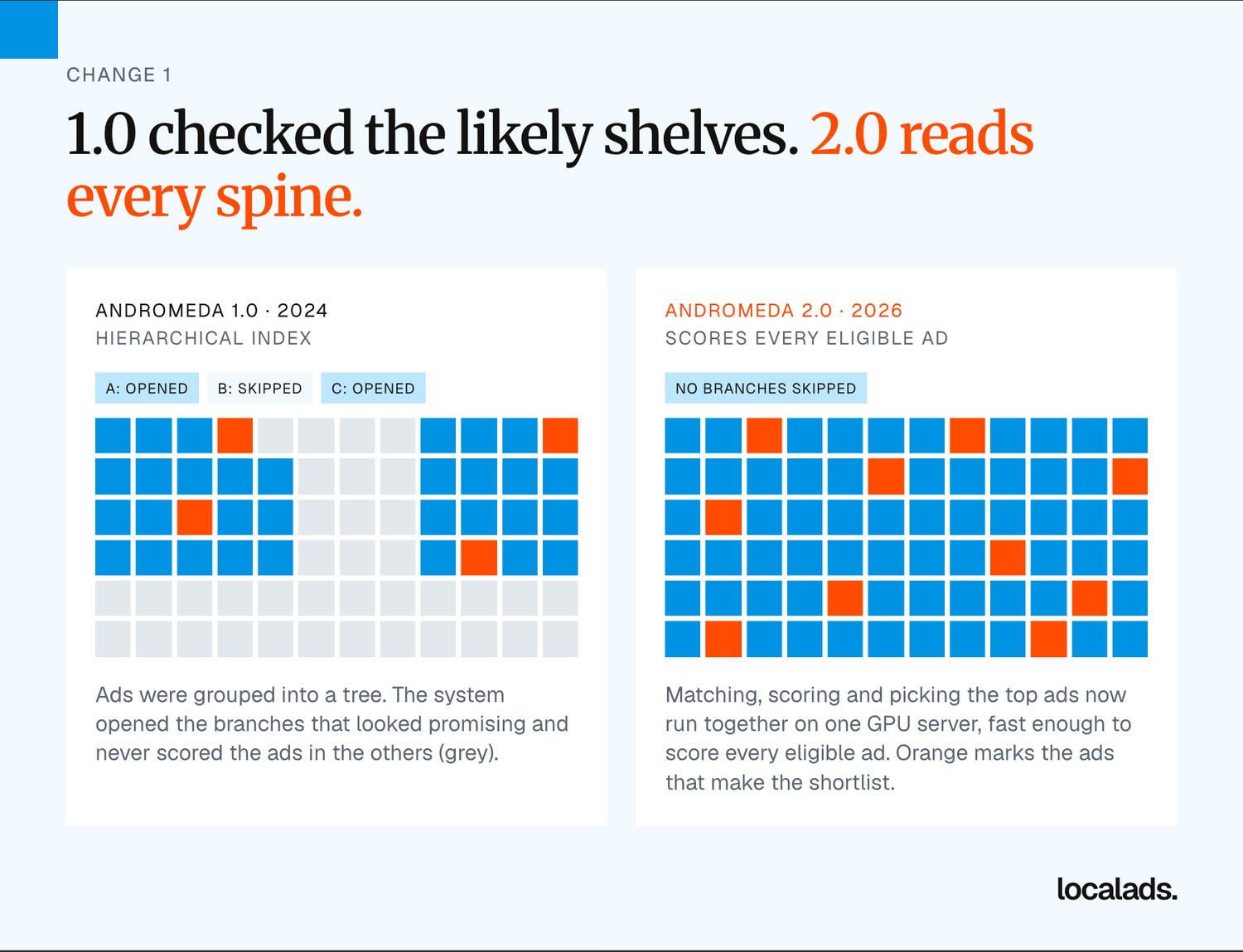
Think of the 2024 system as a librarian who knows roughly where the good books are. Ads were organised into a tree. For each person, Andromeda walked down the branches that looked promising and ignored the rest. That is fast, but it means an ad sitting in a branch that never got opened was never scored for that person at all.
The 2026 system reads every spine on every shelf. Meta's post says that in production it "scores every eligible ad with near ranking-level model performance". It got there by moving the three steps (matching ads against targeting, scoring them, and picking the top ones) onto a single GPU server and fusing them into one piece of code, which cut network traffic by about 100x and let the whole thing run at over a billion ads a second.
What it means for you: a sharp, niche ad is less likely to get lost because it sat in the wrong branch. The flip side is that a weak ad cannot hide behind a lucky grouping either. Each ad now competes on its own merits, for each person, every time.
Change 2: a panel of specialists reads each person
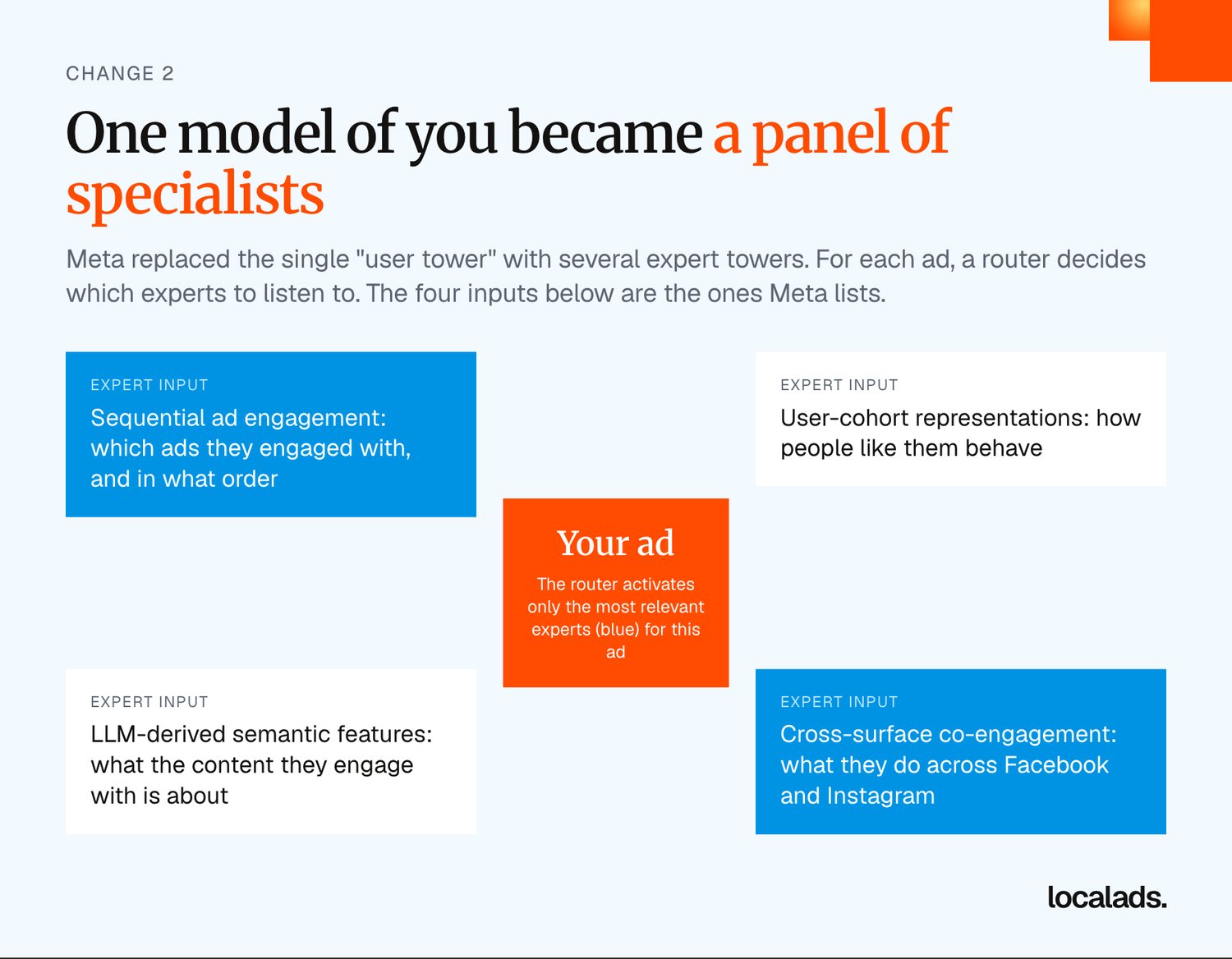
The old Andromeda had one model of each person, which Meta's engineers call a "user tower". The new one replaces it with "an ensemble of specialized user towers as experts", and puts a router in front of them. For each ad, the router activates only the most relevant experts. This design is called mixture-of-experts, the same idea used in many modern AI chatbots: instead of one generalist answering everything, a small panel of specialists answers each question.
Meta lists four kinds of input feeding those experts:
- Sequential ad engagement events: which ads the person engaged with, in order.
- User-cohort representations: how people similar to them behave.
- LLM-derived semantic features: what the content they engage with is about, as read by a language model.
- Cross-surface co-engagement: what they do across Facebook and Instagram together.
What it means for you: the router decides which specialists matter for your ad based on what the ad is. An ad that clearly signals who it is for (a parent worried about what their kids use, a runner with sore knees, a founder short on time) gives the router something specific to match. A generic product shot gives it very little. This is the same "creative is targeting" logic from the first Andromeda, with a sharper instrument on Meta's side.
Change 3: the order of what people saw now counts
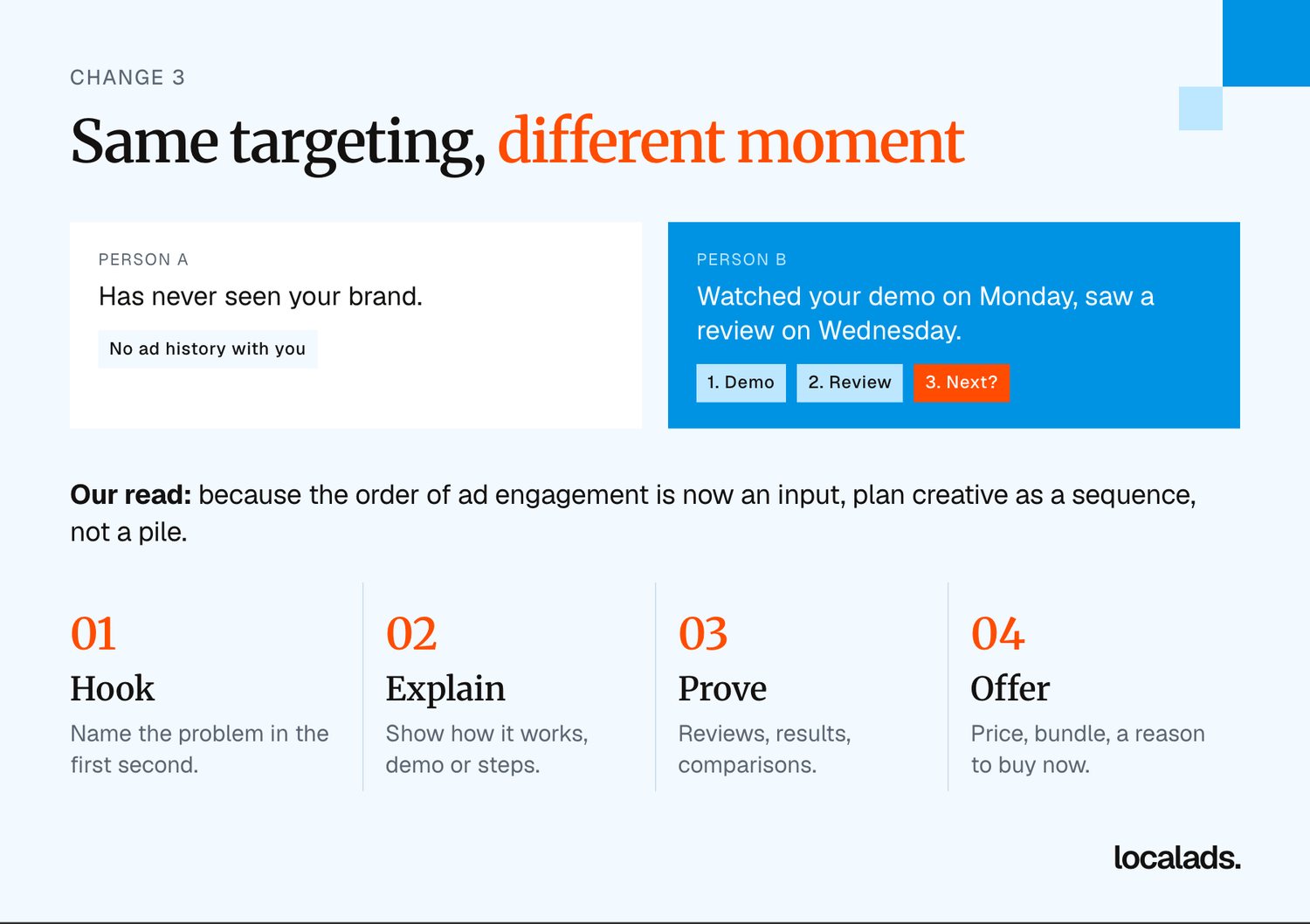
"Sequential ad engagement events" is the phrase in Meta's post that marketers should underline. The system is not only counting what a person engaged with. It is reading the order.
Meta does not say how that sequence is used, so the next part is our interpretation, not Meta's. Two people can match your targeting perfectly and still be in completely different places. Someone who has never heard of you needs a hook. Someone who watched your demo on Monday and read a review on Wednesday is closer to needing an offer. If the system can see that history, then an account that only runs one kind of ad (say, ten versions of a discount banner) has nothing useful to show either of them at the right moment.
What it means for you: plan creative as a sequence, not a pile. Cover the hook, the explanation, the proof, and the offer, so there is a relevant ad for every stage a person can be in.
Change 4: it costs far less to run, so it can look at more
The least glamorous change explains the other three. Meta says the new retrieval model needs about 300x fewer compute operations per prediction than the 2024 model, while the whole pipeline is 100x faster. A system that is that much cheaper per ad can afford to score every ad, run several expert models per person, and still answer within the milliseconds a feed allows.
Meta also says it is "not yet at its ceiling", with deeper models and more retrieval pathways planned. Expect this layer to keep changing without announcements in Ads Manager.
The numbers Meta published, and what they do not tell you
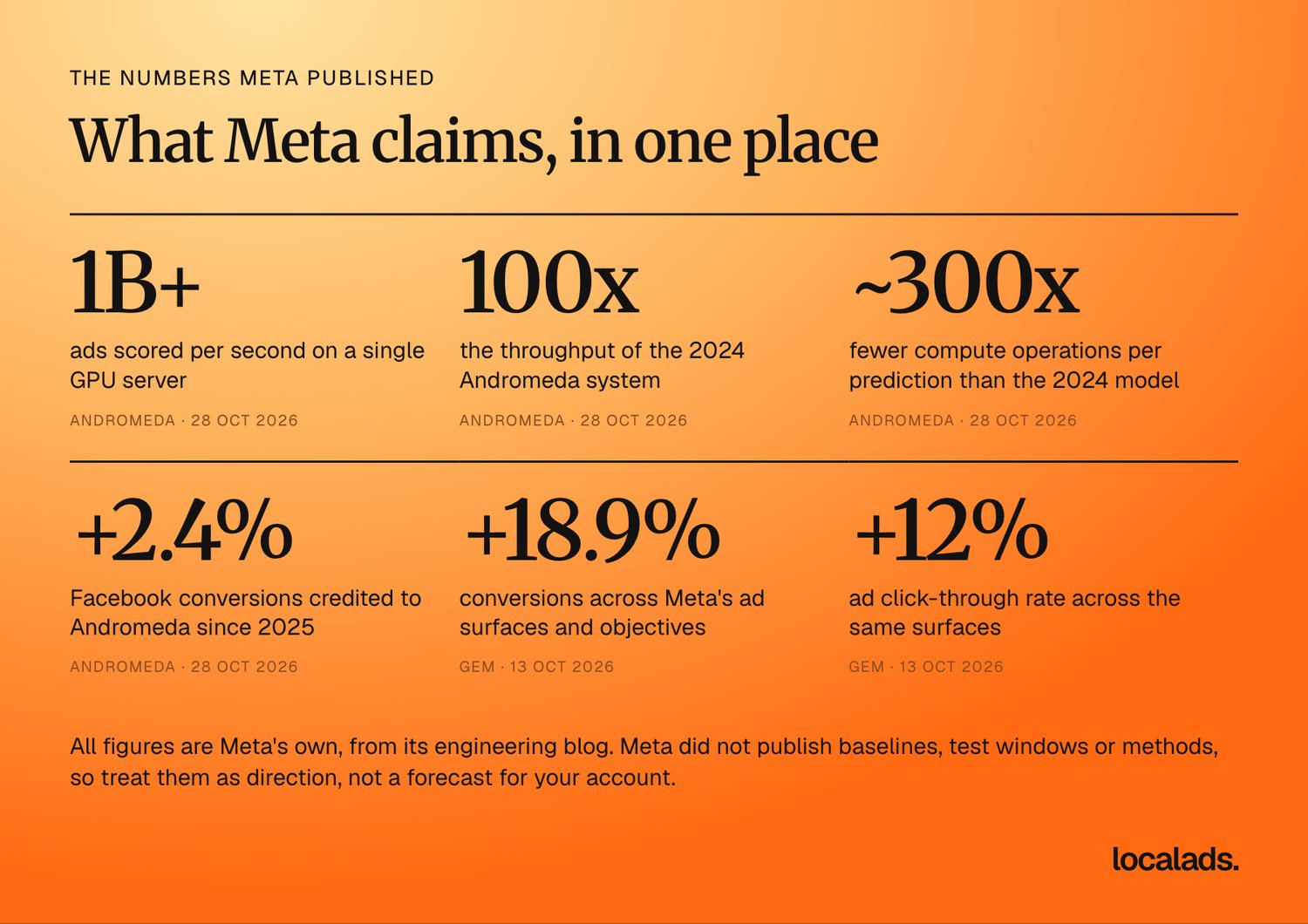
| Claim | Number | Source | What is missing |
|---|---|---|---|
| Retrieval throughput | Over 1 billion ads per second, one GPU server | Meta Engineering, 28 Oct 2026 | GPU count per server and latency |
| Speed vs 2024 | 100x | Meta Engineering, 28 Oct 2026 | The 2024 figure was quoted per GPU card, the 2026 one per server |
| Compute per prediction | About 300x fewer operations | Meta Engineering, 28 Oct 2026 | Nothing advertiser-facing |
| Conversions from Andromeda | +2.4% on Facebook since 2025 | Meta Engineering, 28 Oct 2026 | Baseline, window, method, Instagram |
| GEM conversions | +18.9% across ad surfaces and objectives | Meta Engineering, 13 Oct 2026 | Baseline and method |
| GEM click-through rate | +12% | Meta Engineering, 13 Oct 2026 | Baseline and method |
Two honest caveats. First, these are Meta's own numbers about Meta's own system, and none of them come with a published baseline or test design. They describe direction, not what will happen in your account. Second, a 2.4% conversion lift averaged across all of Facebook can hide much bigger swings in both directions for individual advertisers. Accounts built around many near-identical ads may feel this change very differently from accounts that already run varied creative. Trade coverage of the post and of Meta's third-quarter earnings call makes the same point about missing methods.
Where GEM fits (and why "Andromeda vs GEM" is the wrong fight)
People often ask whether Andromeda or GEM is "the algorithm". The answer is both, at different gates. Andromeda decides which ads make the shortlist. GEM, Meta's Generative Ads Model, is a large foundation model on the ranking side. Its 13 October update describes one central model that learns across Facebook, Instagram and Meta's other surfaces, and then passes what it learns down to the hundreds of smaller ranking models that actually serve ads.
| Andromeda | GEM | |
|---|---|---|
| Stage | Retrieval (gate 1) | Ranking (gate 2) |
| Job | Build a shortlist from every eligible ad | Predict clicks, conversions and value for the shortlist |
| October 2026 update | Scores every eligible ad, mixture-of-experts, sequence signals | One central foundation model across surfaces, longer engagement history |
| Meta's headline claim | +2.4% Facebook conversions since 2025 | +18.9% conversions, +12% CTR |
| Anything to switch on? | No | No |
Coverage of Meta's October earnings call also mentions a "Generative Recommender" now running on Facebook Feed, with a conversion lift of nearly 2% in targeted segments. Meta has not yet published an engineering post on it, so treat the details as early.
For a marketer, the combined effect is what matters. Both gates now read more about each person and more about each ad. The more clearly your creative says who it is for and why they should care, the more both systems have to work with.
What Andromeda 2.0 means for your creative
The short version: Andromeda does not reward more ads. It rewards more ideas. Here is what that looks like with real ads.
These are four creatives LocalAds generated for Better Bright, a toothpaste trial kit. They look like four ads. They are really one.
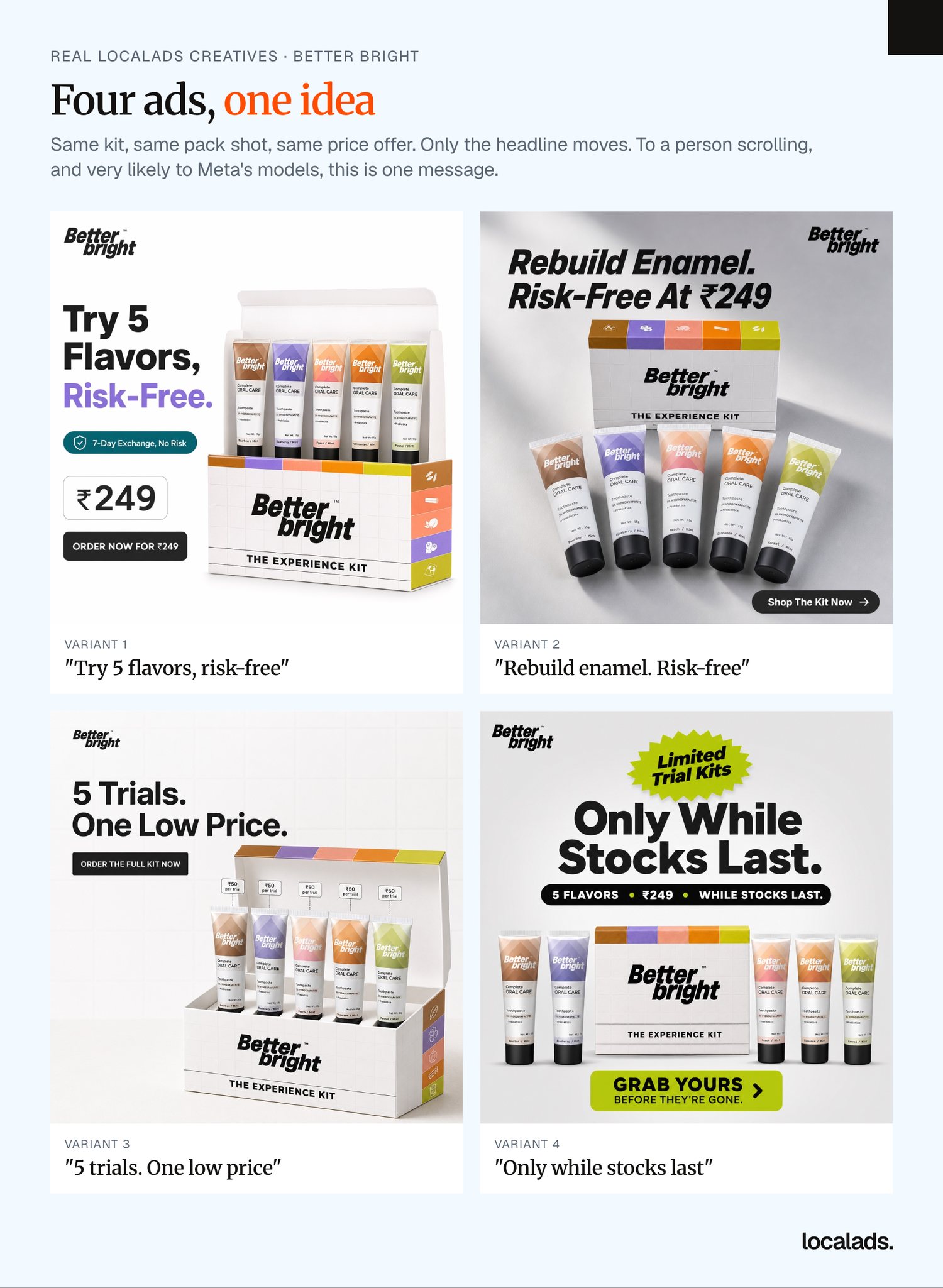
Same kit, same pack shot, same price offer, same buyer. Only the headline moves. To a person scrolling, and very likely to Meta's models, that is one message. Meta has not published how its models group similar ads, so we cannot tell you the exact rule. What we can say is that four headline swaps give the router one kind of person to look for.
Now four creatives for the same product that are genuinely different:

Each one speaks to a different worry: fear of the dentist, family safety, the science, and the cost of dental bills. Each gives the router a different kind of person to match, and each would make sense to a different specialist on Meta's side. That is what "creative diversity" means in practice: a different problem, person or promise, not a different color or font.
And because the order of engagement now counts, the same product can be laid out as a sequence:
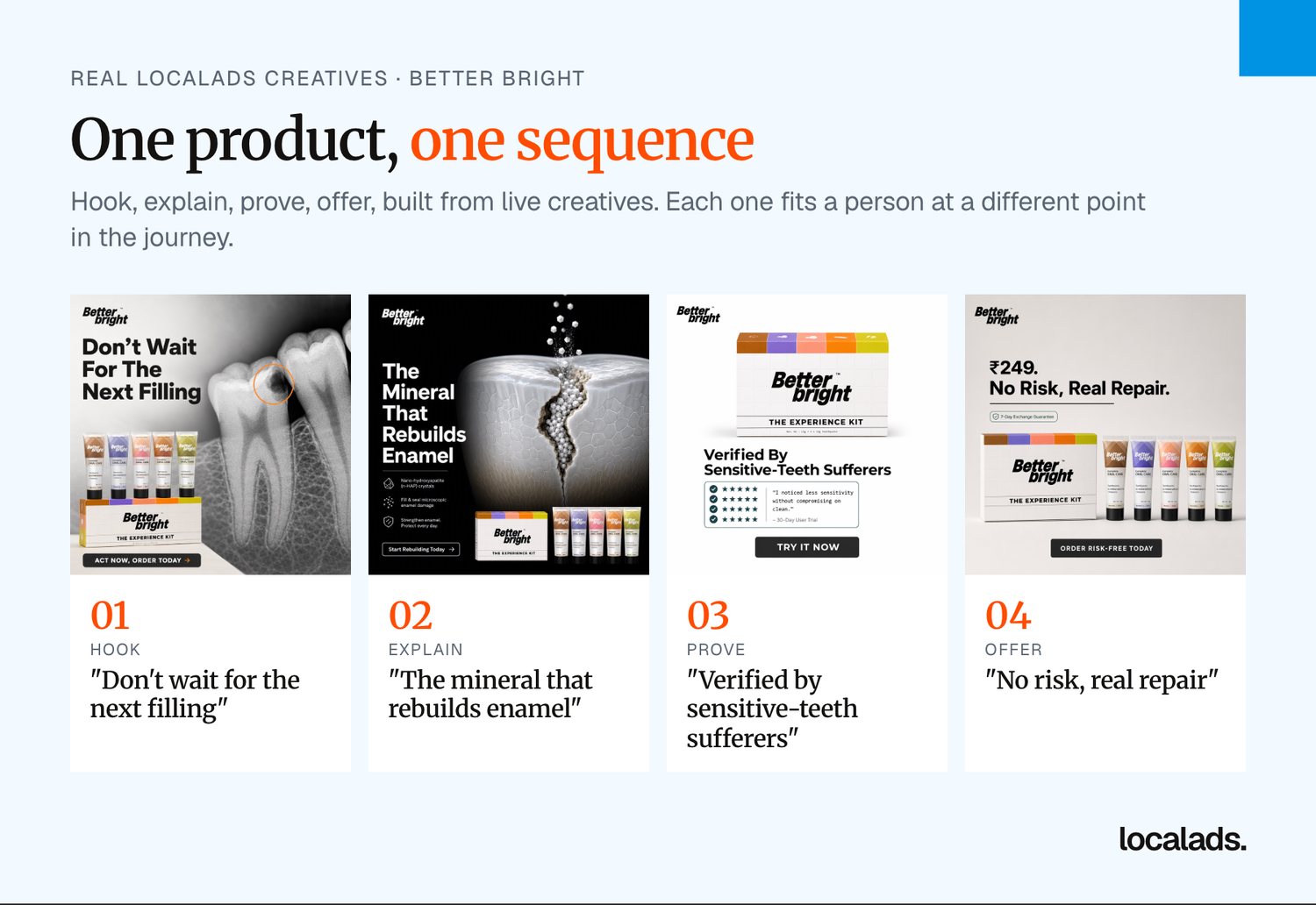
Hook, explain, prove, offer. None of these ads tries to do all four jobs at once, and together they cover every stage a person can be in. If you are short on hook ideas, our video ad hooks guide has a long list, and AI creative variations for paid social testing covers how to vary concepts rather than surface details.
Myths to ignore this month
Every Meta change brings a wave of confident claims. These are the ones we keep seeing, checked against what Meta actually published.
| You will hear | What Meta actually said |
|---|---|
| "Turn on the new Andromeda setting." | There is no setting. The engineering post describes back-end changes that run under every campaign. |
| "Meta confirmed Entity IDs." | Neither Andromeda engineering post mentions Entity IDs. It is an agency term for how similar ads may be grouped. |
| "Targeting is dead now." | Meta says the new index keeps "the full fidelity of production targeting semantics". Your targeting still decides which ads are eligible. |
| "Andromeda decides in 300 milliseconds." | Meta's posts give no latency figure for the whole system. |
| "Upload 50 variations for 50 chances." | Meta's guidance, per a spokesperson speaking to Marketing Brew, is "deliberately outcome-based": "diversify your creative, test, and let the system optimize." |
| "This is why your results dropped last week." | Meta gives no go-live date for the new version. Compare periods before blaming, or rebuilding, anything. |
Your Andromeda 2.0 checklist
- Count ideas, not ads. Export your live ads and group them by the idea behind them: the problem, the person, the promise. Ten color swaps of one ad are one idea.
- Run three to six genuinely different angles per ad set. This is our rule of thumb, not a Meta number. Different problem, person or promise in each. Fewer, more different ads beat many similar ones.
- Plan a sequence. Make sure you have at least one hook, one explainer, one proof ad and one offer live for each core product, so there is something relevant for every stage.
- Mix formats. Statics, video and creator-style ads give the system different signals about the same idea. Our video ad formats guide covers the formats worth testing.
- Clean up your signal. Check that your Pixel and Conversions API are sending the right purchase and lead events. Both gates learn from what you report.
- Simplify the account. Merge fragmented ad sets that target the same people with the same creative. Fewer, broader ad sets with more varied creative give the system room to match.
- Do not panic-rebuild. If performance shifted, compare like-for-like periods before tearing down a campaign that was working.
- Refresh by idea, not by date. When an angle fatigues, replace it with a new angle, not a recolored copy. Our guide to creative fatigue covers the warning signs.
What does not change
Some things are exactly as they were. Your bid strategy and budget still shape how often you can win the auction. Ad quality and relevance still lower what you pay, which we explain in why Meta CPMs keep rising. Your offer and landing page still decide whether a click turns into a sale. Andromeda 2.0 changes who gets considered for your ad and how fairly each ad is judged, not whether a weak offer converts.
FAQ
What is Meta Andromeda 2.0? It is the industry's name for the next generation of Andromeda, the retrieval system Meta uses to shortlist ads for each person on Facebook and Instagram. Meta described it on 28 October 2026. It scores every eligible ad, uses several specialist models of each person, and reads the order of a person's ad engagement.
What is the difference between Andromeda 1.0 and 2.0? Andromeda 1.0 (December 2024) searched a hierarchical index and only scored ads in the most promising branches, using one model of each person. Andromeda 2.0 scores every eligible ad, uses a mixture of expert models with a router, adds the sequence of ad engagement as a signal, and runs about 100x faster.
Do I need to change anything in Ads Manager? No. There is no new setting or report. The change runs underneath every campaign. What you control is your creative mix, your account structure, and the quality of your conversion data.
What is the difference between Andromeda and GEM? Andromeda is retrieval: it builds a shortlist from every eligible ad. GEM is ranking: a large foundation model that helps Meta's ranking models predict clicks and conversions for that shortlist. Both were updated in October 2026.
How many creatives should I run per ad set after Andromeda 2.0? Meta does not give a number. Its public guidance is to diversify creative, test, and let the system optimize. Our rule of thumb is three to six genuinely different angles per ad set, refreshed when an angle fatigues, rather than dozens of near-identical variants.
Is detailed targeting dead? No. Meta says the new system preserves its targeting rules, so your targeting still decides which ads are eligible. But within that eligible pool, the creative does most of the work of finding the right people, so broad targeting with varied creative usually beats narrow targeting with one message.
Did Andromeda 2.0 cause my performance drop? Possibly, but Meta gave no go-live date, and the published conversion gains are averages. Compare like-for-like periods, check your tracking, and look at whether your live ads are really one idea in many versions before changing structure.
The takeaway
Andromeda 2.0 is not a new button. It is a better reader. It now looks at every eligible ad, reads each person through a panel of specialists, and remembers the order in which they saw things. That makes it fairer to good, specific creative and harsher on accounts that run one idea in twenty outfits.
The work for marketers is the same as with the first Andromeda, only more so: give the system distinct ideas, in a sensible sequence, with clean signal behind them. The hard part is producing enough genuinely different creative every week. That is the part LocalAds is built for: paste a product URL and it works out the angles the page can support and renders an on-brand creative for each, in static and video.