On this page
Your best Meta ad had a great first week. By day fourteen it was quietly bleeding money. Nothing broke. That is creative fatigue, and it is the single most predictable reason your winning ad dies.
If you run paid social, you have lived this cycle. A creative launches, ROAS looks fantastic, you scale the budget, and around the two-week mark the numbers slide: CPA creeps up, ROAS drifts down, and the ad that was carrying the account starts dragging it. The instinct is to blame the algorithm, the audience, or a competitor. Usually it is none of those. The audience simply saw the ad too many times.
Understanding why Meta ads stop converting is less about the platform than a simple truth of human attention: the same image stops working once enough people have decided about it. This post breaks down the two-week cliff, how to spot it before it wrecks a month, why throwing budget at it backfires, and the one fix that holds. It starts with treating creative as the real lever on Meta, not an afterthought.
The two week cliff is real
The pattern is consistent enough to set your calendar by it. Most static creatives on Meta follow the same arc: a strong opening as the algorithm finds the responsive slice of your audience, a plateau, then a decline that starts between day 10 and day 18 depending on spend and audience size.
The mechanism is exposure. Meta shows your ad to the people most likely to convert first, your cheapest and highest-intent impressions, and they are finite. Once the system has cycled through that responsive core, it either shows the same ad to those people again (rising frequency) or reaches into a colder audience (rising CPM). Either way the economics get worse: the ad did not, your remaining audience did. The cliff is steeper in 2026 because broad targeting and Advantage+ mean your creative is doing the targeting, so a single fatigued creative has nothing to hide behind. Two weeks is now a planning assumption for a scaled static creative, not a worst case.
What creative fatigue actually is
Creative fatigue is the decline in an ad's performance caused by the same people seeing the same creative repeatedly, until it stops earning attention and clicks. It is an audience-side problem, not a delivery bug: the ad is unchanged, but the people looking at it moved from "new and worth a glance" to "seen it, scrolling past."
This matters because fatigue gets blamed for problems it did not cause, sending teams chasing the wrong fix. Separate three things that all look like "my ads stopped working" but have different cures.
Creative fatigue. The ad has been shown too often to the same audience. Signal: frequency rising while CTR falls and CPM stays flat. The audience is not exhausted, this creative is. Fix: rotate in a fresh creative.
Audience saturation. You have run out of new people to reach at a reasonable price. Signal: CPM climbing into colder inventory even with a fresh creative. Fix: expand the audience or add placements, not just a new image.
Auction shift. The market moved (a competitor entered, a seasonal spike, CPMs up account-wide). Signal: CPM up across all creatives at once. Fix: this is external; adjust bids and do not misread it as a creative problem.
Treat every slump as fatigue and you will burn fresh creatives against a saturation or auction problem they cannot solve. The dashboard tells you which one you have.
How to spot fatigue in your dashboard
ROAS is a lagging indicator. By the time it drops enough to alarm you, you have already spent a week feeding a dying creative. The earlier signals sit in four metrics you watch as a set. Fatigue has a fingerprint: frequency up, CTR down, CPM flat-ish, CPA up. When those four move together, it is fatigue, not a bad week. Here are the thresholds most performance teams use to trigger action, tunable but close enough to catch fatigue before it eats a month.
| Metric | Healthy | Warning | Act now | What it means |
|---|---|---|---|---|
| Frequency (7-day) | under 2.0 | 2.0 to 3.0 | over 3.5 | Same people seeing it too often |
| CTR (link) trend | stable or rising | down 15% from peak | down 25%+ from peak | Attention is fading |
| CPM trend | stable | up 10 to 20% | up 25%+ vs all ads | Distinguishes fatigue from saturation |
| CPA trend | stable | up 15% | up 25%+ | The lagging confirmation |
Read them as a pattern. Frequency above 3.5 with a 25% CTR drop and stable CPM is textbook fatigue: pull the creative, not the campaign. Frequency still low but CPM climbing on a fresh creative is saturation. CPM up across every ad is an auction shift. Always pull a 7-day rolling view, not lifetime: lifetime numbers average away the exact decline you are trying to catch, which shows up in the trend about a week before ROAS makes it obvious.
Why more budget makes it worse
The reaction to a winning ad slipping is often to scale it harder, to defend the ROAS you got used to. On a fatiguing creative, that is the exact wrong move. More budget on a fixed creative forces Meta to buy more impressions from the same audience in the same window, which does two bad things: it pushes frequency up faster, accelerating the fatigue you are trying to outrun, and it pushes delivery into colder, more expensive inventory sooner, raising CPM as the system reaches for people who were never a great fit. You pay more to show a tired ad to worse prospects more often, and CPA climbs.
Scaling spend on a fresh creative compounds in your favor; scaling a fatigued one compounds against you. Budget is a multiplier, not a fix. The answer to "my ROAS dropped" is never more money behind the same image. It is a different image.
The only durable fix is creative volume
If fatigue is caused by the same people seeing the same creative, the only durable cure is a steady supply of fresh creative to rotate in before frequency and CTR go critical. Not one hero ad you protect, but a pipeline. The winning accounts are not the ones with the single best creative; they are the ones that never run out of the next one.
Your creative refresh rate has to at least match your fatigue rate. If a scaled static creative fatigues in roughly two weeks, you need a fresh variation ready inside that window, per active audience: a weekly cadence of new, distinct, on-brand creatives entering rotation as tired ones exit, not a burst of fifty ads once a quarter.
How much you need scales with spend, because higher spend burns the responsive audience faster and hits the frequency thresholds sooner. Rough guidance most teams converge on:
| Monthly ad spend | Fresh creatives per week | Why |
|---|---|---|
| Under $5k | 3 to 5 | Low frequency pressure, slower burn |
| $5k to $20k | 6 to 10 | Fatigue arrives faster at scale |
| $20k to $50k | 10 to 20 | Multiple audiences fatiguing in parallel |
| $50k+ | 20 to 40+ | Continuous rotation across many angles |
The word doing the work in that table is distinct. Ten variations of the same image in a different font do not solve fatigue, because the audience recognizes the ad regardless of the color swap. What resets attention is a genuinely different angle: a new hook, a new audience framing, a new visual idea for the same product. Volume without variety just fatigues in parallel. The two ads below are a rotation pair: when the first tires, the next angle is already staged, so frequency resets instead of climbing.
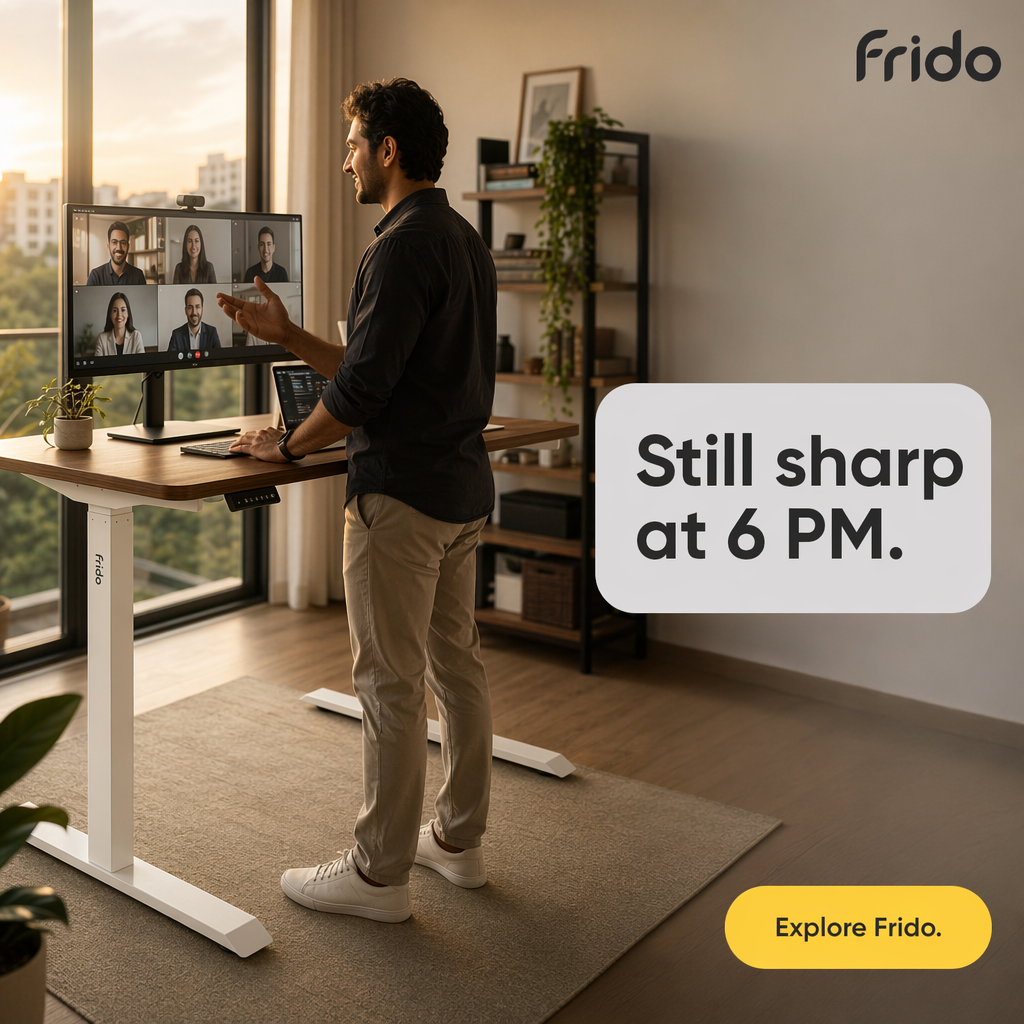
Rotation slot one, for the comfort brand Frido: the audience is professionals and the angle is staying sharp through the workday, "Still sharp at 6 PM." When its frequency climbs past 3.5, it exits and the next angle enters.

Rotation slot two, for the sock brand Soxytoes: a different product, audience (desk-bound office workers), and angle (circulation and recovery). A distinct creative like this is what resets attention, not a recolor of the first.
A note on the obvious counter-move: frequency capping on Meta ads. Caps limit how often one person sees your ad, which buys time, but they do not create fresh creative or expand your audience, and on broad and Advantage+ your control over frequency is limited anyway. Capping is a brake that manages the symptom; volume treats the cause. If your pipeline is thin, no capping strategy will save you.
How lean teams keep a pipeline full
Most teams stay stuck in the two-week cycle not because they misunderstand fatigue, but because producing a steady stream of distinct, on-brand creatives is hard when you are waiting on a designer to turn around three statics per brief. Demand outpaces capacity, so the account defaults to running the same few ads until they die.
That production gap is the constraint worth solving. If you can generate a spread of distinct, strategy-backed creatives from your existing product page in minutes, the weekly refresh cadence stops being a stretch. This is the idea behind generating ads directly from a product URL: each creative maps to a different audience and angle, so you get variety by construction. Start a free trial and generate a week's worth of distinct angles against your own product. Never be one fatigued creative away from a bad month.
FAQ
Why do my Meta ads stop converting after two weeks? Because the same responsive audience has seen the creative too many times, which is creative fatigue. Meta shows your ad to the highest-intent people first, and once that core has been cycled through, frequency rises and performance falls. The ad did not break; your remaining audience stopped responding, usually between day 10 and day 18 on a scaled static creative.
How do I know if it's creative fatigue or something else? Read four metrics together, not ROAS alone. Fatigue shows as rising frequency plus falling CTR with a roughly flat CPM. If CPM is climbing even on a fresh creative, that is audience saturation. If CPM is rising across every ad at once, that is an auction shift. Each has a different fix.
Does frequency capping fix ad fatigue on Meta? It slows fatigue for a given creative but does not cure it. Caps buy time by limiting how often one person sees your ad, but they do not produce fresh creative or expand your audience, and your control over frequency is limited on broad and Advantage+ anyway. Treat capping as a brake and creative volume as the real fix.
What is a good creative refresh rate? At minimum it should match your fatigue rate, roughly every two weeks per active audience for scaled static creatives, meaning a weekly cadence of new, distinct creatives. The number scales with spend: a few per week under $5k, ten or more above $20k, because higher spend burns the responsive audience faster.
Why does raising the budget make a fatigued ad worse? More budget forces Meta to buy more impressions from the same audience in the same window, pushing frequency up faster and reaching into colder, more expensive inventory sooner. You pay more to show a tired ad to worse prospects more often, so CPA climbs.
The takeaway
Meta ads stop converting after two weeks because attention is finite and a single creative cannot renew it. The cliff is predictable, it shows up in frequency and CTR before ROAS confirms it, and it gets worse when you respond by spending more. The durable fix is not a smarter bid or a tighter frequency cap; it is a pipeline of distinct, on-brand creatives feeding rotation faster than your audience fatigues.
If your account runs on a handful of ads you keep pushing past their expiry, make the next creative cheap and fast to produce. Paste a product page into LocalAds, see how many distinct angles one URL generates, and rotate them in before frequency climbs instead of after ROAS falls.
Related reading: