On this page
The short answer. A video ad hook is whatever happens in the first one to two seconds that makes someone stop scrolling: an impossible image, a line spoken mid-thought, a question written on screen, a character already in trouble. Most hooks fall into five types, and the right type depends on the ad's format more than on the product. Below are twenty hooks, each shown as the actual first frame of an ad LocalAds rendered for the same product (a copper water bottle, with sneakers in one), so you can see that the hook changes everything even when the product does not.
Why the hook is most of the ad
On Reels, TikTok and Shorts the viewer decides in about a second whether to keep watching, usually with the sound off. Everything else in the ad (the script, the offer, the call to action) only matters for the people the hook kept. That is why the same product with the same offer can perform completely differently in two formats: the first frame is doing a different job.
Three rules hold across every hook below:
- Something is already happening. No logos, no slow fade-ins, no "hi guys". The frame opens mid-action or mid-sentence.
- It reads on mute. Either the image explains itself, or a word on screen does.
- It points at the viewer's problem or curiosity, not your product. The product earns its entrance later.
Type 1: visual hooks (the image does the work)
These hooks need no words. The first frame is strange, satisfying or obviously relatable, and the viewer stays to find out why.
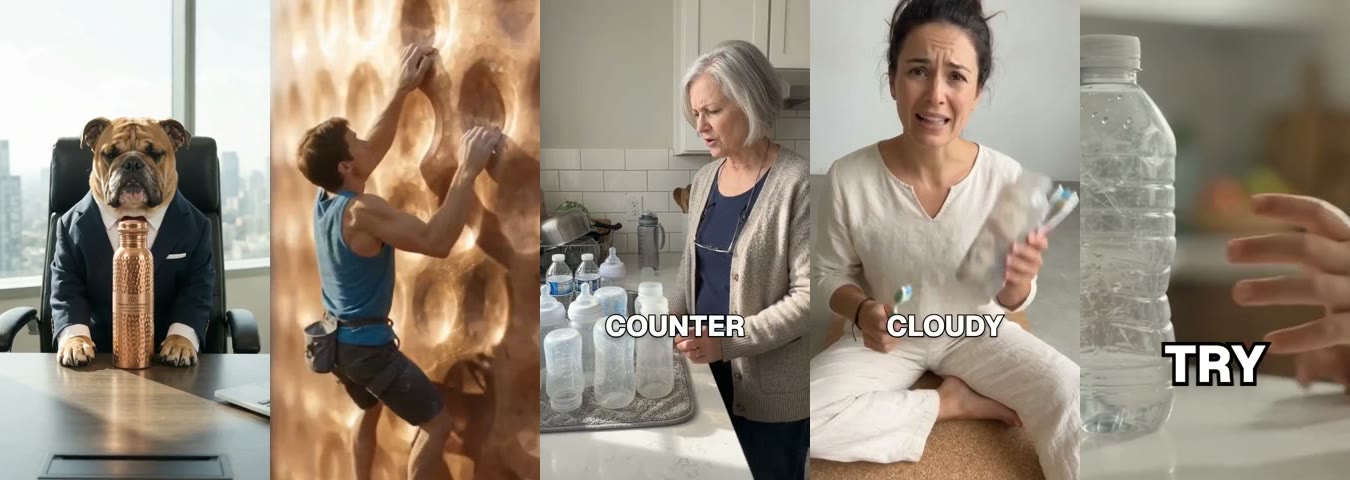
| # | Hook | First frame | Format | Example line or caption |
|---|---|---|---|---|
| 1 | The impossible image | A bulldog in a suit, at a CEO's desk, with the bottle | Absurd hook | No words needed. Real sound only |
| 2 | The scale reveal | A climber scaling what turns out to be the bottle | Miniature world | "This is not a mountain." |
| 3 | The problem in the room | A counter crowded with plastic bottles | Before / after | "If your counter looks like this, watch this." |
| 4 | The usual fix failing | Scrubbing a cloudy bottle with toothbrushes | Deliberately rough AI | "Cloudy. Still." |
| 5 | The worse alternative, up close | A crumpled plastic bottle, a hand reaching for it | Cinematic spec ad | "Try something better." |
The impossible image is the strongest pure stopper, because the viewer cannot process it in a glance:
Played completely straight, in one continuous shot. The joke and the product arrive together, so they are remembered together.
The scale reveal works on the same principle, with a payoff a second later:
Type 2: spoken hooks (the first line does the work)
Creator and conversation formats hook with a line, spoken in the first second, with the person already on screen. Subtitles carry it for the people watching on mute.
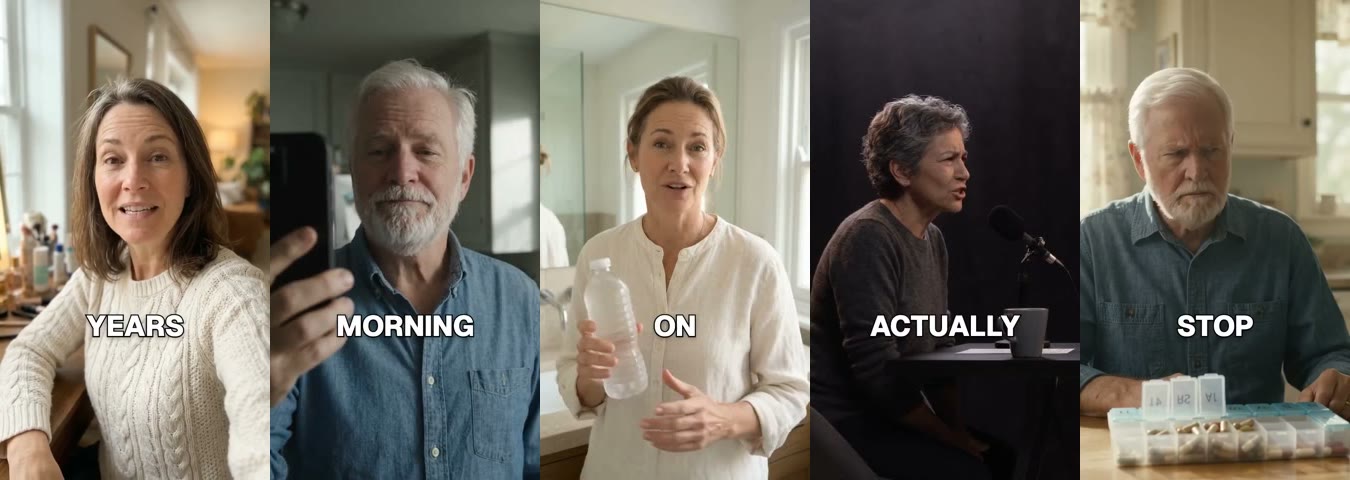
| # | Hook | First frame | Format | Example line |
|---|---|---|---|---|
| 6 | The confession | A creator, mid-sentence, at home | UGC talking head | "I spent years buying the wrong thing." |
| 7 | The routine | A selfie in the kitchen, first thing | Creator vlog | "Morning. First thing I do now is..." |
| 8 | The mistake callout | A presenter holding the "wrong" product | Explainer | "You're drinking from this? Okay, we need to talk." |
| 9 | Mid-conversation | A podcast host reacting | Podcast-style | "Actually, wait. You refill it how many times?" |
| 10 | The conflict | An argument, already in progress | Micro-drama | "Stop. Dad, just stop." |
The conflict hook is the most reliable of the spoken five, because the viewer needs to know how the argument ends:
Spoken hooks fail in one predictable way: a greeting. "Hey guys" and "So today I want to show you" burn the only second you have. The full structure of creator scripts is in UGC ad script examples.
Type 3: written hooks (a word on screen does the work)
These open on text that is part of the scene, not a caption stuck on top: a word chalked on a board, a title on a whiteboard, a TV lower third.
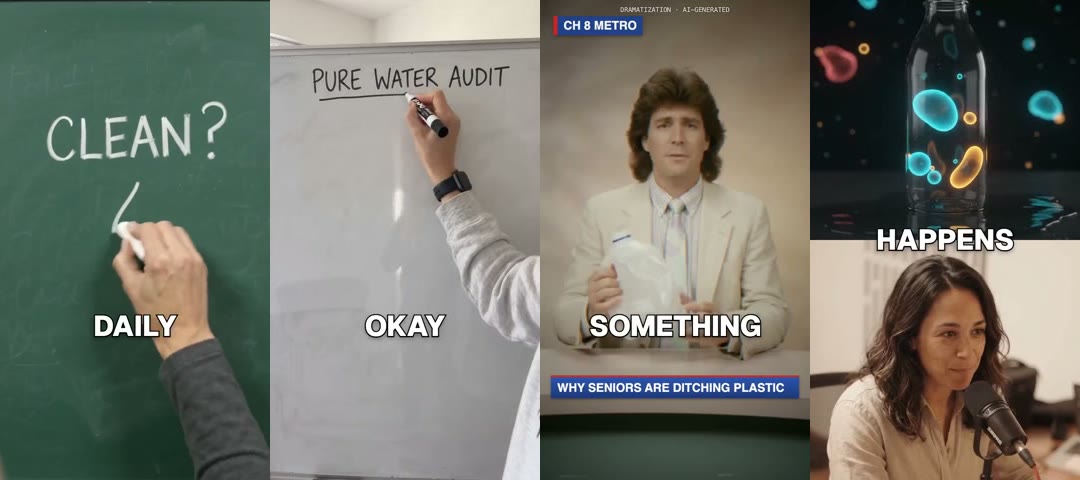
| # | Hook | First frame | Format | Example line |
|---|---|---|---|---|
| 11 | The one-word question | "CLEAN?" being chalked | Chalkboard explainer | "Is your water bottle actually clean?" |
| 12 | The audit title | "Pure Water Audit" at the top of a board | Whiteboard explainer | "Okay, so: what's in it, what it costs, is it worth it?" |
| 13 | The fake broadcast | A 1980s host and a lower third | Found footage | "Something strange is happening at the community centre..." |
| 14 | The invisible, made visible | What lives inside the bottle, animated | Podcast with animation | "This is what happens inside your bottle." |
Written hooks are the best choice when your product needs a reason before it needs a feeling: ingredients, comparisons, pricing, myths. They also survive the mute button better than any other type.
Type 4: character hooks (a feeling does the work)
Animated and musical formats hook with emotion: a character visibly in trouble, a look nobody expected, or a line sung in the first second.
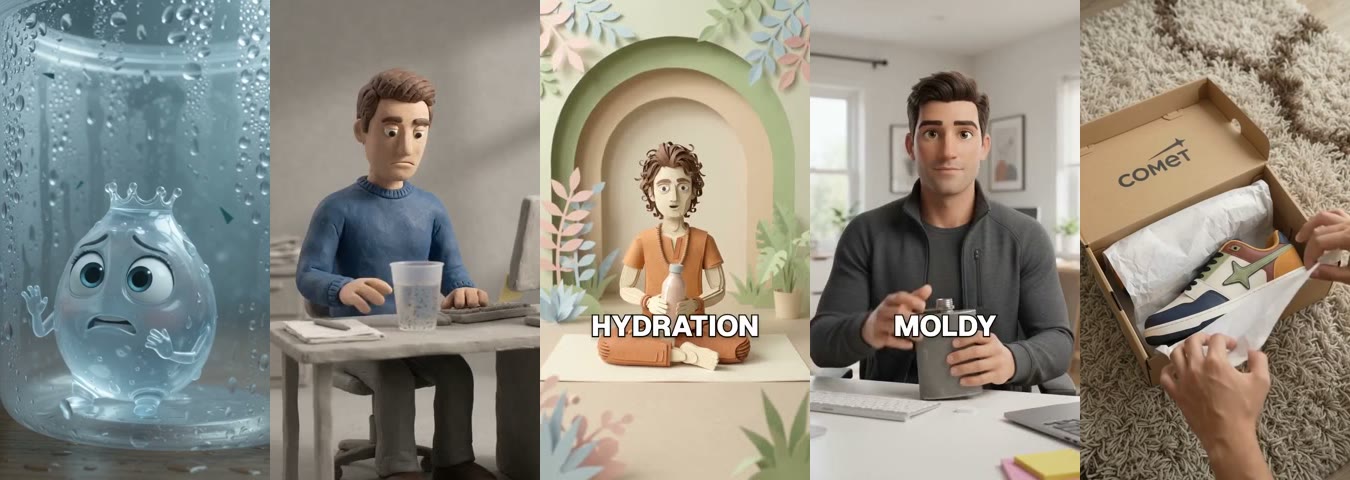
| # | Hook | First frame | Format | Example line |
|---|---|---|---|---|
| 15 | The hero in trouble | A tearful 3D water drop, trapped | Pixar-style | "Nobody ever asks the water how it feels." |
| 16 | The villain arrives | A glum clay office worker, a cup of something murky | Claymation | "Meet the thing living in your desk cup." |
| 17 | The unexpected material | A whole world built from paper | Stylized animation | The look is the hook. A narrator, or none |
| 18 | The sung problem | A frown at a moldy flask | Song ad | "My flask smelled like last week's coffee..." (sung) |
| 19 | The unboxing | Hands opening a box | UGC voiceover | "I've been waiting for these all week." |
The character hook is the best answer to "AI faces look fake". A cartoon or clay character is not trying to look real, so the hook never falls into the uncanny valley. More on that in Pixar-style ads.
Type 5: the texture hook
| # | Hook | First frame | Format | Example line |
|---|---|---|---|---|
| 20 | The macro texture | An extreme close-up of hammered copper in warm light | Storyboard commercial | "Hydration, hand-hammered." |
A beautiful macro is the slowest hook on this list, and it belongs in retargeting, where the viewer already knows the brand and the job is desire rather than attention.
How to pick the hook type
| If your product... | Lead with | Because |
|---|---|---|
| Has a visible, instant result | Visual hooks (usual fix failing, problem in the room) | The result is the proof |
| Is bought on trust | Spoken hooks (confession, routine) | A person vouching is the proof |
| Needs a reason first | Written hooks (question, audit title) | The viewer has to understand before they believe |
| Has an invisible benefit | Character hooks or the invisible made visible | Animation can show what a camera cannot |
| Sells in a crowded, impulse category | The impossible image | It wins the first second outright |
Then test two or three hook types against each other with the same offer. The winning hook type tells you more than any single winning ad. The full set of formats behind these hooks is in 20 video ad formats that work in 2026.
How LocalAds writes the hook for you
Every format in LocalAds has its own hook rule built in: the micro-drama opens on the conflict in the first second, the podcast opens mid-conversation, the before and after opens on the problem in the viewer's own home. You pick who the ad is for and the format, and LocalAds writes three stories for that audience, each with a different hook. You read the script, change any line or ask the director for a sharper opening, and it renders the finished 9:16 ad with subtitles and music at 1 credit per finished second.
FAQ
What is a hook in a video ad? The first one to two seconds, designed to stop the scroll. It can be an image, a spoken line, a word on screen or a character's emotion, and it decides whether anyone sees the rest of the ad.
How long should a video ad hook be? One to two seconds for the stopping moment, with the full hook (the problem or question it sets up) landing within three seconds. Anything that takes longer to start, like a logo or a greeting, loses most viewers before the hook.
What makes a good TikTok or Reels ad hook? Something already happening in the first frame, readable on mute, about the viewer's problem rather than your product. Impossible images, conflicts in progress and spoken confessions are among the most reliable.
Should the product appear in the hook? Usually not as the subject. The exception is the absurd hook, where the product is part of the impossible moment so the joke and the brand are remembered together. In most other formats the product enters after the hook has bought you a few seconds.
How many hooks should I test? Test two or three different hook types on the same ad body and offer, rather than ten variations of the same type. Different types tell you what your audience responds to; variations of one type only tell you which wording won.