On this page
The before-and-after is the most persuasive format in skincare, and the most likely to get your ad rejected or your account restricted. That tension is why so many beauty brands either avoid transformation creatives entirely or keep getting slapped by review. There is a better path, and it starts with understanding what the platforms actually restrict versus what marketers assume they do.
This post is a practical guide to building skincare ad creatives that carry the persuasive weight of a before-and-after without the compliance risk. We will cover why these ads get flagged, the specific things Meta and advertising regulators police, and the problem-state approach that converts and passes. Real generated examples throughout.
Why before-and-after skincare ads get flagged
Three separate problems hide inside "my before-and-after got rejected," and they need different fixes.
Problem one: the personal-attributes rule. Ad platforms restrict creatives that imply knowledge of, or make people feel called out about, a personal characteristic. Meta's advertising standards on personal attributes are explicit about this, and skin condition (acne, aging, pigmentation, sensitivity) is squarely a personal attribute. A literal before-and-after that says "your skin looks like the left, here's the right" can trip this, because it implies the platform knows something about the viewer's skin.
Problem two: unsubstantiated transformation claims. A before-and-after is a visual claim. If the implied promise ("this will clear your acne," "this erases wrinkles") is not backed by evidence you can produce, it is an unsubstantiated claim regardless of whether words appear on the image. The picture makes the promise for you.
Problem three: idealized or misleading results. Retouched, exaggerated, or non-representative before-and-afters are restricted in many markets by both the platform and the advertising regulator. A result that a typical customer will not get is treated as misleading.
Notice that none of these is "before-and-afters are banned." They are not. It is the transformation promise, the personal callout, and the unsubstantiated claim that get policed. Strip those, keep the persuasion, and you have a creative that passes.
Here is the same idea as a quick reference you can hold against any creative:
| Element | Usually gets flagged | Usually passes |
|---|---|---|
| Framing | "Do you have chronic dryness?" (diagnosis) | "Foundation flaking by 2 PM?" (scenario) |
| Benefit | "Cures acne," "erases wrinkles" | "Helps," "visibly smooths the look of" |
| Proof | "Clinically proven," "94% saw results" (no study) | A real seal or a claim you can substantiate |
| Imagery | Literal same-face transformation of a skin condition | Problem state plus product, results representative |
The US frameworks behind these lines are the FTC's health products compliance guidance on substantiation and the FDA's cosmetic-versus-drug claim rules; Meta layers its own ad standards on top. None of this is legal advice, but building to the right-hand column clears most reviews the first time.
The compliant alternative: sell the problem, not the transformation
The move that keeps the selling power and drops the risk is to show the problem state and the product, framed around appearance and experience, rather than a literal before-to-after transformation of the same face.
Here is a real generated example for CeraVe. It leads with the problem (irritation from a harsh cleanser) and the product, without promising a specific clinical outcome:
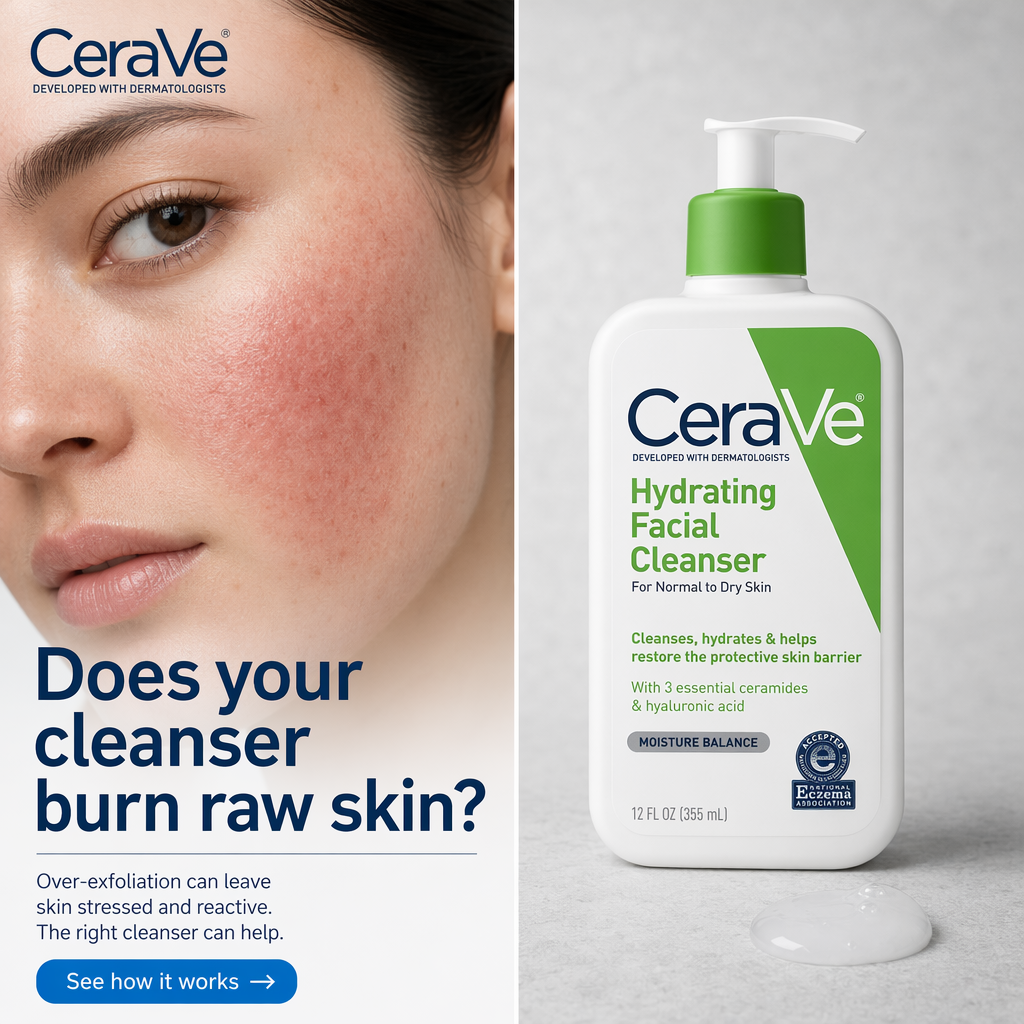
A real LocalAds output. It shows a relatable problem state (redness from over-exfoliation) and positions the product as a gentler option, using "can help" rather than a cure claim. There is no false transformation and no invented statistic, so the persuasion survives the compliance pass.
Why this works where a literal before-and-after fails: it dramatizes the pain point (which is what actually drives the click) without promising a guaranteed result or implying the platform knows the viewer's skin. The redness is a scenario, not a personal callout, and the benefit is hedged to what the product can reasonably support.
The same pattern works for a routine or texture problem rather than a skin condition. Here is a version built around a functional frustration (makeup not sitting well on dry skin) rather than a medical concern:
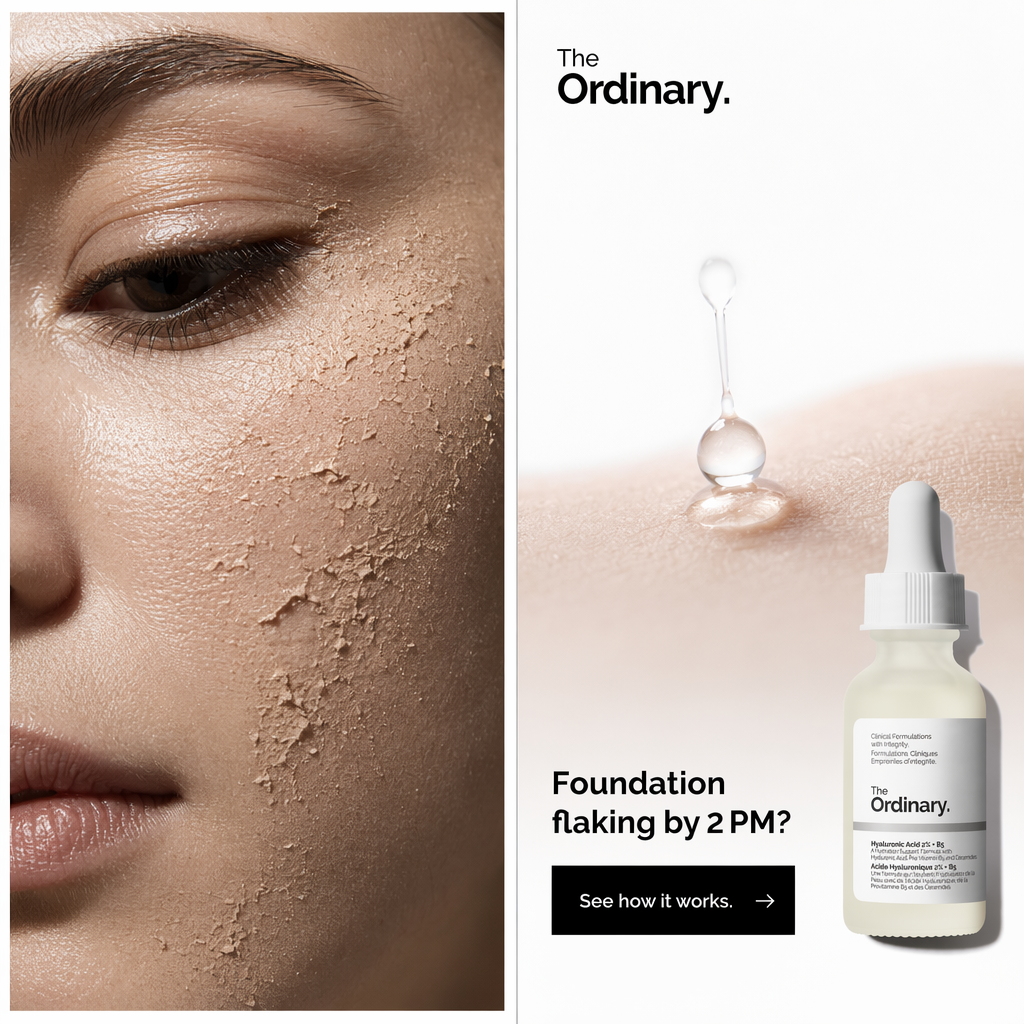
A real LocalAds output. This is the safest tier of all: the "problem" is a cosmetic, non-medical annoyance (flaking foundation), the fix is framed as a smoother base, and nothing here claims to treat a skin condition. It reads like a before-and-after but makes no regulated promise.
The rules of thumb that keep you clear
Turn the above into a checklist you can apply to any skincare creative:
- Frame the problem as a scenario, not a diagnosis. "Foundation flaking by 2 PM?" is a scenario. "Do you have chronic dryness?" is closer to a personal callout. The first invites, the second targets.
- Use appearance-based, hedged benefit language. "Visibly smooths the look of," "helps," "supports." Avoid "cures," "treats," "eliminates," "clears," and "permanent."
- Never put an unsubstantiated stat or "clinically proven" flag on the image unless you have the study on file. The image is a claim surface too.
- Keep results representative. If you use any real result, it should be typical and unretouched, with the disclosures your market requires.
- Avoid the literal same-face transformation for medical concerns. Problem-state plus product is the safer construction than a guaranteed "before to after" of a treated condition.
- Match the claim to your evidence tier. Cosmetic annoyance (flaking, dullness) is the lowest risk. Skin condition (acne, eczema, pigmentation) is the highest, so hedge hardest there.
This is not legal advice, and the exact rules vary by market and platform, so run your final creatives past whoever owns compliance. But building to this checklist means most of your ads clear review the first time instead of bouncing.
How to produce these at scale without re-briefing
The hard part of compliance is not knowing the rules, it is applying them consistently across dozens of creatives when you are shipping fast. That is where the workflow matters.
Because LocalAds builds creatives from your product page (your real claims, your real ingredients, your brand tone) rather than from a blank prompt, the copy starts closer to what you can actually say, and the angles it generates lean toward problem-state framing rather than transformation promises. You still own the final compliance review, but you are editing claim-safe drafts instead of rewriting risky ones. Each creative comes out as a finished static ad sized for every placement, and you can animate any of them into video from the same workspace when a still is not enough.
For the copy-side rules that pair with this, see ChatGPT ad copy prompts for skincare brands, and for the photography side, AI product photography for skincare.
FAQ
Are before-and-after skincare ads banned on Meta? No. What is restricted is the transformation promise, the personal-attribute callout, and unsubstantiated or idealized results. A creative that shows a problem scenario and the product, with appearance-based hedged language and no invented stats, generally passes even though it carries the same persuasive weight.
What words should I avoid in skincare ad creatives? On both copy and the image itself: "cure," "treat," "heal," "eliminates," "clears," "permanent," and "clinically proven" or specific result percentages unless you can substantiate them. Replace outcome promises with appearance-based language like "visibly smooths the look of" or "helps."
Can I still use a real customer's before-and-after photo? Sometimes, if the result is typical rather than cherry-picked, is unretouched, carries the disclosures your market requires, and does not imply a guaranteed outcome. The risk is highest for medical skin conditions and lowest for cosmetic concerns. When in doubt, use a problem-state creative instead.
Why does a "problem-state" ad convert as well as a before-and-after? Because the click is driven by recognition of the pain point, not by the promised result. Showing a relatable problem (flaking foundation, redness, tightness) makes the viewer think "that's me," which is the same psychological trigger a before-and-after uses, minus the regulated promise.
How do I keep this consistent across many ads? Build from your real product page rather than free-form prompts, so claims start grounded, and apply a fixed checklist (scenario not diagnosis, hedged benefit, no unsubstantiated stats) to every creative. A URL-to-creative workflow does most of that by construction, leaving you a lighter final review.
The takeaway
You do not have to choose between persuasive skincare ads and compliant ones. The before-and-after gets flagged because of the transformation promise, the personal callout, and the unsubstantiated claim, not because showing a problem is off-limits. Lead with a relatable problem state and the product, hedge the benefit to what your evidence supports, and keep invented stats off the image, and you keep the conversion while clearing review.
The way to make that repeatable is to start from your real product page instead of a blank prompt, so every creative is claim-safe by default and you are reviewing rather than rewriting. Generate ads from your product URL and see how problem-state creatives look when they are built to pass.
Related reading: