On this page
ChatGPT will write you a hundred ad headlines in ten seconds. None of them are an ad.
That gap is the whole reason this post exists. If you run paid social for a D2C brand, you have almost certainly opened ChatGPT, typed "write me 5 Facebook ad headlines for my product," and pasted the least-bad one into a draft. It works, sort of. The copy is grammatical, on-topic, and forgettable, and you spend more time fixing the output than you saved generating it.
The problem isn't ChatGPT. The problem is how most people prompt it. A vague ask gets vague copy, and a vague ask is what you type when you're tired and shipping under deadline. Good ChatGPT ad copy prompts are specific, structured, and loaded with the same context you would give a freelance copywriter: who the buyer is, what the product actually does, and which angle you're testing. That is the difference between "write some ad copy" and copy you'd actually run.
This post gives you 20 copy-paste ad copywriting prompts, grouped into hooks, primary text, angles and objections, and CTAs, so you can stop reinventing the prompt every time. But it also draws a line most AI-ad content dodges: prompts get you words on a page. They do not get you a finished, on-brand ad. We'll cover both halves honestly, because knowing where ChatGPT for marketing stops is as useful as knowing where it starts.
Prompts get you copy, not creative
Let's be precise about what a prompt actually returns, because the confusion here wastes a lot of time. When you prompt ChatGPT, you get text: a headline, a body paragraph, a list of hooks, a call to action. That is copy. It is not a creative.
A creative is the finished thing that runs in the feed: the visual, the layout, the product shot, the brand colors, the headline set in your typeface, and the copy locked into a frame sized for Meta or TikTok. Copy is one ingredient in that. A brilliant hook in a plain text box is not an ad, and neither is a beautiful product photo with no words on it.
This matters because "ChatGPT wrote my ad" is a category error that leads teams to skip the expensive half of the work. You still have to design the layout, source or shoot the visual, apply brand styling, and export it at the right dimensions. AI ad copy prompts compress the writing step from an hour to five minutes. The other steps are still there, and for most brands they are the bottleneck, not the words.
So treat this post's prompts as what they are: a fast, reliable way to generate the language layer of your ads. We'll come back to how that language becomes a real ad near the end. First, the part ChatGPT is genuinely good at.
Three rules for prompting better ad copy
Before the templates, internalize these three rules. They are the difference between the generic output everyone complains about and copy you can actually test. Every template below is built on them.
Rule 1: Feed it the page, not a summary. The single biggest quality jump comes from pasting your real product page, or the key facts from it, into the prompt. The exact product name, price, the specific claims ("10g protein, no added sugar"), the ingredient list, the guarantee, three real customer review quotes. When you summarize your product in one sentence, ChatGPT fills the gaps with invented, average-sounding benefits. When you give it the raw material, it writes from your actual offer. Most weak AI copy is a summarization problem, not a model problem.
Rule 2: Name the audience and the angle, separately. "Write an ad for my protein bar" gives the model no strategy to execute, so it defaults to the blandest possible pitch. Instead, specify the audience ("busy professionals who skip breakfast") and the angle ("the guilt-free 3pm snack") as two distinct inputs. One product supports many audience-and-angle pairs, and each one deserves its own prompt run. This is also what makes your results legible later: when you know which angle a losing ad was testing, you learn something. For a deeper method on where angles come from, see AI creative variations for paid social testing.
Rule 3: Constrain the format, or you'll get an essay. ChatGPT loves to write long, hedged, adjective-heavy prose. Ads don't work that way. Put hard limits in the prompt: character counts, number of variations, banned words ("no 'unlock,' 'elevate,' 'game-changer'"), reading level, and tone. A constrained prompt returns copy you can paste; an unconstrained one returns a draft you have to edit down. Constraints are not a nice-to-have, they are the prompt.
With those three rules loaded, here are the templates. Fill the bracketed slots, and keep your product facts, audience, and angle handy to paste in.
Hooks (templates 1 to 5)
The hook is the first line that stops the scroll. These prompts generate a spread you can pick from, not a single guess.
Template 1: The hook spread.
You are a senior D2C direct-response copywriter. Product facts:
[paste product name, price, top 3 claims, guarantee].
Audience: [audience]. Angle: [angle].
Write 10 scroll-stopping first lines (hooks) under 8 words each.
Vary the type: question, bold claim, number, contradiction,
callout to the reader. No emojis. No exclamation marks.
Template 2: The problem-first hook.
Using these product facts [paste], write 7 hooks that open with the
exact problem [audience] feels, in their own words, before mentioning
the product. Make the pain specific and physical, not abstract.
Max 10 words each.
Template 3: The number hook.
From these claims [paste real numbers: price, weight, %, time],
write 6 hooks built around a single concrete number. The number must
be real and from the facts above. Front-load the number. Under 9 words.
Template 4: The pattern-interrupt hook.
Write 8 hooks for [product] that break the reader's expectation with a
contradiction or an uncomfortable truth about [category].
Audience: [audience]. Avoid clickbait; every hook must be defensible
by the product facts: [paste]. Under 10 words each.
Template 5: The comparison hook.
Write 6 hooks that contrast [product] against the old way [audience]
currently solves [problem] (e.g. the expensive specialist, the
mass-market brand, the DIY workaround). Facts: [paste].
One clean contrast per hook. Under 11 words.
Primary text (templates 6 to 10)
The primary text is the body copy above or below the creative. It carries the argument. These build on a chosen hook.
Template 6: The full primary text.
Write 3 versions of Meta primary text for [product]. Facts: [paste].
Audience: [audience]. Angle: [angle]. Structure each: hook line,
2 short sentences of benefit tied to a real claim, one line of proof,
one CTA. Under 90 words. Conversational, no jargon, no hype words.
Template 7: The PAS body.
Write primary text using Problem-Agitate-Solve. Problem: [the pain].
Agitate it in one vivid sentence [audience] will recognize. Solve with
[product] and its specific mechanism: [paste how it works].
Under 80 words. End with a soft CTA.
Template 8: The story-led body.
Write a 4-sentence primary text in first person, as a real customer of
[product] who had [problem]. Use these review themes: [paste 2-3 real
review quotes]. Keep it grounded and specific, no melodrama.
End with why they'd tell a friend.
Template 9: The benefit-stack body.
From these features [paste], write primary text that translates each
feature into a benefit [audience] cares about. Feature -> benefit,
3 to 4 lines, scannable. Lead with the benefit, not the feature.
Under 70 words. Plain language.
Template 10: The objection-led body.
Write primary text that opens by naming the #1 reason [audience]
hesitates to buy [product] ([paste the objection]), then dismantles it
with a real fact or guarantee from: [paste]. Honest tone, not defensive.
Under 85 words.
Angles and objections (templates 11 to 15)
These prompts do strategy work: they help you find angles and handle the reasons people don't buy. Use them before writing copy, then feed the winners back into the hook and body templates.
Template 11: The angle generator.
Here is my product page content: [paste]. Act as a performance
strategist. List 8 distinct ad angles this product can credibly run,
each with: the audience it targets, the core promise, and one sentence
on why it would resonate. No overlap between angles.
Template 12: The objection map.
For [product], list the top 6 reasons [audience] would NOT buy, ranked
by how common they are. For each, give the underlying fear and one
honest counter drawn from these facts: [paste]. Don't invent claims.
Template 13: The review-mining prompt.
Here are 15 customer reviews: [paste]. Extract: (1) the exact phrases
customers use to describe the problem, (2) the benefit they mention
most, (3) any surprising use case. Return verbatim language I can put
straight into ad copy.
Template 14: The us-vs-old-way angle.
Write the argument for why [product] beats how [audience] solves
[problem] today. Name the old way, its 3 hidden costs, and how
[product] removes them. Facts: [paste]. Keep it fair; no strawman.
Output as a tight 5-line pitch.
Template 15: The single-claim deep dive.
Take this one claim about [product]: [paste the strongest claim].
Write 5 different ad concepts that each make this single claim the
entire point of the ad. Vary the emotional register: reassurance,
status, relief, curiosity, pride.
CTAs (templates 16 to 20)
The call to action decides whether the click happens. These generate options tuned to intent and offer.
Template 16: The CTA spread.
Write 12 call-to-action lines for [product] with offer [paste offer].
Range from soft (low commitment) to direct (buy now). Under 6 words
each. No "click here." Match the tone to [brand tone].
Template 17: The urgency CTA (honest).
Write 5 CTAs that create real urgency for [product] using only true
scarcity or timing from: [paste actual offer/stock/deadline].
No fake countdowns. If no real urgency exists, say so and write
5 value-forward CTAs instead.
Template 18: The offer-led CTA.
My offer is [paste: discount, bundle, guarantee, free shipping].
Write 8 CTAs that lead with the offer as the reason to act now.
Keep each under 8 words. Make the value unmistakable.
Template 19: The low-friction CTA.
Write 6 CTAs for a top-of-funnel [audience] who doesn't know
[brand] yet. Goal is the click, not the purchase. Reduce perceived
commitment (learn, see, try, check). Under 6 words each.
Template 20: The CTA-plus-reassurance.
Write 6 CTA lines for [product] that pair the action with a
reassurance from [paste: guarantee, returns, reviews count].
Format: [action] + [reason it's safe]. Under 12 words total each.
Where prompts hit a wall
Run those 20 templates and you'll have more usable ad language than you can test in a month. That is real value, and it's most of what people mean when they talk about d2c copywriting with AI. But the moment you try to turn that language into ads you can actually launch, two walls appear fast.
Wall one: there is no visual. ChatGPT hands you text. It cannot photograph your product, lay out the frame, apply your brand colors and fonts, place the headline where it belongs, or export at 1080x1080 and 1080x1920. Every hook you generated still needs to be married to a visual and a layout, and that is a design job. For most D2C teams this is the actual constraint. The words were never the four-day bottleneck; the finished, on-brand creative was. A folder of headlines doesn't move CPMs.
Wall two: brand-voice drift. ChatGPT has a house style, and it leaks into everything. If you generate copy across 20 prompt runs over several sessions, you'll notice the same rhythms, the same hedges, the same slightly-too-polished cadence, regardless of whether your brand is blunt and funny or calm and clinical. Holding a consistent brand voice across dozens of variations means editing every single output by hand, which quietly erases the time you saved. The more you scale prompt output, the more the drift shows.
Neither wall means the prompts are useless. It means prompts are step one of a longer job, and pretending otherwise is why so many teams have a doc full of AI headlines and still no ads in the feed.
From copy to a finished on brand ad
The honest move is to stop treating "copy" and "creative" as the same task. Copy is language. A creative is copy plus a visual plus layout plus brand styling, exported at the right size. You need both, and prompts only give you one.
Here's what "copy plus visual equals a finished ad" actually looks like when the two halves are joined:
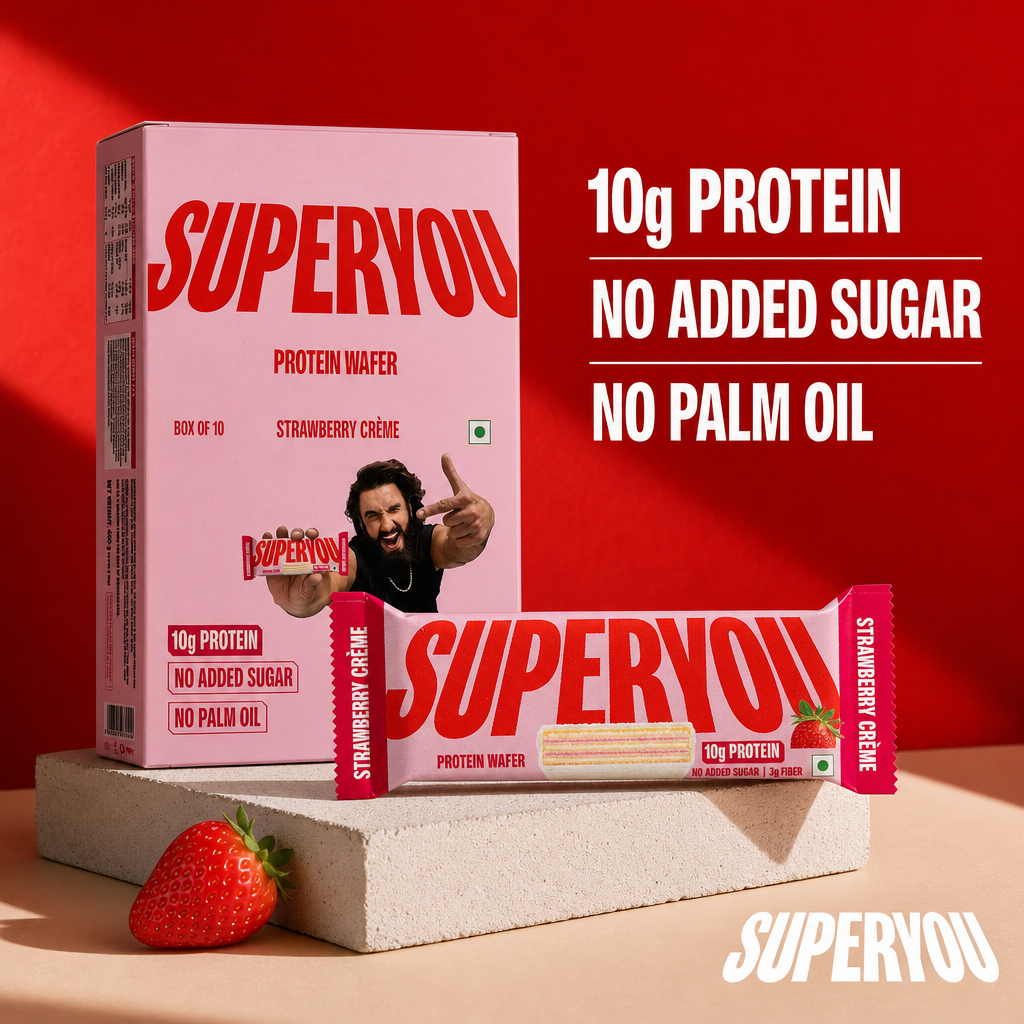
A real LocalAds output for SuperYou: the headline "10g protein, no added sugar, no palm oil" is the copy layer, but it's the product shot, the brand-red background, the spec callouts, and the layout that make it an ad you can launch. The claims are pulled from the actual product page, not invented.
That is the gap the prompts can't close on their own. One path is to keep ChatGPT for the words and hand the visual half to a designer or a template tool, wiring the two together each time. It works, and if you already have design capacity it may be all you need. The tradeoff is that you're back to managing two workflows and re-briefing the visual for every angle you generated.
The other path is to skip the re-briefing entirely. Instead of prompting for copy and then separately sourcing a visual, you can generate the whole strategy-and-creative stack from your product URL. LocalAds reads your product page (product, price, real claims, brand tone) and builds a strategy tree of audiences, angles, and hooks, then renders each one into an on-brand static creative sized for Meta, TikTok, Pinterest, and YouTube. No prompt writing, no separate design pass, and the brand voice stays consistent because it's derived from your page rather than reassembled prompt by prompt. To be clear about the range: LocalAds makes static creatives, animates any of them into video, and generates 30-second creator-led UGC video ads with AI voiceover from the same product page. If you want to see the finished-ad half done for you, you can generate ads straight from your product URL and compare the output to what a prompt-only workflow leaves you holding.
For most brands the right answer is a blend. Use these ChatGPT prompts to mine angles, sharpen hooks, and pressure-test objections, because ChatGPT for marketing is genuinely fast at that. Then let something purpose-built carry the copy into a real, on-brand creative you can launch the same day.
FAQ
Can ChatGPT write good ad copy for D2C brands? Yes, if you prompt it well. The quality depends almost entirely on the context you feed it: paste your real product facts, name the audience and angle separately, and constrain the format. Vague prompts produce generic copy; specific, structured prompts produce copy you can actually test. What ChatGPT cannot do is turn that copy into a finished, designed ad.
What is the difference between ad copy and ad creative? Copy is the language: headlines, body text, CTAs. A creative is the finished ad that runs in the feed: copy plus the visual, layout, brand styling, and correct export dimensions. Prompts get you copy. You still need design work, or a tool that renders the creative, to get an ad you can launch.
Why does my AI ad copy sound generic? Almost always because the prompt summarized your product instead of showing it. When you write "an ad for my protein bar," the model invents average benefits to fill the gap. When you paste the real product name, price, exact claims, and a few genuine review quotes, it writes from your actual offer. Generic copy is usually a context problem, not a model problem.
How do I keep AI copy on-brand across many variations? Put your brand voice rules directly in every prompt (tone, banned words, reading level, example lines you love) and expect to hand-edit outputs, because ChatGPT drifts toward its own house style at scale. If maintaining voice across dozens of creatives is the goal, a tool that derives the voice from your product page holds consistency better than repeated prompting.
Are these prompts enough to run ads, or do I need a design tool too? The prompts give you the copy layer only. To actually launch, you need to pair each piece of copy with a visual, lay it out, apply brand styling, and export at the right sizes. That's either a designer, a template tool, or a URL-to-creative tool that produces the finished static ad for you. Prompts are step one, not the whole job.
The takeaway
ChatGPT ad copy prompts are one of the highest-leverage tools a D2C marketer has, as long as you use them for what they're good at. Feed the model your real page, split audience from angle, and constrain the format, and the 20 templates above will hand you more testable hooks, body copy, angles, and CTAs than you can ship in a cycle. That is the copy layer, solved.
Just don't confuse a doc full of headlines with a folder full of ads. The visual, the layout, and the on-brand rendering are still waiting, and for most teams that's the real bottleneck. When you want the copy carried all the way into launch-ready creative, generate ads from your product URL and let the finished half get built for you while you keep the prompts for the thinking.
Related reading:
- AI Creative Variations for Paid Social Testing
- 30 ChatGPT Ad Copy Examples That Actually Convert
- Best AI Ad Creative Tool for D2C Brands
</content> </invoke>