On this page
ChatGPT will write you fifty skincare headlines before your coffee is cold. Then Meta will reject half of them, and the other half will sound like every other serum on the feed.
That is the specific problem this post solves. If you run paid social for a skincare or beauty brand, generic ad copy is only half your pain. The other half is that beauty is a regulated category, and the model has no idea. It will happily hand you "clinically proven to erase wrinkles" or a before-and-after promise that gets your account flagged. Good skincare ad copy has to clear two bars at once: it has to sell, and it has to be claim-safe. Vague prompts fail both.
This post gives you 18 copy-paste prompts written specifically for skincare and beauty, grouped into hooks, routine and ingredient angles, objection handling, and CTAs. It also does the thing most AI-ad content skips: it draws the line where prompts stop. Prompts get you words. They do not get you a compliant, on-brand, finished ad. We will cover both halves honestly, because for a beauty brand the second half is where the real risk and the real cost live.
Prompts give you copy, not a compliant creative
Be precise about what a prompt returns, because the confusion wastes time and, in beauty, money. When you prompt ChatGPT you get text: a hook, a body paragraph, an ingredient callout, a CTA. That is copy. It is not a creative, and it is not vetted.
A creative is the finished thing that runs in the feed: the on-skin visual, the product shot, your brand palette, the headline set in your typeface, and the copy locked into a frame sized for Meta or TikTok. Copy is one ingredient. A brilliant hook in a plain text box is not an ad, and a beautiful texture shot with no words is not one either.
In beauty there is a third layer the model ignores entirely: claim compliance. Meta's advertising standards, and in the US the FTC's rules on substantiating health and beauty claims, restrict what you can promise about skin. ChatGPT does not know your substantiation, your market, or which words trigger a review. So its output is not just unfinished, it is unvetted. Treat every line it gives you as a first draft that a human still has to make true and make legal.
So use these prompts for what they are: a fast way to generate the language layer. We will come back to how that language becomes a real, claim-safe ad near the end. First, the rules that make the output usable.
Three rules for prompting better skincare copy
Before the templates, internalize these three. They are the difference between rejected, generic output and copy you can actually test.
Rule 1: Feed it the page and the label, not a summary. The biggest quality jump comes from pasting your real product page and INCI list into the prompt: the exact product name, price, the hero ingredient and its percentage ("2% encapsulated retinal," "10% niacinamide"), the texture, the claim you are legally allowed to make, and three real review quotes. When you summarize your product in a sentence, ChatGPT invents average, unsubstantiated benefits. When you give it the raw material, it writes from your actual formula. Most weak beauty copy is a context problem, not a model problem.
Rule 2: Name the skin concern and the angle, separately. "Write an ad for my serum" gives the model no strategy, so it defaults to the blandest pitch. Instead, specify the audience by concern ("acne-prone skin in their late 20s") and the angle ("the un-sticky sunscreen you'll actually reapply") as two distinct inputs. One product serves many concern-and-angle pairs, and each deserves its own run. It also makes your testing legible: when you know which angle a losing ad was on, you learn something. For where angles come from, see how to find your best ad angles.
Rule 3: Constrain the format and ban the risky words. ChatGPT writes long, hedged, adjective-heavy prose, and it reaches for medical language beauty ads can't use. Put hard limits in every prompt: character counts, number of variations, reading level, tone, and a banned-words list that covers both cliché ("unlock," "elevate," "game-changer") and compliance traps ("cure," "treat," "clinically proven," "eliminates," "permanent"). A constrained prompt returns copy you can paste. An unconstrained one returns a draft you have to rebuild.
With those loaded, here are the templates. Fill the bracketed slots, and keep your product facts, ingredient list, and approved claims handy to paste in.
Hooks (templates 1 to 5)
The hook is the first line that stops the scroll. These generate a spread to pick from, not a single guess.
Template 1: The concern-first hook spread.
You are a senior beauty direct-response copywriter. Product facts:
[paste product name, price, hero ingredient + %, texture, approved claim].
Audience: [skin concern + age range]. Angle: [angle].
Write 10 scroll-stopping first lines under 8 words each.
Vary the type: question, bold-but-legal claim, number,
contradiction, callout to the reader. No emojis, no exclamation marks.
Do not use the words: cure, treat, clinically proven, eliminates.
Template 2: The problem-agitate hook.
Audience: [concern, e.g. "reactive skin that stings with most actives"].
Write 8 opening lines that name the frustration precisely before
mentioning the product. Ground each in a real daily moment
(the 3pm oil slick, the winter tightness, the post-shave burn).
Under 12 words each. Empathetic, not clinical.
Template 3: The myth-buster hook.
Hero ingredient: [ingredient]. Common misconception: [myth, e.g.
"oils break you out" or "SPF makes you greasy"].
Write 6 hooks that flip the misconception in the first 6 words,
then tease the reason. Keep claims to what this label supports:
[paste approved claim].
Template 4: The "for people who" callout.
Write 8 hooks in the format "For [specific person] who [specific
struggle]." Audience: [concern]. Make the person unmistakably
specific (retinol beginners scared of peeling, gym users whose
sunscreen runs into their eyes). Under 12 words. No hype adjectives.
Template 5: The sensory hook.
Texture and experience: [describe: gel-cream, fast-absorbing,
weightless, cushiony]. Write 6 hooks that lead with how the product
FEELS on skin, not what it claims to do. Concrete sensory verbs only.
Under 9 words each.
Routine and ingredient angles (templates 6 to 11)
Skincare sells on where a product fits in a routine and what is actually in it. These prompts build the middle of the ad.
Template 6: The routine-step primary text.
Write 3 primary-text variations (under 125 words each) that position
[product] as one clear step in a routine: when to use it, before/after
what, and the single result the label supports. Audience: [concern].
Angle: [angle]. End each with one line of what NOT to expect,
so it reads honest. Ban: cure, treat, clinically proven.
Template 7: The ingredient-explainer.
Hero ingredient: [ingredient + %]. In plain language a non-scientist
gets, write 3 short body-copy blocks explaining what it does and why
the concentration matters, WITHOUT making a medical claim. Cite only
this approved claim: [paste]. 60-90 words each. No jargon walls.
Template 8: The "swap this for that" angle.
Write 5 ad angles framed as replacing something the buyer already
does or owns (a heavier cream, three separate products, a salon
treatment). Audience: [concern]. For each, one hook + one supporting
line. Keep every promise inside: [approved claim].
Template 9: The routine-simplification angle.
Product: [product]. Write 4 variations selling the idea of a shorter,
simpler routine (fewer steps, fewer products, less decision fatigue).
Audience: [busy persona]. Tone: calm, not shouty. Under 100 words each.
Template 10: The seasonal angle.
Season/condition: [e.g. monsoon humidity, dry winter, high UV summer].
Write 6 hooks and 2 primary-text blocks tying [product] to the skin
problem that season creates. Specific to the climate of: [market].
Approved claim only: [paste].
Template 11: The sensitive-skin reassurance angle.
Audience: reactive or sensitive skin. Write 4 primary-text variations
that lead with what the formula LEAVES OUT (fragrance, essential oils,
alcohol, whatever applies: [list]) and the patch-test-friendly framing.
Reassuring, specific, under 100 words. No "gentle enough for everyone"
blanket claims.
Objections and CTAs (templates 12 to 18)
The last job is closing: handling the "will this work for me" doubt and giving a clean next step.
Template 12: The objection-handler.
Top 3 objections for [product]: [list, e.g. "too expensive," "won't
work on my skin type," "actives scare me"]. Write one primary-text
block per objection that names it and answers it with a real fact from:
[reviews, guarantee, ingredient list]. 70-90 words each. No dismissiveness.
Template 13: The review-led social proof.
Paste 5 real review quotes: [paste]. Turn them into 4 ad copy blocks
that lead with a customer's words, then add one line of context.
Keep the customer's voice, do not upgrade their claim into a medical one.
Template 14: The beginner-safe CTA set.
Audience: [ingredient] beginners who are nervous. Write 8 CTAs that
lower the risk of the first purchase: reference [return policy,
sample size, patch-test guidance, guarantee]. Format: [action] +
[reason it's safe]. Under 12 words each.
Template 15: The urgency-without-hype CTA.
Write 6 CTAs that create a reason to act now WITHOUT fake scarcity or
countdown pressure: restock, seasonal relevance, routine timing.
Under 10 words. No "hurry," no "last chance," no invented deadlines.
Template 16: The comparison-frame primary text.
Write 3 primary-text blocks that contrast [product] with the generic
alternative the buyer defaults to (a drugstore version, a heavier
formula, doing nothing). Fair, not disparaging. Anchor every claim to:
[approved claim]. Under 110 words.
Template 17: The FAQ-to-ad angle.
Paste your product-page FAQ: [paste]. Convert the 5 most common
questions into 5 short ad angles, each answering the question in the
hook. Great for retargeting warm traffic. Under 90 words each.
Template 18: The bundle/routine-kit angle.
Products in the set: [list]. Write 4 copy blocks selling the set as a
complete routine, not a discount pile: what each step does, the result
the labels support, who it's for. Under 120 words. Ban: cure, treat.
Run those 18 and you will have more usable skincare ad language than you can test in a month. That is real value. But the moment you try to turn that language into ads you can launch, two walls appear, and one of them is unique to beauty.
Wall one: the compliance wall
This is the wall that catches skincare brands specifically, and ChatGPT will walk you straight into it.
The model does not know your market's advertising rules, your substantiation file, or which phrases trigger a Meta review. Left alone, it produces confident claims like "clinically proven to reverse aging," "cures acne," "eliminates dark spots permanently," or before-and-after promises. Those are the exact constructions that get beauty ads rejected or accounts restricted. The words that make copy feel powerful are often the words you are not allowed to use.
So every line the model gives you needs a compliance pass a human owns:
- Swap outcome guarantees for supported claims. "Erases wrinkles" becomes "visibly smooths the look of fine lines," if that is what your evidence supports. Cosmetic claims describe appearance, not physiology.
- Kill unsubstantiated proof language. "Clinically proven," "dermatologist proven," and specific percentages ("94% saw results") require a study on file. If you do not have it, cut it.
- Handle before-and-afters carefully. Many platforms restrict or scrutinize before-and-after imagery and "personal attributes" targeting for skin. Copy that leans on a transformation promise inherits that scrutiny.
- Avoid drug-claim verbs. "Treat," "cure," "heal," "prevent" push a cosmetic into drug territory in most regulatory frameworks, a line the FDA spells out explicitly. Keep to cosmetic, appearance-based language.
None of this means the prompts are useless. It means the prompt output is a draft, and the compliance edit is not optional. That edit is real work, and it is the work the model cannot do for you.
Wall two: there is still no creative
The second wall is the one every category hits. ChatGPT hands you text. It cannot photograph your product, shoot the on-skin swatch, lay out the frame, apply your brand palette and fonts, place the headline where it belongs, and export at 1080x1080 and 1080x1920.
For a skincare brand this is a heavy lift, because beauty lives and dies on the visual: texture, skin, light, packaging. Every claim-safe hook you generated still has to be married to a real on-skin visual and a layout, and that is a design and photography job. The words were never the four-day bottleneck. The finished, on-brand creative was. A folder of headlines does not move your CPMs.
Here is what "claim-safe copy plus a real visual equals a launchable ad" actually looks like:
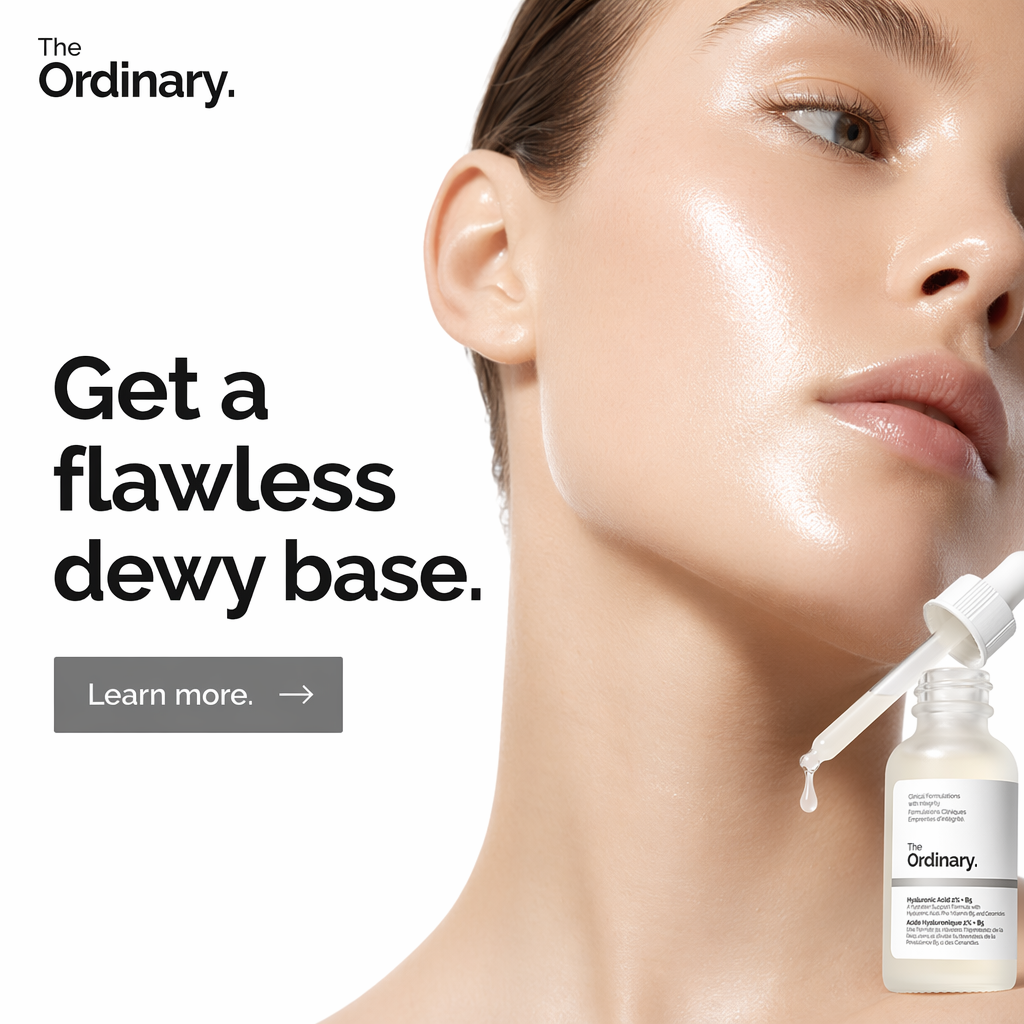
A real LocalAds output for The Ordinary. The hook "Get a flawless dewy base" is the copy layer, but it is the glowing on-skin shot, the serum-and-dropper product callout, the clean type, and the layout that make it an ad you can launch. The claim stays cosmetic and appearance-based, which is exactly the compliance line prompts miss on their own.
That is the gap prompts cannot close. One path is to keep ChatGPT for the words, run your own compliance edit, and hand the visual to a designer or template tool, wiring the three together for every angle. It works if you already have that capacity. The tradeoff is three workflows per creative.
From copy to a finished, on-brand ad
The honest move is to stop treating "copy" and "creative" as the same task. Copy is language. A creative is claim-safe copy plus a real visual plus layout plus brand styling, exported at the right size. You need all of it, and prompts give you one piece.
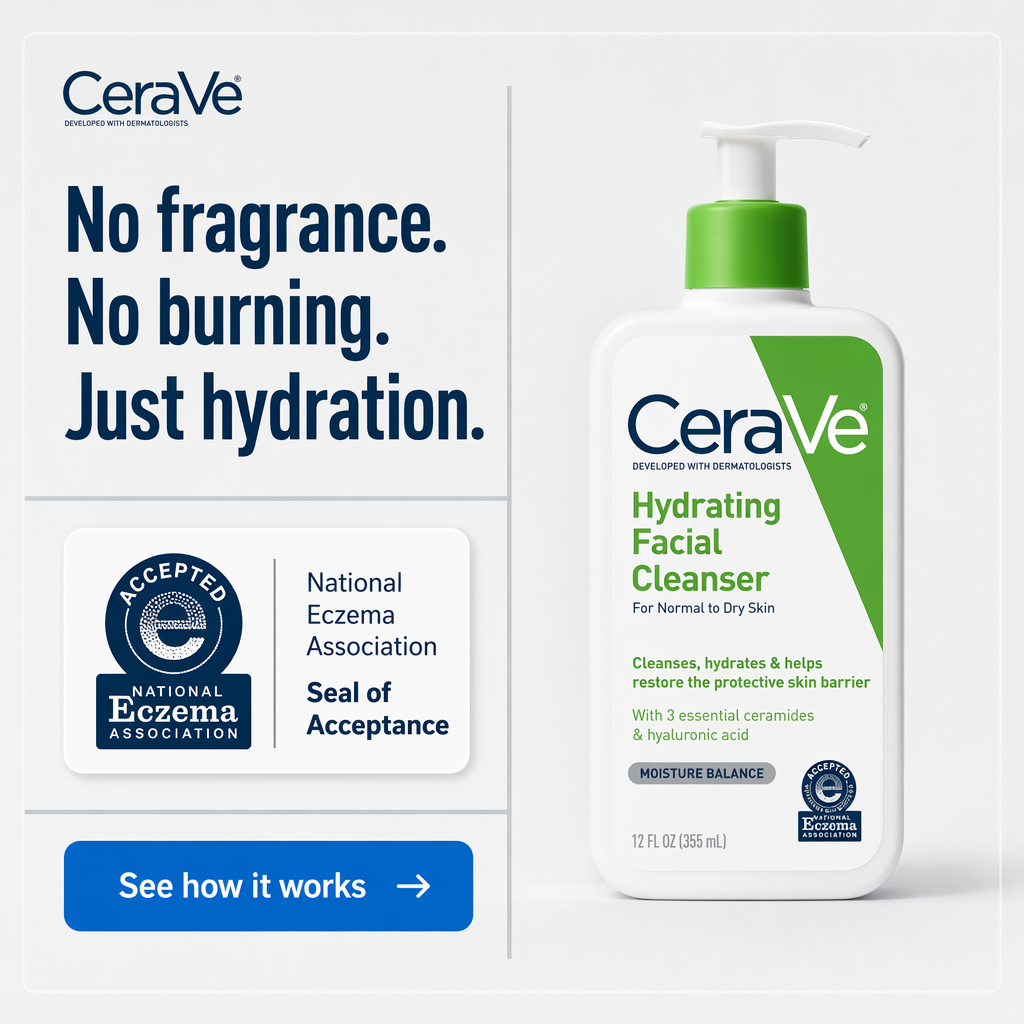
A real LocalAds output for CeraVe. Notice the copy is doing the selling with claim-safe language ("No fragrance. No burning. Just hydration."), the trust marker is a real seal rather than an invented statistic, and the benefit is specific and appearance-based rather than a medical promise. That is the whole ad, not just the words, and it clears the compliance bar by construction.
The other path is to skip the re-briefing entirely. Instead of prompting for copy, editing it for compliance, and separately sourcing a visual, you can generate the whole strategy-and-creative stack from your product URL. LocalAds reads your product page (product, price, real ingredients and claims, brand tone) and builds a strategy tree of skin concerns, angles, and hooks, then renders each into an on-brand static creative sized for Meta, TikTok, Pinterest, and YouTube. Because the copy is derived from your actual page and label rather than reassembled prompt by prompt, it stays closer to what you can legally say, and the brand voice holds across variations. And when you want motion, you can animate those creatives into video from the same workspace, so a still hero can become a scroll-stopping video ad without a separate shoot.
For a deeper look at how this plays out across a full beauty catalog, see AI ad creatives for skincare and beauty brands, and to see the whole flow from a link, generate ads straight from your product URL. The same URL also produces product photography like texture shots and on-skin swatches for the rest of your funnel.
For most brands the right answer is a blend. Use these ChatGPT prompts to mine angles, sharpen hooks, and pressure-test objections, then run a compliance pass, then let something purpose-built carry the copy into a real, claim-safe creative you can launch the same day.
FAQ
Can ChatGPT write good ad copy for skincare brands? Yes, if you prompt it well and edit it after. Quality depends on the context you feed it: paste your real product facts, hero ingredient and percentage, approved claims, and a few genuine reviews, and name the skin concern and angle separately. What ChatGPT cannot do is know your compliance rules or turn the copy into a finished, designed ad. Treat its output as an unvetted first draft.
Why does Meta keep rejecting my AI-written beauty ads? Almost always because the copy makes a claim the platform restricts: medical verbs (cure, treat, heal), unsubstantiated proof (clinically proven, specific result percentages), or transformation promises tied to before-and-after framing. ChatGPT does not know these rules, so it writes them freely. Add a banned-words list to every prompt and run a human compliance pass before anything goes live.
How do I keep AI skincare copy claim-safe? Put the constraint in the prompt (ban cure, treat, clinically proven, eliminates, permanent) and still review every line against your substantiation. Swap physiological promises for appearance-based cosmetic claims ("visibly smooths the look of"). If you cannot prove a percentage or a "proven" claim, cut it. The prompt reduces the cleanup; it does not remove your responsibility for it.
What is the difference between ad copy and ad creative in beauty? Copy is the language: hooks, primary text, CTAs. A creative is the finished ad in the feed: claim-safe copy plus the on-skin visual, product shot, layout, brand styling, and correct export sizes. Beauty is especially visual, so the creative half is usually the real bottleneck. Prompts get you copy; you still need design and a compliance check to get a launchable ad.
Do I need a design tool too, or are these prompts enough? The prompts give you the copy layer only. To launch, you pair each claim-safe line with a real on-skin visual, lay it out, apply brand styling, and export at the right sizes. That is a designer, a template tool, or a URL-to-creative tool that renders the finished static ad for you. Prompts are step one of a longer job, not the whole job.
The takeaway
ChatGPT ad copy prompts are one of the highest-leverage tools a skincare marketer has, as long as you use them for what they are good at. Feed the model your real page and label, split concern from angle, constrain the format, and ban the risky words, and the 18 templates above will hand you more testable hooks, routine angles, and CTAs than you can ship in a cycle.
Just do not confuse a doc full of headlines with a folder of launchable ads. In beauty there are two walls the words cannot clear on their own: the compliance edit that keeps you out of trouble, and the on-brand visual that actually sells skin. For most teams those are the real bottlenecks. When you want the copy carried all the way into a claim-safe, launch-ready creative, generate ads from your product URL and let the finished half get built for you while you keep the prompts for the thinking.
Related reading:
- AI Ad Creatives for Skincare & Beauty Brands: Real Examples
- ChatGPT Ad Copy Prompts: 20 Templates for D2C Marketers
- AI Product Photography From a URL, No Prompting
- Best AI Ad Creative Tool for D2C Brands
- ChatGPT Ads Specs 2026: Every Character Limit, Reconciled
- ChatGPT ads creative from your product URL
- The ChatGPT Ads guide: markets, formats and specs